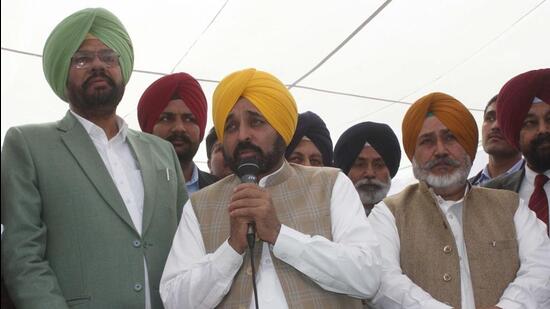
An 11-member committee of experts, who are entrusted with the responsibility of formulating farmer policy, were also in attendance at the mega event.
Speaking on the occasion, PAU vice-chancellor Satbir Singh Gosal said the Sarkar Kisan Milni is a brainchild of the CM, adding, “During a recently meeting, the CM said till the time experts, government officials and farmers don’t sit at one platform the issues related to farming will not be resolved. The ‘milni’ is aimed at establishing better coordination between experts, government departments and farmers.”
Notably, he event was organised in the backdrop of farmers organisations having put the Aam Aadmi Party-led state government on the mat over issues including guaranteed minimum support price(MSP), lifting of crops to encourage diversification, dispute over the farmer suicide compensation, jobs to the kin of the farmers who died during the farmers’ agitation in 2020-2021, timely power and fertilizer supply and expensive machinery for stubble management among other.
Agriculture department officials maintained that the meeting would play an important role in preparing a roadmap for the formulation of an agricultural policy set to be prepared by March 31.
{{/usCountry}}Agriculture department officials maintained that the meeting would play an important role in preparing a roadmap for the formulation of an agricultural policy set to be prepared by March 31.
{{/usCountry}}As many as 14 government departments also participate in the event being held at the PAU campus.
A total of 18 separate enclosures, where the farmers involved with varied crops, could discuss their issues and share feedback with the experts and officials concerned had been set up.
Special emphasis was laid on addressing issues being faced by cotton farmers at the enclosure number five, while problems being faced by those in the Kandi area, agriculture machinery, food processing and start-ups’ and sugarcane crop will also be discussed.
Responding positively to the event, Gurpreet Singh, a farmer from Amritsar, said it marked the first time that the government officials, PAU experts and farmers have sat on the same panel and discussed difficulties faced by the farmers, adding, “I hope similar events are conducted at other locations as well.”
Harminder Singh Sidhu, a progressive farmer, echoed the sentiment, saying “Timely power and fertiliser supply, lifting issues can only be resolved only through dialogue.” Fellow progressive farmer Davinder Mushkabad from Machhiwara, meanwhile, said there was a need to push for the waiver of 18% GST on setting up of polyhouse.
Experts and officials also held meetings with farmers associated with floriculture, vegetable crop, fruits andagroforestry among other fields.
Over 10,000 progressive farmers associated with PAU Kisan Clubs, Krishi Vigyan Kendra (KVK)s and the agricultural department had earlier paved the way for the Kisan Milni.
Notably, PAU Teachers Association (PAUTA) and Guru Angad Dev Veterinary And Animal Sciences University Teachers Association had also recently held a protest against the undue delay in adoption of revised pay scales and revision of pensions by the state.
The two teachers’ bodies had also announced a boycott of the event and threatened a protest on the day if their demands were not heard.
Poultry farmers also shared their concerns of the ever-increasing privatisation’s impact on the small-scale poultry sector with the CM during the meeting.
Highlighting the rising cost of inputs in broiler farming, Poultry farmer Sanjay Sharma said corporate companies were exploiting farmers through contract farming practices and throwing small players out of the business.
“These corporates have deep pockets and by offering poultry items at cheaper rates, they throw rivals out of the business and after establishing a monopoly, these corporates jack up the prices,” he said, demanding government intervention and regulation of the industry.
Notably, under contract farming, poultry farmers, who once owned units, work as employees for bigger companies. The maintenance cost for raising each bird is ₹12-13, but the farmers receive a meagre ₹5 for the same.