
 E-Paper



Admission denial under EWS category violates fundamental rights: Delhi HC
The observation came as the court allowed a plea seeking directions for admission of a child to Indraprastha World School under the category


Denial of admission to a school under the Economically Weaker Section (EWS)/Disadvantaged Group category despite seat allotment frustrates the noble objective of the Right to Education Act and violates fundamental rights, the Delhi high court has said.

The observation came as the court allowed a plea seeking directions for admission of a child to Indraprastha World School under the category. The school denied the admission, claiming the student’s residence was not within one kilometre radius of the institute. The court earlier issued an order for interim admission while directing an inquiry into the denial.
ALSO READ: Give free books, not money, to EWS students: HC to Delhi govt
Under the Right to Education (RTE) Act, 2009, 25% of seats in entry-level classes — nursery, Kindergarten (KG) and I — in all private schools are to be reserved for the EWS category. One of the caveats is that the student must reside within a 1km radius of the school.
In its latest order dated February 28, justice Mini Pushkarna said the child will continue to study under the category in the school, citing the Directorate of Education (DoE)’s inquiry report confirming the child stayed within one kilometre of the school.
“This court would rely upon the report as submitted by the DoE which has been submitted on the basis of an enquiry conducted by the Vice Principal of the local Government School,” the court said. It added it would not go into fact-finding to probe the school’s objection.
ALSO READ: Decoding EWS quota and its implications
The court said it cannot lose sight of the noble objective of providing good education to the economically downtrodden strata of society and bringing them into the mainstream.
To be sure, the Delhi government as well as courts have time and again pulled up private schools and issued notices to them for violating RTE Act. Schools, however, cite various reasons, including the delay in filing of general seats (as they admit one EWS student for every three general quota students), for not admitting such students.
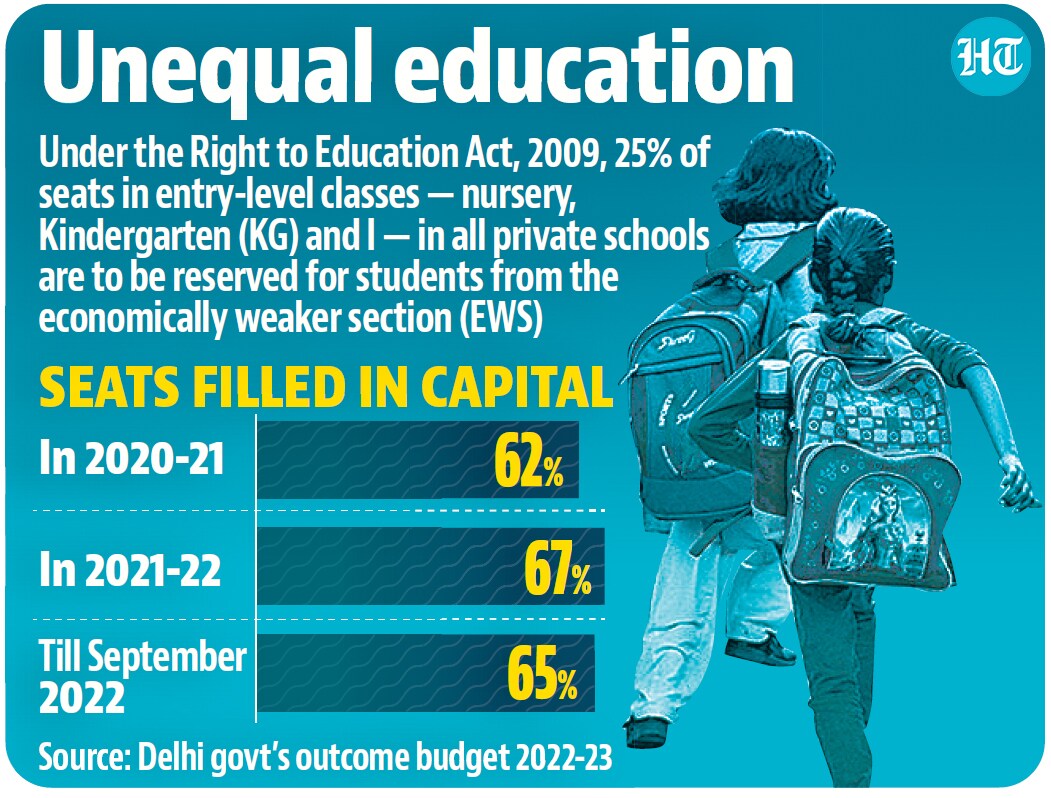
According to Delhi government’s outcome budget 2022-23, 35% of around 40,000 EWS seats reserved under RTE act across private schools in Delhi remained vacant till September 2022. The situation was just as dismal in the previous years, with only 67% seats being filled in the academic year 2021-22 and 62% in 2020-21, government data shows.
Most schools, however, agree that no student should be denied admission on flimsy grounds.
Sudha Acharya, chairperson, National progressive school conference (NPSC) also said no such cases have been reported ahead of this year’s admissions. “In a rare case if the student lives really far away, then we inform the Directorate of Education (DoE), but even then, the power to deny admission does not lie with the school and should not be done,” she said.


