
 E-Paper



Day 2 of anti-encroachment drive at Tughlaqabad, residents in lurch
Delhi urban development minister Saurabh Bhardwaj raised concerns over the displacement of people, and sought their rehabilitation.

 Prefer HTon Google


Shameem Akhtar, from Uttar Pradesh’s Varanasi, moved to Delhi more than two decades ago in search of work. The 65-year-old went from odd jobs in the first few years to selling fruits and vegetables in Tughlaqabad’s Chhuriya Mohalla where he lived on rent for years. Around three years ago, Akhtar purchased land in the same colony and constructed a two-room house where he lived with family. On Monday, his house was razed as the Archaeological Survey of India (ASI) continued its demolition drive in the Bengali colony area in Tughlaqabad village for the second consecutive day.
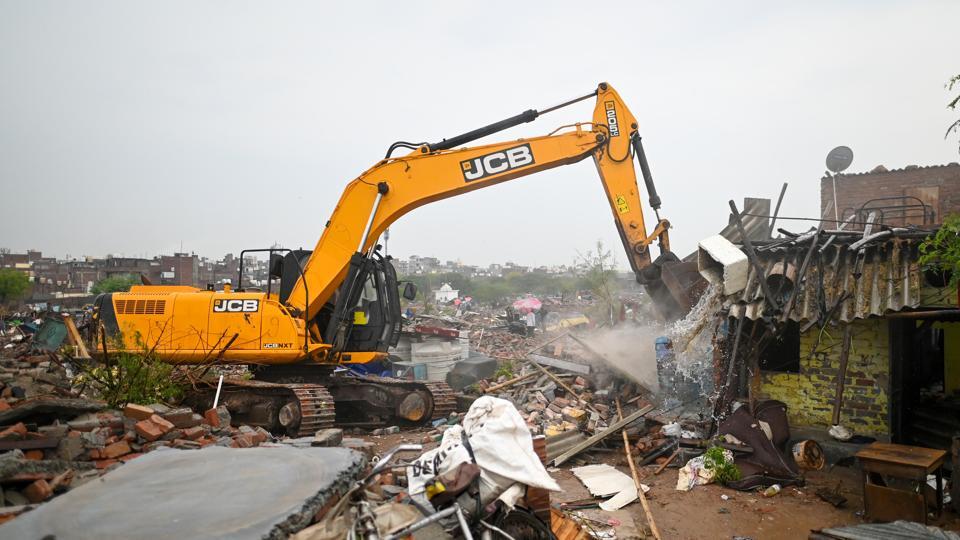
Hundred of houses were demolished by Monday evening although ASI and the district administration did not share details about the number of houses that had been razed. Akhtar is among the hundreds in the area that have been rendered without a roof over their heads. “For years, we lived on rent here. I saw the number of houses multiply but no one intervened to stop the sale of land. We were given a power of attorney and made to believe that nothing would happen to our houses. But suddenly, without any advance notice, agencies brought down my house. They did not even give me sufficient time to collect my belongings,” alleged Akhtar.
Also Read: Notice to ex-Delhi Jal Board CEO for wrecking 15th-century monument to build bungalow
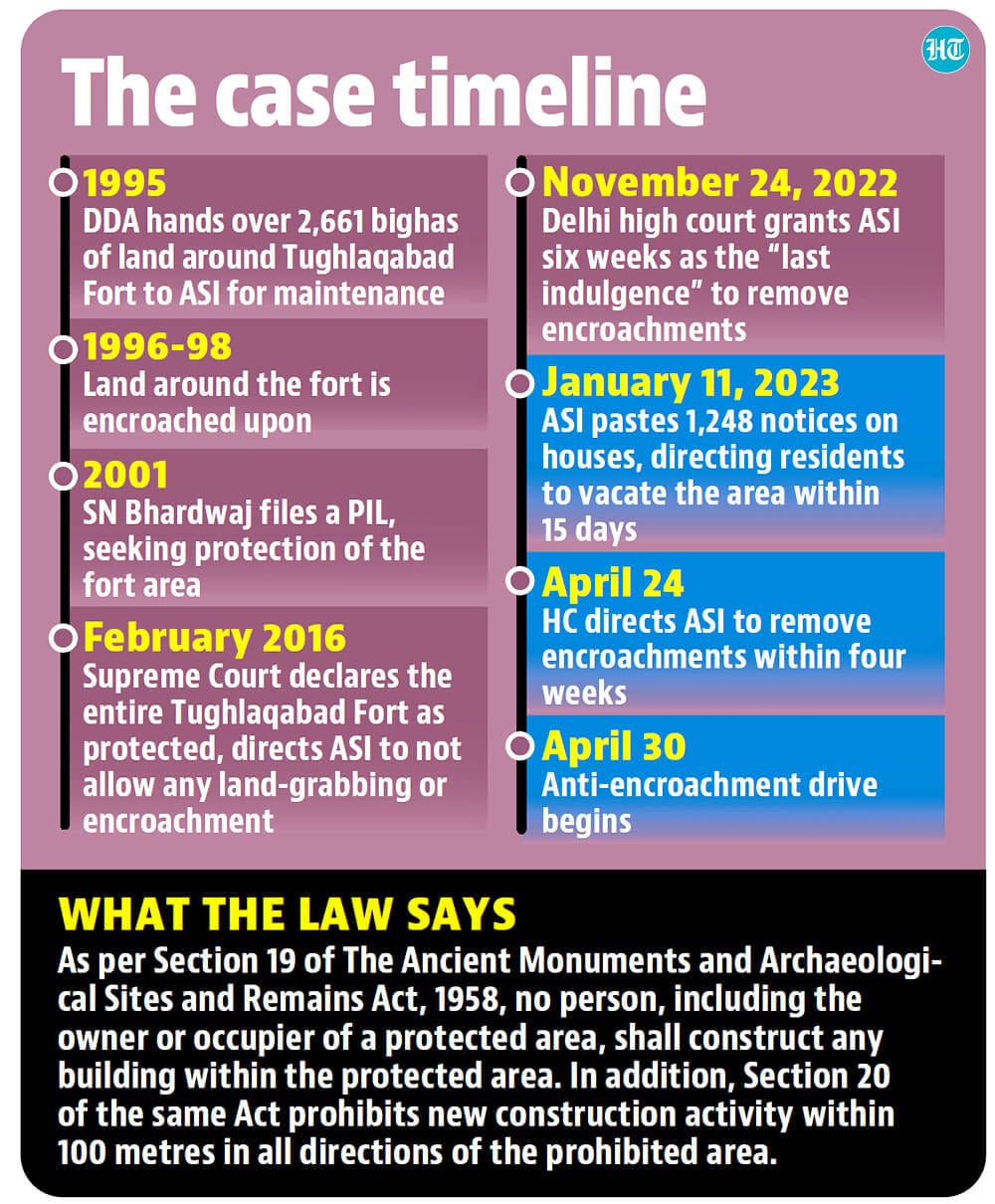
ASI officials had earlier told HT that the Delhi Development Authority (DDA) handed it over an area of 2,661 bighas around the Tughlaqabad Fort for maintenance in 1995. According to Section 19 of The Ancient Monuments and Archaeological Sites and Remains Act, 1958, no person, including the owner or occupier of a protected area, shall construct any building within the protected area. In addition, Section 20 of the same Act prohibits new construction activity within 100 metres in all directions of the prohibited area.
Over the years, the land around the fort was encroached upon, and a legal battle ensued after a public interest litigation (PIL) was lodged by SN Bhardwaj in 2001, seeking protection of the fort premises. Subsequently, the Delhi high court ordered removal of encroachments. In February 2016, the Supreme Court declared the entire Tughlaqabad Fort as protected, and directed ASI to stop land grabbing and encroachment there.
On November 24 last year, the high court granted six weeks as the “last indulgence” to ASI to remove encroachments in and around the Tughlaqabad Fort. On January 11 this year, ASI pasted 1,248 notices on houses in Churriya Mohalla, directing residents to vacate the area within 15 days failing which their houses would be demolished. Last Monday, the high court directed ASI to remove encroachments within four weeks. The court also asked the area sub-divisional magistrate (SDM) and the Municipal Corporation of Delhi to provide logistical support for removal of encroachments.
Following two consecutive days of demolition, police officials on Monday said that no drive was scheduled for Tuesday. “Over 100 bighas of land was cleared over the past two days. More than 1500 permanent and semi-permanent structures were demolished. To maintain law and order, 40 police companies each were deployed on both days,” said special commissioner of police (law and order) Sagar Preet Hooda.
ASI officials did not respond to HT’s queries about the operation.
Isha Khosla, district magistrate (south-east) did not respond to queries seeking comment.
On Monday, when HT visited the neighbourhood, residents were seen fervently digging through the debris as they attempted to salvage whatever little remained of their belongings. Many simply sat over the remains of their demolished houses while others took shelter on the main road.
Parul, 40, has been living in the area for the past 25 years. She said that the demolition had taken everyone by surprise since no fresh notice was served after January. “We were under the impression that the court has given relief for four weeks. However, the bulldozers arrived suddenly and started demolishing our houses,” said Parul, who goes by her first name.
A native of Kolkata, Parul works as a domestic help in CR Park area, and has six family members including four children. With no roof over their heads, the family is scrambling to find a place to rent. “With four small children, I don’t know for how long can we survive in the open on an empty stomach. We tried looking for places on rent but everywhere landlords have increased the rent. They are asking 10,000-12000 a month. This is way beyond our earnings,” said Parul.
Parul’s daughter studies in Class 8 and was driven by circumstances to give school a miss on Monday. “I don’t know if and when I’ll be able to go to school now. I managed to save my books before the demolition but since nothing else is in place, going to school looks difficult,” said Suhana, Parul’s daughter.
Ishrat Khatoon, from Patna in Bihar, has been living in the area for the past 10 years. Khatoon, 50, said that the demolition took everyone by surprise, and alleged that it was initiated without any prior intimation. “A notice was given in January but no drive was undertaken. Dealers who sold us the land said that our houses were safe and nothing would happen. More than three months had lapsed since the last notice which gave us an impression that out houses are safe. However, without sending a fresh notice and giving us sufficient time to vacate, bulldozers started razing down our house,” alleged Khatoon.
She alleged that people were tricked into buying land by local politicians and government officials from different agencies. “We were never told that the land was government property. Why would anyone allow their hard-earned money go waste? A colony cannot come up without the complicity of officials,” said Khatoon.
Delhi urban development minister Saurabh Bhardwaj raised concerns over the displacement of people, and sought their rehabilitation. Bhardwaj said that the “central government’s ASI” had destroyed the houses of innocent people. He also sought land from the Centre for rehabilitating the displaced people.
“... the court should pay attention to the fact that the central government’s ASI or DDA should provide the land to the Delhi government so that the state government can come up with a rehabilitation plan on that land and make an alternative arrangement for these people to live,” said Bhardwaj.


