
 E-Paper



At Urban Adda, experts push vision for human-centric cities
Urban Adda was organised by the Raahgiri Foundation in collaboration with the International Council on Clean Transportation and GuruJal

 Prefer HTon Google


As India’s cities grow denser and more chaotic, a fundamental question is taking centre stage: What would cities look like if they were designed for people instead of cars?
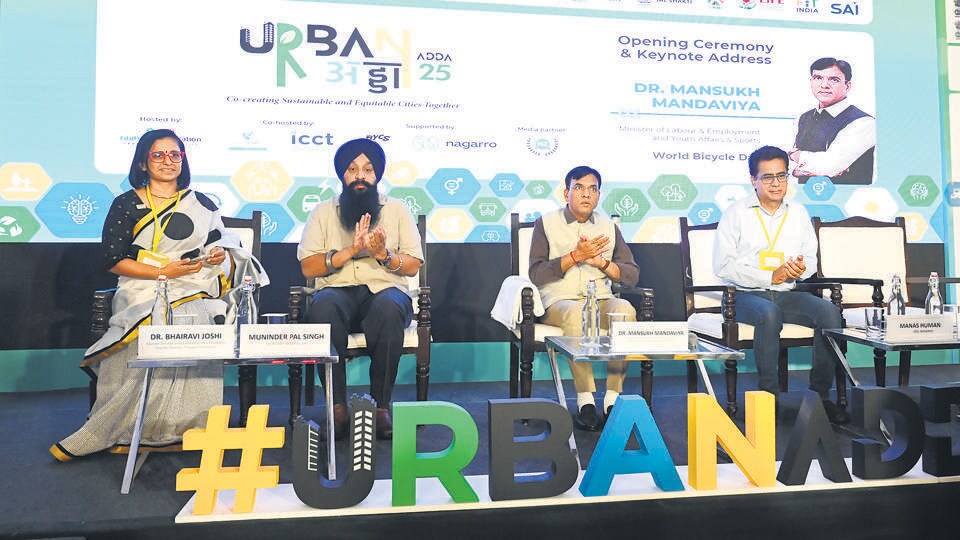
That idea drove the conversations at Urban Adda 2025 — a three-day national dialogue on urban futures that kicked off on World Bicycle Day at India Habitat Centre. Organised by the Raahgiri Foundation in collaboration with the International Council on Clean Transportation (ICCT) and GuruJal, the event was inaugurated by Union minister Mansukh Mandaviya, who urged citizens to embrace cycling as a sustainable and healthy habit. Hindustan Times is the media partner for the event.
“Cycling is the best form of exercise and a solution to pollution,” said Mandaviya, who holds the labour & employment and youth affairs & sports portfolios. Recalling his early days as a member of Parliament, he said, “I cycled to Parliament daily and was known as the ‘cycle-wala MP’. We must shed the notion that cycling is only for a certain segment and turn it into a movement for all.”
The minister also launched two books authored by Dr Bhairavi Joshi — Cycling, Children & Cities, and Road to Cycle2School — advocating safe, active mobility for children and youth.
The event’s inaugural theme, “Gati & Grace – Mobility, Art & Access for All”, focused on building more inclusive, accessible and people-friendly cities. It featured sessions on improving roads, public spaces and transport infrastructure with inputs from policymakers, artists, activists and urban designers.
The opening session titled “The Human Centred Cities: Designing for Well-being, Connection and Sustainable Futures” called for cities to be designed not just efficiently, but equitably.
“A change in mindset is something we are all working towards, but statutory guidelines are extremely important,” said Ranjit Gadgil, programme director at Pune-based NGO Parisar. “Mandates are needed so that standard urban designing can be done. Then, experts can be brought in to implement these designs.” The session was moderated by Sarika Panda Bhatt of the Raahgiri Foundation.
In the second session, experts discussed adopting a “Vision Zero” approach — aiming for zero road deaths or serious injuries, which can only be possible through proper planning and implementation of rules.
Professor Geetam Tiwari of IIT Delhi, in her keynote address, argued that effective enforcement alone would not suffice — roads must be designed to forgive mistakes. “We cannot rely on individuals to always make the right decision — our roads must be designed to forgive human error,” she said. “Even if an individual jumps a red light, for instance, an uneven road surface could automatically reduce their speed and lower the risk of a fatal crash. It does not mean we should encourage not following traffic rules, but the infrastructure should be designed in such a way that even if there are people who do not follow rules, lives are not lost.”
A subsequent session, ‘User Experience, Accessibility and Inclusion by Design’, focused on making public infrastructure inclusive for persons with disabilities (PWDs). Four volunteers participated in a short exercise simulating PWD experiences — two used wheelchairs, one was blindfolded, and one used crutches to navigate around the room.
Stuti Kacker, former secretary, ministry of social justice and empowerment, said, “In the early days of the Accessible India campaign, people would ask — where are the PWDs? We realised they’re often isolated and reluctant to come out. After 10 years, there’s more awareness, but the system is still not seamless and we need to work on that.”
Among the panellists was Anuj Dayal, principal executive director, corporate communications, at Delhi Metro Rail Corporation (DMRC). Delhi Metro was among the first public transport systems in the country to incorporate accessibility features such as tactile strips, audio announcements and ramps for elevators.
“The national building code and the CPWD helped us incorporate these additions, but we also consulted activists like Anjlee Agarwal and Javed Abidi,” said Dayal, stating users can call the station master at any Metro station to ask for crutches or wheelchairs. “In that case, the metro staff guides them to the platform,” he said. He noted that in lifts, buttons are placed at a low height, but acknowledged past complaints that not all lifts had ramps. “We have tried to take feedback and incorporate changes wherever possible,” he said.

Stay updated with all top Cities including, Bengaluru, Delhi, Mumbai and more across India. Stay informed on the latest happenings in World News along with Delhi Election 2025 and Delhi Election Result 2025 Live, New Delhi Election Result Live, Kalkaji Election Result Live at Hindustan Times.


