
 E-Paper



Delhi logs coldest November in five years
According to the monthly data, the last time Delhi logged a cooler November was in 2020, when the average minimum was 10.3°C.

 Prefer HTon Google


New Delhi: Delhi logged its coldest November in five years, aided by below-normal minimum temperatures, clocking an average minimum of 11.5 degrees Celsius (°C) up to November 29, according to data from the India Meteorological Department (IMD).
Meanwhile, on Saturday, Delhi logged a minimum temperature of 10.4°C, providing some respite from the cold, given that it was 0.1°C higher than normal and 2.3°C higher than the minimum recorded a day ago. The air quality, however, remained hazardous, in the lower-end of the “very poor” category.
Delhi recorded its lowest temperature in three years on Wednesday, with the minimum plunging to 8°C, three degrees below normal and the lowest reading in November since 2022. The Capital logged a minimum of 7.3°C on November 29, 2022. However, this year, the temperature is yet to fall below the 8°C threshold.
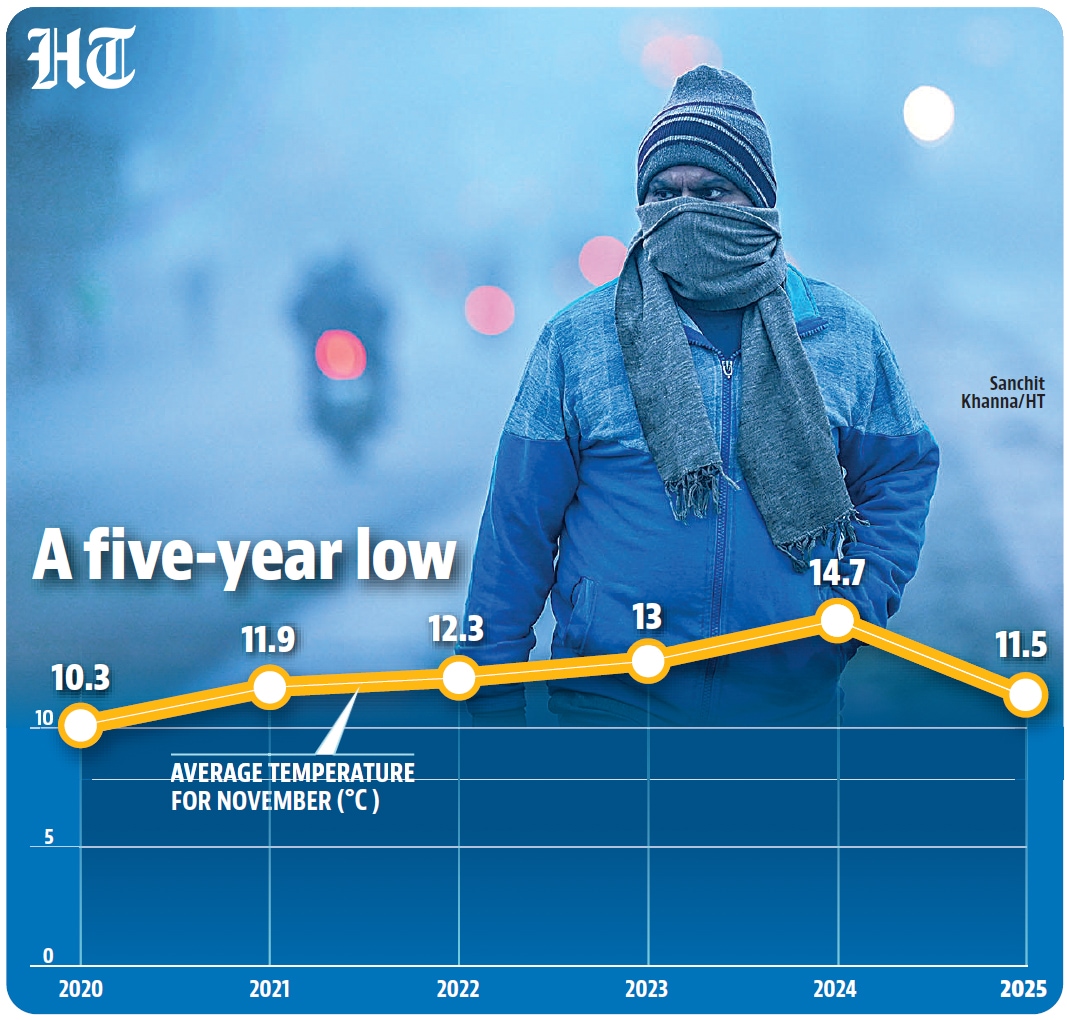
According to the monthly data, the last time Delhi logged a cooler November was in 2020, when the average minimum was 10.3°C. Then, Delhi clocked seven days with temperatures lower than 8°C. The minimum fell to 7.5°C as early as November 15 and the lowest minimum was recorded at 6.3°C, on November 23, 2020.
The average minimum November temperatures from 2021 to 2024 were 11.9°C, 12.3°C, 13°C and 14.7°C, respectively.
On Saturday, Delhi recorded a sunny morning with largely clear conditions, clocking a maximum temperature of 26.5°C, close to the normal. The average maximum temperature for the month was 27.6°C, which is the same as in 2023 and 2020. It was relatively higher last year, at 29.4°C.
The meteorology
Higher nighttime humidity and falling temperatures have been aiding the formation of secondary pollutants that has kept the air quality from improving further despite clearer skies, officials said. While overall conditions in Delhi remain largely stable, western disturbances earlier in the month helped nudge temperatures downward.
IMD’s forecast indicates no major western disturbance approaching in the next few days, which should keep surface winds light. Despite a slightly warmer Saturday, minimum temperatures are expected to fall gradually again in the coming days.
“Minimum temperature is likely to be around 9-10°C over the next couple of days while shallow fog may also be seen during the morning hours over the next few days, Sunday onwards,” an IMD official said.
Regional weather patterns may also be influenced by cyclonic storm Ditwah over the southwest Bay of Bengal, given that it is likely to gradually move north-northwestwards. Although the system’s direct influence on Delhi’s weather is limited, meteorologists said its circulation is currently suppressing wind flow over north India. This has contributed to the persistently stagnant conditions in Delhi-NCR.
Meanwhile, the IMD expects the early days of December to remain mostly dry in the northern plains, with minimum temperatures likely to see a sharper dip once the cyclonic system weakens and wind patterns normalise. The IMD has said that no significant change in maximum temperatures is expected for at least the next five days.
No respite from pollution
Air quality continued to remain in the “very poor” category on the day, with Delhi clocking a 24-hour average air quality index (AQI) of 306 on Saturday, significantly lower than the 369 recorded on Friday evening, according to the Central Pollution Control Board’s (CPCB) daily bulletin.
Increased winds have helped disperse pollutants, but the situation is likely to worsen again over the next few days.
Despite this, the Commission for Air Quality Management (CAQM) this week rolled back measures under Stage 3 of the Graded Response Action Plan (Grap), ending the “work from home” mandate and hybrid classes for Class 5 and lower, as well as the resumption of construction activities.
Experts say that the prolonged streak exposes systemic failures in pollution control.
“The lack of efficient utilisation of data and tools available at the disposal of the regulators and government in controlling emissions at source systematically from key sectors, such as transport, industries, power, waste and construction sector, drives air quality into hazardous category whenever meteorological factors turn unfavourable,” said Sunil Dahiya, founder and lead analyst at Envirocatalysts.
“The government should step up and ensure time-bound targeted emission load reduction from all key sectors with transparency in actions and strict accountability framework. Emission load reduction at source is the only way to reduce air pollution because we can’t control the meteorology,” he said.


Stay updated with all top Cities including, Bengaluru, Delhi, Mumbai and more across India. Stay informed on the latest happenings in World News along with Delhi Election 2025 and Delhi Election Result 2025 Live, New Delhi Election Result Live, Kalkaji Election Result Live at Hindustan Times.


