
 E-Paper



Delhi pollution: Curbs imposed by agencies had little impact, say experts
The Commission for Air Quality Management (CAQM) on November 16, after directions from the Supreme Court, put in place a slew of measures to check pollution levels, including a ban on construction across the NCR, stopping the entry of trucks

 Prefer HTon Google


Residents of the Capital breathed “very poor” air for the third straight day on Wednesday, even a month after the central air quality management panel imposed curbs on polluting activities across the National Capital Region (NCR), with experts blaming the coupled impact of inaction against active local pollutants and unfavourable weather conditions for the negligible effects of these restrictions on the city’s pollution indices.
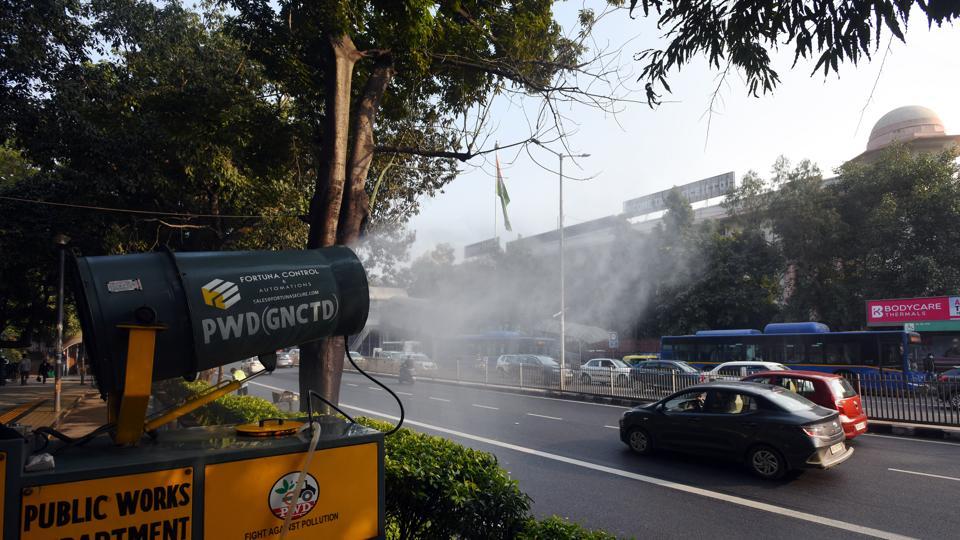
Delhi’s air quality index (AQI) continued in the “very poor” zone on Wednesday, with a reading of 363 at 4pm, barely lower than 367 on Tuesday and worse than 331 on Monday, according to data released by the Central Pollution Control Board (CPCB).
Over the last fortnight, Delhi has recorded one “severe”, nine “very poor” and five “poor” AQI days. The city recorded at least one “moderate” air day during the same period last year, as well as in 2019.
The Commission for Air Quality Management (CAQM) on November 16, after directions from the Supreme Court, put in place a slew of measures to check pollution levels, including a ban on construction across the NCR, stopping the entry of trucks carrying non-essential items into Delhi, as well as shutting schools and educational institutions.
Experts, however, said that these measures have not had the desired impact due to a combination of “misdirected” orders and inconducive weather conditions.
“After Diwali, Delhi has not received a proper western disturbance, which brings some rain and clears out accumulated pollutants. We received one spell of rain, but just 1mm, which was barely enough to clear the air. The accumulated pollutants since Diwali have also not been cleared off because of slower than usual winds. Winds from the northwest have seen several obstructions, which means that by the time they reached Delhi, they weakened and could not properly disperse pollution particles,” said Mahesh Palawat, vice-president (meteorology and climate change), Skymet Weather Services.
Palawat said that November and December usually see at least two to three western disturbances each. But this year, only one active western disturbance has hit the city over the two months so far. Maximum wind speeds have also only gone up to 15kmph in the period.
Further, the delayed monsoon withdrawal this year also pushed back stubble burning season in Punjab and Haryana, which then peaked around Diwali (on November 4), creating a double whammy situation for the Capital. The remnants of pollution from this period are yet to disperse entirely, said experts.
This, they said, can be seen in the severe concentration of aged organic carbon in Delhi’s air currently, according to the Union ministry of earth science’ air quality early warning system. Aged organic carbon (OC2) is an indicator of accumulated pollution in the air.
The data showed that from November 3 to December 10, the OC2 levels were between 80µg/m3 and 150µg/m3, which indicates high accumulation.
Experts meanwhile said that action against local air pollution sources needed to be amped up.
Anumita Roychowdhury, executive director (research and advocacy), Centre for Science and Environment (CSE), said that several pollution analysis and weather forecasting systems in Delhi showed that vehicles were the biggest contributor to the city’s poor air.
“We recently released an analysis studying the data from IITM’s (Indian Institute of Tropical Meteorology) decision support system and found that after stubble burning season ended, vehicular emissions were the biggest contributor to Delhi’s pollution, and there has not been much focus on that. Yes, the truck entry has been banned, but after the construction of the Eastern and Western Peripheral Expressways, the share of non-destined trucks entering Delhi is anyway very low,” said Roychowdhury.
She added, “We are yet to make any concrete call on increasing parking charges and improving our public transport systems to discourage the use of private vehicles, especially at a time we are witnessing an emergency situation.”
CAQM spokespersons did not respond to requests for comment.
Other experts also agreed on the need for stronger moves against local pollution sources, while also working on the air shed as a whole.
“Forecasts indicate that emissions from vehicles, road dust and biomass burning industries and regional emissions from nearby districts such as Sonipat and Jhajjhar (Haryana) are driving the pollution levels in the Capital. Therefore, actions must be taken to reduce emissions from year-round sources of pollution like transport, road and construction dust, and disposal of municipal waste. Further, restrictions on heavy vehicles entering the city should continue to be enforced,” said Tanushree Ganguly, programme lead, Council on Energy, Environment and Water (CEEW)
She added, “The Delhi government should also explore hiking the parking charge to limit the use of privately owned vehicles... Since a significant share of Delhi’s pollution burden can still be attributed to sources outside the city limits, it is important to ensure stringent enforcement and a close watch on its compliance of the CAQM directions in NCR districts as well.”


