
 E-Paper



Delhi’s air quality ‘severe’ for third straight day as smog, stubble fires persist
Farm fires contributed 15.45% to Delhi’s air on Tuesday and 13.68% on Monday. It is expected to be just over 10% on Thursday.

 Prefer HTon Google


Delhiites woke up to another morning shrouded in smog on Thursday, as the city’s air quality remained in the ‘severe’ category for the third consecutive day. The average air quality index (AQI) stood at 405 around 8am, only slightly better than 418 at 4pm on Wednesday, when the Central Pollution Control Board (CPCB) issued its daily national bulletin.
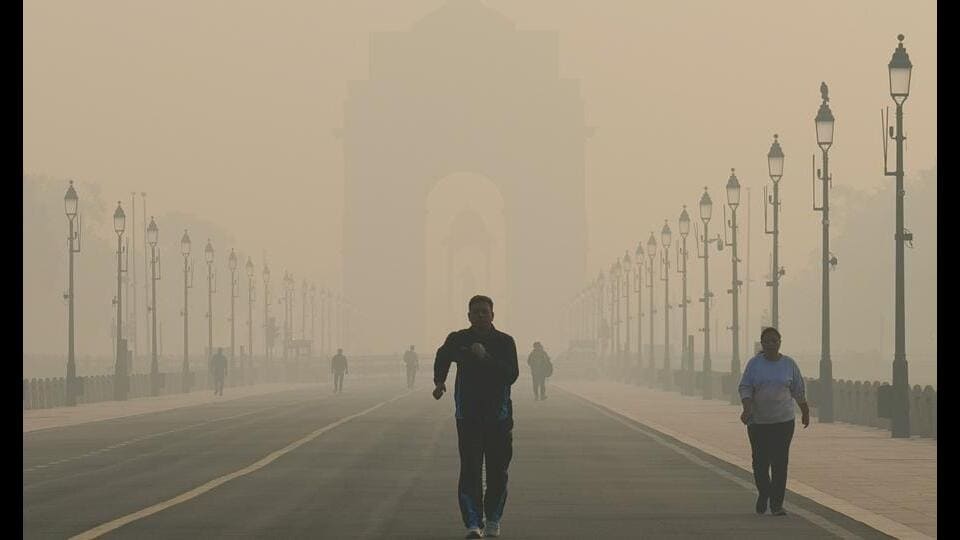
The national capital and Jind in Haryana were the joint-most polluted cities in the country on Wednesday.
The AQI in Delhi reached 428 on Tuesday, the highest since December 19 last year, when it was 451. Akin to Wednesday, winds continue to remain slow, with low temperatures leading to inversion. Inversion is characterised by a layer of warm air sitting on top of cooler air, trapping it. The warm layer tends to lock in the smog close to the surface, creating a visible haze as pollutants are not able to disperse.
Mahesh Palawat, vice president at Skymet, said winds continue to remain low, touching a maximum speed of 10 km/hr during the day on Wednesday. “In the early hours, winds have mostly been calm. The wind direction was northwesterly till Wednesday, but it then fluctuated to westerly and southwesterly,” he said, stating forecasts show marginal improvement from Thursday onwards.
Data from the Decision Support System (DSS) showed stubble burning is on the rise, with its contribution on Wednesday higher than the share of vehicular emissions in Delhi. The share of farm fires was 22.4% to Delhi’s PM 2.5, followed by 15.5% from Delhi’s transport sector.
Farm fires contributed 15.45% to Delhi’s air on Tuesday and 13.68% on Monday. It is expected to be just over 10% on Thursday owing to westerly winds.
The smoke could be seen stretching across the entire Indo-Gangetic Plain region on satellite imagery.
Data from CPCB’s Sameer app, meanwhile, showed that out of the 39 active ambient air quality monitoring stations in the city, 25 of these were in ‘severe’ category on Thursday. The worst impacted locations in the city included Bawana (460), Wazirpur (454) and Rohini (447).
The Commission for Air Quality Management (CAQM) in NCR had invoked stage-3 measures of the Graded Response Action Plan (Grap) in the region with immediate effect on Tuesday.
Under the prevailing Grap-3, private or non essential construction is prohibited, as restrictions on private BS-3 petrol and BS-4 diesel four-wheelers in Delhi, Gurugram, Faridabad, Ghaziabad and Gautam Budh Nagar also came into force.
Further, primary schools, until class five, will operate on ‘hybrid’ mode now, an order by the Department of Education (DoE) said on Tuesday. This will stay in place until further orders.
However, stage-3 may be revoked on Thursday if the AQI dips below 400 – the threshold set for this category.
Forecasts by the Centre’s Air Quality Early Warning System (EWS) for Delhi show Delhi’s AQI is expected to be ‘very poor’ on Thursday, with it likely staying in this range till Saturday.
“The outlook for the subsequent six days from Saturday onwards also shows AQI is likely to be in the ‘very poor’ category,” EWS said. The same model had earlier forecast AQI to be in the ‘very poor’ range on Wednesday too.
Last November, Delhi recorded eight severe air days in November, with a peak of 494 recorded on November 18 – the second highest AQI ever recorded in the capital. There were nine severe air days in November 2023; three in 2022; 11 in 2021; nine in 2020; seven in 2019; five in 2018; seven in 2017; 10 in 2016 and seven in November of 2015.


Stay updated with all top Cities including, Bengaluru, Delhi, Mumbai and more across India. Stay informed on the latest happenings in World News along with Delhi Election 2025 and Delhi Election Result 2025 Live, New Delhi Election Result Live, Kalkaji Election Result Live at Hindustan Times.


