It’s 24 karat gold—the kalash , or the finial, at the top of the Humayun’s Tomb. The gilded metal glistens in sunshine. Just some steps away is a much smaller tomb. Its dome is dotted with wild grass. But it too is as intense as its celebrity counterpart. The effect is caused by the dome’s enigmatic blue, which is neither shiny, nor pale. The shade appears fragile, and one fears it might wash out during the rains, or under the harsh sunshine.
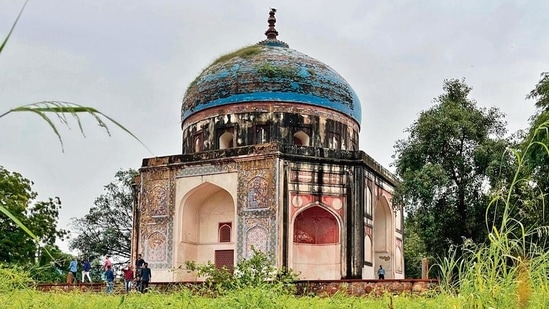
The Nila Gumbad, or the blue dome, stands at the far-east of the Humayun tomb complex. It isn’t visited by as many sightseers as the Mughal emperor’s mausoleum, but it is the oldest edifice in the compound, which is a UNESCO world heritage site.
In the beginning there was just this Nila Gumbad. It stood on an island, surrounded on all sides by the river Yamuna. The tomb was built by Humayun 500 years ago in the memory of… this fact is lost to history. The grave inside is also lost to the vagaries of time. Humayun died in 1556, and his grand tomb, commissioned a decade later by son Akbar, eventually shifted the attention away from Nila Gumbad. Centuries passed. The Yamuna drifted away. Railway tracks came up beside the Nila Gumbad, followed by a railway station. Some decades ago, a slum of 400 jhuggis grew about the blue dome. At long last, the tomb was restored to its original self early this year—it was brought within the Humayun Tomb complex in December 2019. The dome originally contained 1,50,000 blue Timurid brick tiles, out of which 20,000 had disappeared. The conservation project—executed by Aga Khan Trust for Culture in partnership with the Archaeological Survey of India—included compensating for these missing tiles. The new tiles were handmade in the style of the original. Many of the original tiles have lost their glaze, but they have been retained because of their antiquity. The young tiles seamlessly trickle into their duller old ancestors, as if trying to resuscitate a vanishing pattern.
Meanwhile, the ground around the tomb perseveres with the dome’s haunting ambiance. It is dense with trees; some of the branches are laced with gigantic cobwebs. The arcaded wall towards the west of the tomb is particularly picturesque—it has to be the remnants of a mosque, for the niches are undoubtedly the Mecca-facing mihrabs.
{{/usCountry}}Meanwhile, the ground around the tomb perseveres with the dome’s haunting ambiance. It is dense with trees; some of the branches are laced with gigantic cobwebs. The arcaded wall towards the west of the tomb is particularly picturesque—it has to be the remnants of a mosque, for the niches are undoubtedly the Mecca-facing mihrabs.
{{/usCountry}}Within the tomb, the stone chamber lies steeped in a cooling darkness; the daylight streams in reluctantly through the stone screens. This afternoon it is raining heavily. The blue dome has condescended to shelter a stray dog (called Whitey by the guards). He is sitting inside, waiting for the rain to end.
Stay updated with all top Cities including, Bengaluru, Delhi, Mumbai and more across India. Stay informed on the latest happenings in World News along with Delhi Election 2025 and Delhi Election Result 2025 Live, New Delhi Election Result Live, Kalkaji Election Result Live at Hindustan Times.
Stay updated with all top Cities including, Bengaluru, Delhi, Mumbai and more across India. Stay informed on the latest happenings in World News along with Delhi Election 2025 and Delhi Election Result 2025 Live, New Delhi Election Result Live, Kalkaji Election Result Live at Hindustan Times.