Minars rise above the walls. Domes rise above the roof. Arches frame the prayer hall. Moti Masjid, the pearl mosque. Built entirely of white marble.
Art historian John Ruskin wrote an epic three-volume treatise on the stones of Venice. This modest series picks a smaller subject, the white marble of Delhi’s Red Fort, most of whose buildings are made of red sandstone. Lal Qila is otherwise too large and complicated to chronicle in a single lifetime. One courtyard leads to another. One pavilion opens into another. Every visit leaves something unseen. Marble provides a way of looking at one aspect of the fort at a time. This time, the destination is Moti Masjid.
The mosque stands towards the deeper end of the complex. It was not part of Shah Jahan’s original plan for the fort. The emperor, whose living quarters were inside the fort, would travel in a cavalcade of elephants and horses to the grand Jama Masjid outside the fort for the special Friday prayers. Aurangzeb, Shah Jahan’s son, once he became emperor, built Moti Masjid within the fort, close to the royal bath.
Sadly, Moti Masjid has been closed to visitors for years. Its door stays shut, leaving the lovely courtyard deserted and unseen. An out-of-print book, “The Red Fort, Delhi” by Louise Nicholson, reproduces a haunting British-era watercolour painting of the mosque. It shows the masjid, its courtyard, a few pigeons and two worshippers. Seated separately in the otherwise empty courtyard, these two figures seem absorbed in their individual solitudes, their distance from each other making the small space appear vast.
This mosque is distinguished for several reasons. Delhi is full of Mughal-era monuments, but buildings commissioned by Aurangzeb are rare. (Ironically, his lasting, if inadvertent, legacy to the city’s spiritual landscape is the Sufi shrine of Hazrat Sarmad Shahid, the naked fakir who was executed on his orders.) The mosque is also unusual for being an emperor’s private place of worship. Its other distinction is its marble. Unlike Agra, the other Mughal capital, Delhi has relatively few monuments built in this stone. One exception is Chausath Khamba in the central part of the city, but it predates Aurangzeb.
{{/usCountry}}This mosque is distinguished for several reasons. Delhi is full of Mughal-era monuments, but buildings commissioned by Aurangzeb are rare. (Ironically, his lasting, if inadvertent, legacy to the city’s spiritual landscape is the Sufi shrine of Hazrat Sarmad Shahid, the naked fakir who was executed on his orders.) The mosque is also unusual for being an emperor’s private place of worship. Its other distinction is its marble. Unlike Agra, the other Mughal capital, Delhi has relatively few monuments built in this stone. One exception is Chausath Khamba in the central part of the city, but it predates Aurangzeb.
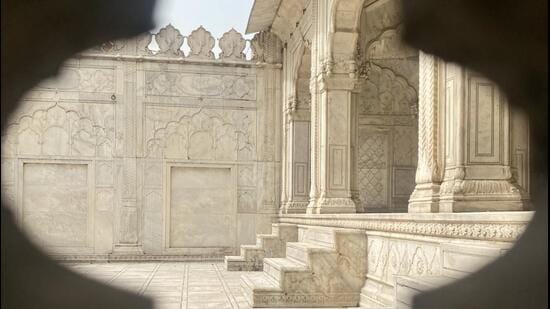
{{/usCountry}}Once, the locked doors briefly opened for an exclusive visit, allowing a rare entry into the mosque. Inside, it was silent. Marble was everywhere, blinding under the afternoon sun, the stone surface thoroughly carved into flowers and vines. Even the ceiling was not spared. The carvings looked as rich as a densely embroidered dress, yet the overall effect was austere.
This afternoon, a visitor bends before the locked doors, attempting to look through the narrow gap into the marble sanctuary, partaking something of its stillness, seclusion, and unstained whiteness.
Stay updated with all top Cities including, Bengaluru, Delhi, Mumbai and more across India. Stay informed on the latest happenings in World News along with Delhi Election 2025 and Delhi Election Result 2025 Live, New Delhi Election Result Live, Kalkaji Election Result Live at Hindustan Times.
Stay updated with all top Cities including, Bengaluru, Delhi, Mumbai and more across India. Stay informed on the latest happenings in World News along with Delhi Election 2025 and Delhi Election Result 2025 Live, New Delhi Election Result Live, Kalkaji Election Result Live at Hindustan Times.