
 E-Paper



Delhiwale: The crowns they wear
On the protective head gear of Bazar Sirki Walan labourers

 Prefer HTon Google


They say the world is the size of each man’s head. For daily-wage labourers in Old Delhi’s Bazar Sirki Walan, it might be truer of their headgear. Almost ever man wears a peculiar sort of cap, and every cap is similar in design. And, as some of the men revealed, each person makes his headgear himself.
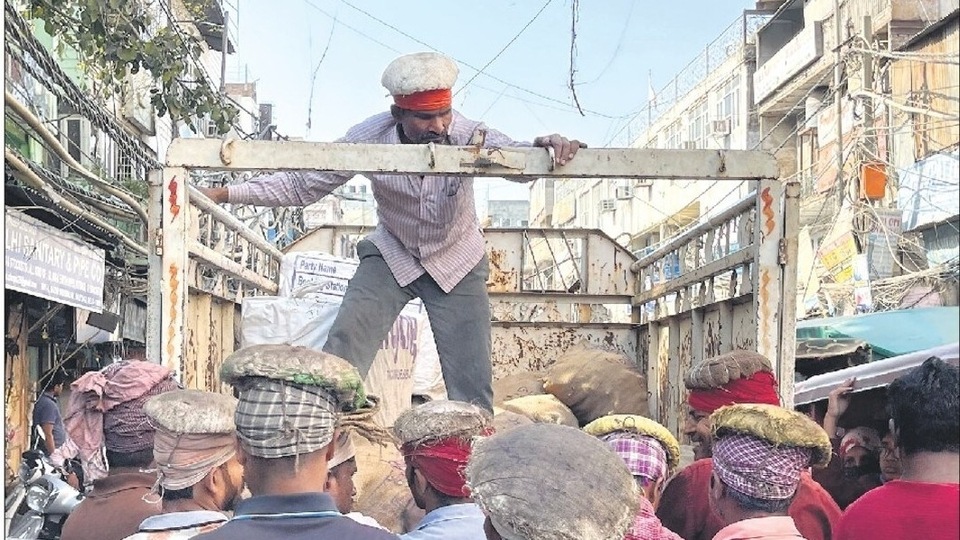
“It’s usually made of plastic,” says Ganesh, a labourer waiting for work by the market’s main street. The plastic used for caps happens to be the material used for sacks one finds in granaries, he adds. Ganesh’s colleague Arvind confirms this fact. He says that “only two things are used to make the cap, one is the plastic of the sack, and the other is a sutli of plastic.” And, of course, there is the sui, the needle to sew the whole thing together.
Assignments in the market come often, Ganesh explains, and they’re often about loading or unloading goods from a vehicle to warehouse/shop, or the other way round. “We mazdoor,” adds the elderly Bharat Lal Yadav, “carry bhari (heavy) things on our head, so this cap serves as a cushion.” Bharat Lal Yadav has been a labourer in Bazar Sirki Walan for more than 30 years.
While the headgear has a common design, there is no common view on its name. Some labourers call it topi, some call it helmet, some call it kundi, some call it beetha, and there is at least one man who calls it nothing. “Never thought of giving it a name,” says labourer Hukum Singh, amusedly.
Labourer Bharat Lal Yadav says it takes about an hour to sew a beetha. Like sone other labourers in Bazar Sirki Walan, he doesn’t consider Delhi his home — his home is his village in Bihar. “We bhai log sleep on the (market) pavement at night.” And it was at night, under the light of the street lamp, that he stitched his beetha. “It took me one and a half hour,” he says. His friend Chandan, who is having chai beside him, says that a beetha can last for a year, after which one has to make a new one.
Soon, a van enters the lane. It is filled with cartons. The labourers instantly get up and circle around the van. All one now sees is a sea of geethas.


