Despite moderate spells rain of in parts of the city, Delhi’s pollutions level got worse, falling perilously close to the ‘very poor’ zone, with the average air quality index (AQI) reading hitting 298, according to the Central Pollution Control Board (CPCB), even as officials said they expect the air to get better from Monday.
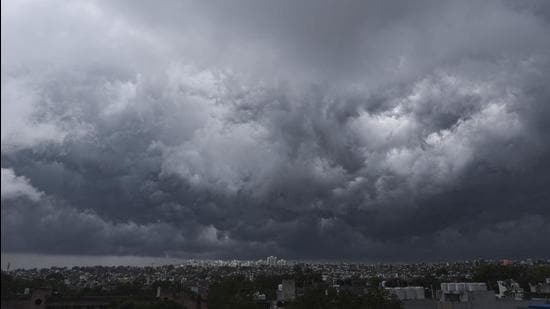
The weather office, meanwhile, said showers are likely to continue on Monday as well.
The air quality deteriorated after Saturday, when the AQI was 284, also in the ‘poor’ zone. At 6pm on Sunday, the pollution recordings in at least 11 localities were in the ‘very poor’ zone. These included Alipur, Shadipur, DTU, Punjabi Bagh, Nehru Nagar, Sonia Vihar, Narela, Bawana, Anand Vihar and Najafgarh, according to CPCB data.
Pollution levels in Delhi were last worse on June 9 this year, when the AQI hit 305.
An AQI reading between 201 and 300 is categorised as ‘poor’, and one between 301 and 400 is categorised as ‘very poor’.
IMD data shows that between Saturday evening and Sunday evening, the Safdarjung weather station in New Delhi received 20.2mm rainfall, while the Palam observatory received 1.8mm rain. The forecast said moderate showers are likely to continue in Delhi on Monday as well.
Scientists from the India Meteorological Department (IMD) said that spike in bad air was a reflection of the accumulated pollution over the last two days, and that the impact of Sunday’s rain will be visible in an improved AQI on Monday.
{{/usCountry}}Scientists from the India Meteorological Department (IMD) said that spike in bad air was a reflection of the accumulated pollution over the last two days, and that the impact of Sunday’s rain will be visible in an improved AQI on Monday.
{{/usCountry}}“The AQI of the day is a 24-hour average. Delhi started receiving rains and easterly winds from Sunday morning and the improvement in pollution levels will be seen in Monday’s average AQI,” said a senior IMD scientist, adding that this will be aided by rainfall, which is expected to continue in parts of Delhi and the National Capital Region on Monday.
This improvement, however, will be brief, officials warned.
Pollution levels in the city will start rising again, once the western disturbance passes over Delhi and winds start blowing from the northwest — bringing in smoke from paddy residue burning — from October 19.
A senior Union environment ministry official said the Commission for Air Quality Management in the NCR and adjoining areas will announce measures under the Graded Response Action Plan (Grap) once the air quality starts deteriorating again. “We are monitoring the situation closely. The CAQM sub-committee will announce measures depending on the situation,” said the official.
The Union ministry of earth science’s air quality monitoring centre, System of Air Quality and Weather Forecasting and Research (Safar), also said that the contribution of stubble fires in the Capital’s air was down to 2% from 14% on Saturday because of easterly winds on Sunday. On Sunday, 815 stubble fires were reported from parts of Punjab and Haryana, Safar said.
“Low wind speed and low mixing layer height were inhibiting dispersion along with moderate stubble intrusion. However, now that the wind direction is mainly from the eastern side and moderate rainfall is also expected to continue, AQI will improve significantly from tomorrow (Monday) and then degrade again for the next two days,” Safar air quality analysis read.
Data from the past five years indicates that there was a marginal improvement in air quality in 2019, 2020 and 2021 compared to 2016, 2017 and 2018.
The number of poor, severe and very severe days was 168 in 2016; 138 in 2017; 129 in 2018; 114 in 2019; 65 in 2020 and 99 in 2021, the report said. The air quality in Delhi has declined this year compared to 2020, possibly due to the resumption of most economic activities, after the Covid-19 lockdown last year.
Between January 1 and October 15 this year there were 189 days in satisfactory (51–100) and moderate (101–200) category and 99 in poor (201–300) very poor (301–400) and severe (>401) category compared to 224 in good, satisfactory and moderate category in 2020 and only 65 in poor, severe and very severe categories according to CPCB data.
(With inputs from Jayashree Nandi)
Stay updated with all top Cities including, Bengaluru, Delhi, Mumbai and more across India. Stay informed on the latest happenings in World News along with Delhi Election 2025 and Delhi Election Result 2025 Live, New Delhi Election Result Live, Kalkaji Election Result Live at Hindustan Times.
Stay updated with all top Cities including, Bengaluru, Delhi, Mumbai and more across India. Stay informed on the latest happenings in World News along with Delhi Election 2025 and Delhi Election Result 2025 Live, New Delhi Election Result Live, Kalkaji Election Result Live at Hindustan Times.