E-Paper



EDMC deploys new fogging devices in bid to cut pollution
In the new variant, water will be the carrying medium for the insecticide.

 Prefer HTon Google


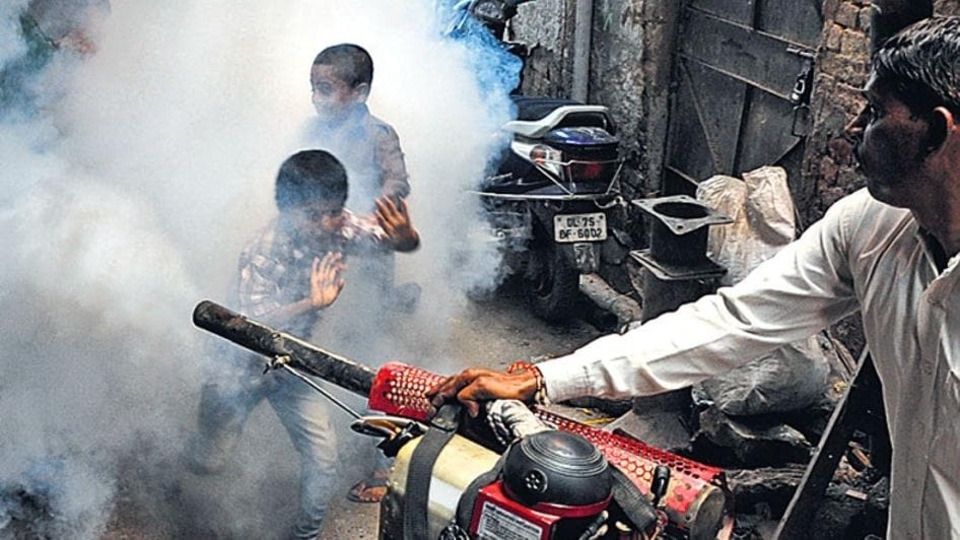
The increased air pollution caused by insecticide-laden petro-diesel smoke during mosquito countering drives is now forcing municipal corporations to look for other alternatives, officials said Wednesday, adding that East Delhi Municipal Corporation (EDMC) has decided to deploy Ultra Low Volume (ULV) cold fogging machines instead of using conventional thermal fogging instruments as part of the revised annual vector-borne disease control programme.
Dr Som Shekhar, municipal health officer of the EDMC, said that the pilot project will begin shortly.
“We mix 25ml of insecticide, usually Cyphenothrin--a synthetic pyrethroid chemical-- in 1 litre of diesel, in a conventional fogging machine. The flashpoint temperature of the insecticide is much higher than diesel. The machine heats up the diesel, which is released under high pressure from a nozzle. As soon as the diesel is released from a high-pressure environment, it starts condensing to form clouds, which carry insecticide molecules,” Dr Shekhar said.
In the new variant, water will be the carrying medium for the insecticide. “As part of the ULV mechanism, no heating is involved and small water droplets are propelled through a high pressure rotating motorised nozzle to create particles, which are 50-75 microns in size. The same efficacy can be achieved without releasing any smoke,” Dr Shekhar said.
The civic body plans to deploy 20 such ULV cold fogging machines this year, another senior public health official explained.
A senior South Delhi Municipal Corporation (SDMC) public health official said that the main problem with cold fogging is public acceptance. “People and councillors are not satisfied as clouds of petro-diesel smoke are visible so they feel there is some action taking place as part of an anti-mosquito drive. In case of cold fogging, only a haze is formed, which dissipates after some time,” the SDMC official explained, requesting anonymity.
Delhi has so far reported 69 dengue cases this year, with eight cases added in the last week. Last year was the second-worst dengue season on record with 9,613 dengue cases and 23 fatalities.