
 E-Paper



The RBI is emerging as an Asian rate outlier. Five charts show why
Reserve Bank of India Governor Sanjay Malhotra stressed a data-dependent approach after policymakers kept the benchmark rate unchanged at 5.25% on Wednesday.

 Prefer HTon Google


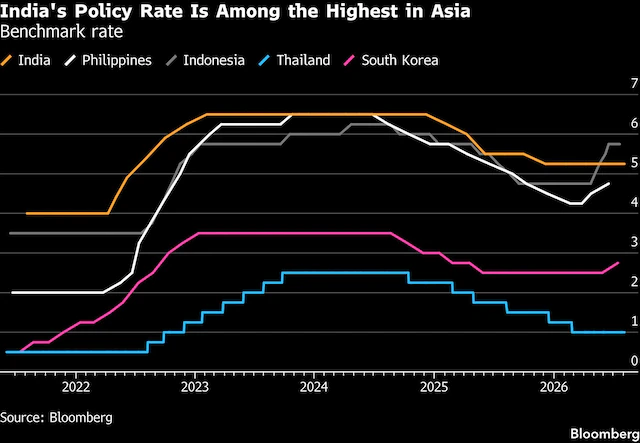
India’s central bank is emerging as one of Asia’s monetary policy holdouts, confident the latest oil shock won’t derail economic growth or fuel the kind of persistent inflation that would warrant higher interest rates.
Reserve Bank of India Governor Sanjay Malhotra stressed a data-dependent approach after policymakers kept the benchmark rate unchanged at 5.25% on Wednesday. The bank has stood apart from regional counterparts ranging from Indonesia to Australia by keeping policy on hold since the Iran conflict erupted.
Watch: RBI Holds Repo Rate at 5.25%, Maintains Neutral Stance
For the RBI, the calculus is supported by one of the world’s fastest-growing economies, inflation that remains within its 2%-6% band and little evidence to date that higher fuel costs are feeding into broader price pressures.
Malhotra “struck a noticeably dovish tone,” said Santanu Sengupta, an economist at Goldman Sachs Group Inc., citing the governor’s view that the recent pickup in inflation reflects temporary supply-side shocks.
In response, Goldman pushed back its call for a first rate hike to December from October. Sengupta noted that if core inflation proves weaker than expected in coming months, the beginning of the RBI’s tightening cycle could potentially be deferred to February 2027.
India’s swap curve has shifted lower, led by the one-year tenor, as traders similarly pushed back wagers for the next rate rise to December from October. Markets are now pricing about 50 basis points of tightening over the next year, down from roughly 75 basis points before Wednesday’s policy decision.
The following charts highlight why investors increasingly believe the RBI can stay on hold this year:
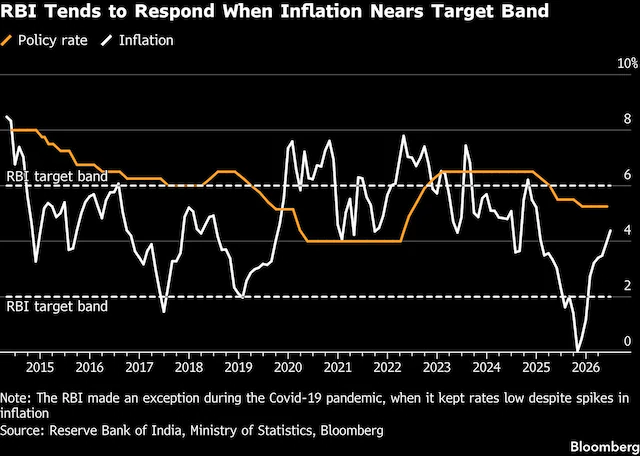
The RBI has typically tightened only when inflation has stayed near its 6% tolerance ceiling, or breached it, for a sustained period and price pressures have become more generalized, as they did during the post-pandemic recovery. The last rate increase came in February 2023.
“The rate hike possibilities will arise only when core inflation is sustaining above 4.5% in a more generalized way,” said Citigroup Inc. economist Samiran Chakraborty. “We expect that this condition is unlikely to be met soon and hence do not foresee a rate hike in 2026.”
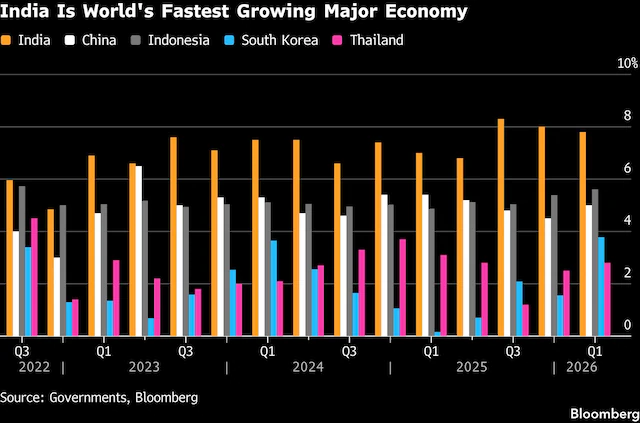
Malhotra cited high-frequency indicators as evidence India’s economy remains on a solid footing. Automobile sales, purchasing managers’ indexes and bank credit growth have all held up, leading the RBI to lift its estimate for gross domestic product growth for the year through March 2027 to 6.7% from 6.6%.
India’s festive season, which typically starts in September and culminates with Diwali in November, will offer another test of the RBI’s inflation outlook. If consumer spending strengthens without pushing up underlying prices, it would support the central bank’s view that recent inflation pressures are driven by temporary supply shocks rather than overheating demand.
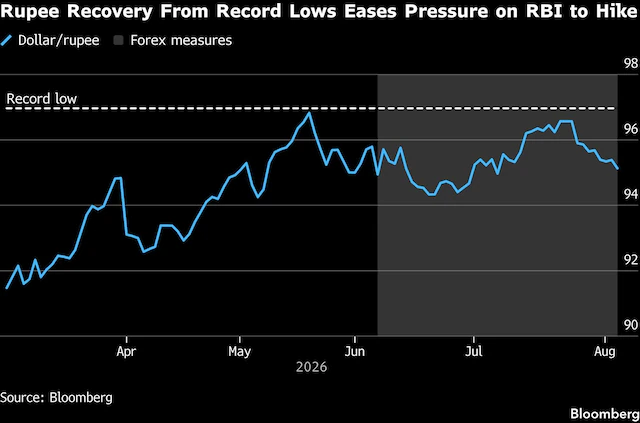
A rebound in the Indian rupee since June has further strengthened the RBI’s case for patience. The currency has climbed nearly 2% from a record low, aided by easing oil prices and the central bank’s measures to attract foreign capital. Malhotra said it could strengthen further as geopolitical tensions recede, helping to contain imported inflation.
Also Read | Gold, code and the rupee: Inside the quiet war over how the world will pay
That, in turn, gives policymakers increased flexibility. Economists at ICICI Bank said the RBI now has greater “degrees of freedom” in deciding the rate path after attracting about $41 billion through its swap scheme. “This has ensured that underlying pressure on the currency is reversed and the medium-term outlook is positive,” they wrote.
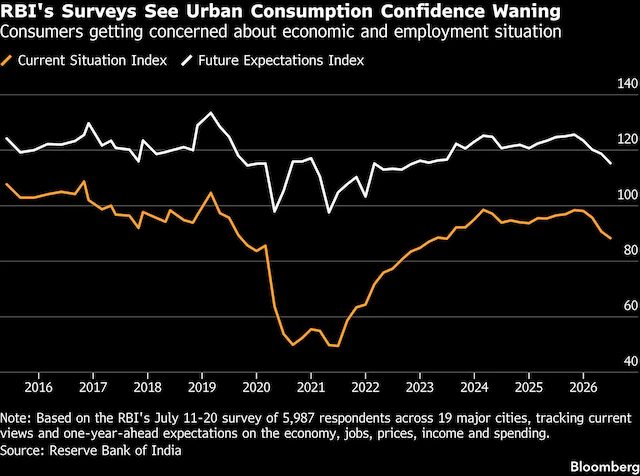
The RBI’s latest surveys, released after the policy decision, also suggest little urgency to tighten. Consumer confidence in urban areas has weakened, with households growing less optimistic about the economy and employment. Confidence in rural areas has also declined steadily since the start of the year.
At the same time, households expect inflation will remain broadly stable in the months ahead. Softer sentiment alongside anchored inflation expectations likely reinforced the central bank’s decision to stay on hold.


