Over 700 artefacts, and five large galleries visually narrating the life and journey of Mughal emperor Humayun, the sunken museum at Humayun’s Tomb, spread across a sprawling 100,000 square feet, is all set to open for the public from August 1, after its formal inauguration by culture minister Gajendra Singh Shekhawat on July 29.
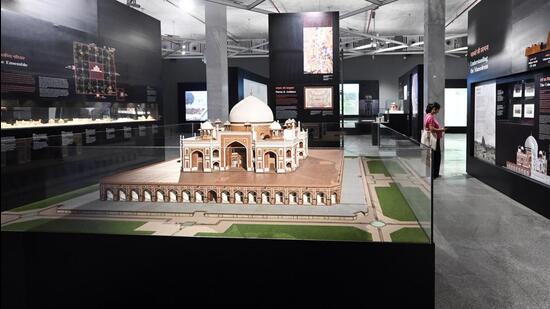
The museum is a facility of the Archaeological Survey of India but has been designed and built by the Aga Khan Trust for Culture (AKTC) — at the culmination of 25 years of conservation effort at the 300-acre Humayun’s Tomb, Sunder Nursery and Nizamuddin Basti area of Delhi, as part of which over 60 monuments have been conserved.
“The purpose of this museum is to tell a story and in that sense the collections and displays here are complete. The artefacts displayed here are just about 5% of the total volume of research done on Humayun. However, it is enough to tell people the story of his life and time and the story of the area of Nizamuddin,” said Ratish Nanda, CEO of AGTC.
There is a layering of information at the museum through multiple original and replicated artefacts, texts, videos, animation and other technologies, Nanda said, adding that it explores Humayun’s travel exploits, his keen interest in astrology and his love for books.
{{/usCountry}}There is a layering of information at the museum through multiple original and replicated artefacts, texts, videos, animation and other technologies, Nanda said, adding that it explores Humayun’s travel exploits, his keen interest in astrology and his love for books.
{{/usCountry}}Like a baoli, the museum building is designed to be underground to retain the views of the adjacent monuments — Sabz Burj, Sunder Burj, and Isa Khan Niyazi’s garden tomb.
Nanda added that while there will be three different entry tickets costing ₹50 each for the Sunder Nursery, Humayun’s Tomb and the new museum, one can also get a combined ticket for all three sites priced at ₹110.
Officials said that the artefacts displayed have been loaned to the ASI by places like the National Museum for 10 years. The 700 artefacts include about 500 original pieces and around 200 replicas that have mostly been created using the same materials and techniques as the originals.
A glimpse into Humayun’s world
Stone ramps descend into the gallery block and a 40 feet wide 3D illustration and architectural models welcome visitors. Delhi’s 2500-year history is relayed through a map showing the seven cities of Delhi.
The first principal gallery, “Where the Emperor Rests”, focuses on the architecture of Humayun’s mausoleum and the personality of the emperor, through stories of his travels, administration of his kingdom, his deep interest in reading, astrology and the arts as well as his patronage of architecture.
The displays include an astrolabe and celestial sphere that Humayun used to consult the stars for auspicious times. One display shows how the emperor chose to wear particular colours on different days of the week. Several ewers or water containers are displayed that were used to serve the emperor water. One of Humayun’s biographies, commissioned by Akbar, was written by his aftabchi or ewer-bearer who accompanied him everywhere for 25 years.
The second gallery, “Icons of a Sacred Landscape”, exhibits the four iconic cultural personalities associated with the Nizamuddin area from the 14th century onwards — Hazrat Nizamuddin Auliya, his disciple, poet Amir Khusrau Dehalvi, Rahim, commander-in-chief of Akbar’s army but more famous as a poet, and Dara Shukoh, who translated the Upanishads into Persian.
“In the Humayun’s Tomb–Nizamuddin area, all 18 Mughal emperors either built here or were buried here. The deep connection of the Mughals with this sacred Sufi landscape is relayed here. So, we have a section depicting all 18 Mughal emperors through the coins of their time. One of the rarest is a coin from Akbar’s time that has ‘Allahu Akbar Jallajalaluhu’ on one side and ‘Ram’ on the other, only three of these exist,” said Nanda.
The original golden finial or Kalash, 18 feet tall, that once crowned the dome of Humayun’s Tomb has also been repaired over several years by traditional coppersmiths and finds the pride of place in the museum. The story of the kalash inspired by the architecture of temples is conveyed here. Similarly, the finely carved chattri or rooftop canopy placed in the museum illustrates the scale on which Humayun’s mausoleum was built. Repaired stone lattice screens from the 14th century onwards, including one from Humayun’s mausoleum show the evolution of the jalli design and the six-edged star at Delhi monuments.
“Few people know that Humayun travelled over 34,000 kilometres during his lifetime, which is over three times that of the known explorer Marco Polo. There are records of his travel across 122 cities from beyond Dhaka in the east to beyond the Caspian Sea in the west, spanning across 27 battles. He did not just travel for work or for acquisitions, but just as a traveller to explore new areas,” added Nanda.
Stay updated with all top Cities including, Bengaluru, Delhi, Mumbai and more across India. Stay informed on the latest happenings in World News along with Delhi Election 2025 and Delhi Election Result 2025 Live, New Delhi Election Result Live, Kalkaji Election Result Live at Hindustan Times.
Stay updated with all top Cities including, Bengaluru, Delhi, Mumbai and more across India. Stay informed on the latest happenings in World News along with Delhi Election 2025 and Delhi Election Result 2025 Live, New Delhi Election Result Live, Kalkaji Election Result Live at Hindustan Times.