On International Biodiversity Day, a butterfly conservatory was inaugurated at the Kamla Nehru Biodiversity Park in north Delhi, designed to keep out monkeys, which have a strong population in the Northern Ridge.
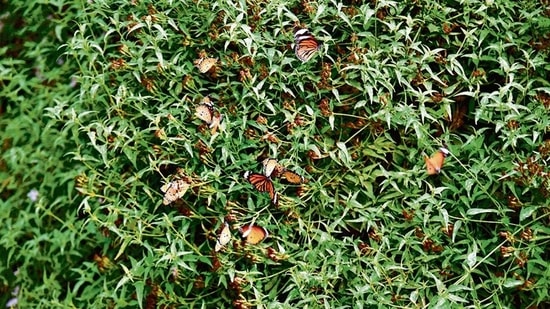
After measuring the wing span of the largest butterfly found in Delhi, the entire conservatory — spread over an area of 672 sqm — has been covered with a wire-mesh based cage, which will allow butterflies to move in and out freely, while preventing monkeys from entering or trampling flowering plants.
Already, 65 different butterfly species have been sighted at the Biodiversity Park, which is run by the Delhi Development Authority (DDA), with the conservatory created in order to increase the count of these butterfly species.
Park officials say among the common sightings are butterflies such as the Plain Tiger, Striped Tiger, Common Gull, Pioneer, White Orange Tip and Yellow Orange Tip, while the rare species include the Great Eggfly Butterfly and the Red Pierrot.
Faiyaz Khudsar, scientist in-charge at the Yamuna Biodiversity Park (YBP) in north Delhi said this set-up allows more such butterfly conservatories to be set up in areas dominated by monkeys, which otherwise make it difficult to grow new plants.
{{/usCountry}}Faiyaz Khudsar, scientist in-charge at the Yamuna Biodiversity Park (YBP) in north Delhi said this set-up allows more such butterfly conservatories to be set up in areas dominated by monkeys, which otherwise make it difficult to grow new plants.
{{/usCountry}}“In normal cases, the plants being grown would get trampled, or eaten. We therefore had to find a solution that allowed butterflies and birds to enter and exit freely, but one that kept out monkeys,” said Khudar.
A mixture of nectar-bearing plants as well as host plants for different butterfly species have both been planted inside the conservatory. These include Ricinus communis (Arand), Acacia leucophleoa (Reonj), Carissa carandus (karaunda), Capparis sepiaria (Hins), Passiflora edulis (Passion flower) and Cuphea hyssopifolia (Cuphea) among others, while nectar-bearing species such as Hamelia patens (Hamelia), Gardenia jasminoides (Gardenia), Indigophera Tinctorea (Neel) and Ixora coccinea (Ixora) are also present inside. “We have also planted some species outside the conservatory, in order to attract butterflies towards the conservatory,” said Khudsar.
The conservatory was inaugurated on Sunday by DDA vice-chairman Manish Gupta, who was also the chief guest for International Biodiversity Day at the park. The other guests included Rajeev K Tiwari, principal commissioner, DDA and professor Monika Kaul from Hansraj College.
“Three-storeyed forests at DDA’s biodiversity parks are slowly becoming the lifeline of Delhi. For a sustainable future, one needs to reduce our consumption and invest in the creation of more such biodiversity parks,” he said.
Professor CR Babu, project in-charge of DDA’s biodiversity parks said more such conservation projects and biodiversity parks were needed across the country to meet this year’s International Day for Biodiversity theme of ‘Building a Shared Future for all life.’
Stay updated with all top Cities including, Bengaluru, Delhi, Mumbai and more across India. Stay informed on the latest happenings in World News along with Delhi Election 2025 and Delhi Election Result 2025 Live, New Delhi Election Result Live, Kalkaji Election Result Live at Hindustan Times.
Stay updated with all top Cities including, Bengaluru, Delhi, Mumbai and more across India. Stay informed on the latest happenings in World News along with Delhi Election 2025 and Delhi Election Result 2025 Live, New Delhi Election Result Live, Kalkaji Election Result Live at Hindustan Times.