Earlier this week, Delhi expanded its air quality monitoring network, but early numbers analysed by HT suggest that data from the six new stations may alter the city’s pollution calculations only marginally – at least for now.
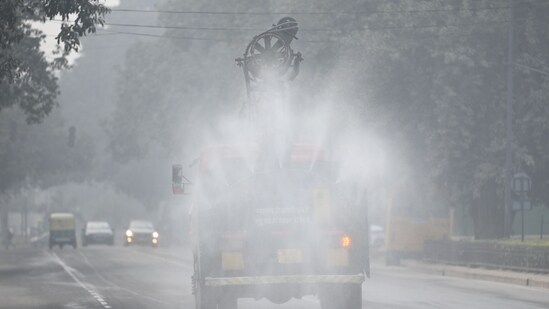
Data from the six ambient air quality monitoring stations – inaugurated on February 9 by Delhi chief minister Rekha Gupta – went live on the Delhi Pollution Control Committee (DPCC) website on Monday morning, expanding the Capital’s monitoring network to 46 stations, the largest of any Indian city.
The six new stations have been set up at Jawaharlal Nehru University (JNU), Indira Gandhi National Open University (IGNOU), SPMSPC Talkatora Garden, the Commonwealth Games Sports Complex, Delhi Cantonment, and Netaji Subhas University of Technology (NSUT) West Campus. On April 26, HT had reported that these locations are relatively greener and less traffic-heavy compared to several existing monitoring sites – effectively adding relatively cleaner stations to the city’s network, which may pull down the citywide average AQI.
For the analysis, HT looked at hourly data from 4pm to 6pm on Monday from these stations to assess how they might influence Delhi’s average AQI when fully integrated. Calculations showed the six new stations altered the city’s average, but by just one point during this period.
{{/usCountry}}For the analysis, HT looked at hourly data from 4pm to 6pm on Monday from these stations to assess how they might influence Delhi’s average AQI when fully integrated. Calculations showed the six new stations altered the city’s average, but by just one point during this period.
{{/usCountry}}Initially, the portal shared real-time readings updated every 15 minutes. From 4pm onwards, it began displaying hourly averages of PM2.5 and PM10 – the two pollutants that drive Delhi’s air quality index (AQI) on most days – along with other parameters.
The average hourly AQI for the 40 existing stations stood at 125, 115, and 109 in the hours ending 4pm, 5pm, and 6pm respectively. When including the new stations, the averages were 126, 114, and 108 for 4pm, 5pm, and 6pm respectively – bringing out a net change of merely one point.
A station-wise breakdown revealed variation. At 4pm, when only the JNU station was reporting, its AQI of 135 exceeded the 40-station average of 125. By 5pm, when all six were reporting, four stations recorded lower AQIs than the average of the older ones. By 6pm, all but the Akshardham station showed lower readings than the 40-station average.
The 24-hour average AQI for the Capital stood at 228 (poor) on Monday, marginally lower than Sunday’s 229.
The new stations, however, are not integrated into the Central Pollution Control Board (CPCB) database. As a result, the official AQI released for Delhi on Monday was calculated using data from the existing 40 stations. Once integrated, the city’s average AQI will be computed using readings from all 46 stations.
To be sure, such an analysis must be read with some caveats.
First, the analysis covered only two hours of data during a relatively clean part of the day and year. The new stations have not yet experienced a severe pollution episode – such as the toxic smog typical of post-monsoon months – which would reveal their true impact on the city’s average.
Second, HT’s calculations approximated official AQI methodology by using PM2.5 and PM10 sub-indices, as these are the main pollutants on most days.
Experts said in order to assess whether the six new stations will reduce the overall AQI or increase it, a larger data set is required. The true impact of the six new stations – whether or not they lower Delhi’s average AQI – however will only become apparent once they have weathered a full cycle of seasons, they stressed.
“It is a good move that the stations are up and running. However, they are yet to be integrated with the CPCB network. In order to compare if it brings down the average AQI possibly in the longer run, one will have to wait longer – to possibly see data over multiple weeks to find out,” said Sunil Dahiya, founder and analyst at the environmental think-tank Envirocatalysts.
Stay updated with all top Cities including, Bengaluru, Delhi, Mumbai and more across India. Stay informed on the latest happenings in World News along with Delhi Election 2025 and Delhi Election Result 2025 Live, New Delhi Election Result Live, Kalkaji Election Result Live at Hindustan Times.
Stay updated with all top Cities including, Bengaluru, Delhi, Mumbai and more across India. Stay informed on the latest happenings in World News along with Delhi Election 2025 and Delhi Election Result 2025 Live, New Delhi Election Result Live, Kalkaji Election Result Live at Hindustan Times.