One of the four remaining Bengal tiger cubs born to tigress Aditi was admitted to the hospital in the early hours of Saturday and is now being hand-reared, with its condition “stable”, the Delhi Zoo said on Sunday. The remaining three cubs are with the mother and are feeding regularly. Two of the six cubs born to seven-year-old Aditi on August 4 died last week, so the zoo is making all efforts to protect the remaining four cubs, officials said.
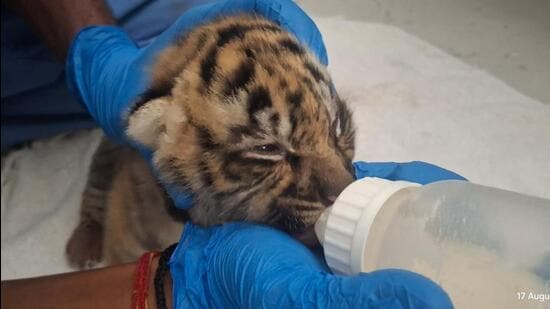
The female cub was shifted to the hospital on Saturday at 12.10 am after it had not consumed milk for more than 12 hours, zoo officials said. The cub had become weak but has been stabilised by being fed a special milk formula for cats, which also contains vitamin supplements.
“The cub did not at first consume the milk formula as it was used to its mother’s milk. It usually takes one to two days to adapt to this. But the milk replacer has successfully been introduced and this was the same formula we used to hand-rear two lion cubs earlier,” said zoo veterinary officer Abhijit Bhawal, adding that the cub is being kept in a special basket and is covered with warm clothes to simulate its mother’s presence.
“Every three hours, the cub is being hand-fed. Its body weight has increased by 200 grams since it was admitted here,” Bhawal told HT, adding that three keepers are monitoring the animal.
{{/usCountry}}“Every three hours, the cub is being hand-fed. Its body weight has increased by 200 grams since it was admitted here,” Bhawal told HT, adding that three keepers are monitoring the animal.
{{/usCountry}}Tigress Aditi’s litter of six Bengal tiger cubs was the largest the zoo had seen in two decades. Of the six cubs, one, which the zoo said was the weakest of the litter, died on August 8. Another cub was fairly weak and was not able to feed on the mother’s milk. “It was weaned and transferred to the zoo hospital on August 9 but died on August 10 despite all efforts to save its life. We are constantly monitoring the mother and cubs through CCTV and the keepers. Required supplements are being given to the mother, too, to enhance milk letdown,” Delhi zoo director Sanjeet Kumar had said previously.
Meanwhile, two smooth-coated otters which had arrived at the Delhi zoo on August 14, after a 1,200-km journey from the Surat Zoo in Gujarat, are doing well. The species was brought back to the zoo after 21 years — it was last seen here in 2004.
Bhawal said the otters are currently in quarantine for a month but have begun exploring the new area. “They have made burrows and are gradually settling in to the new space. Every four to five days, their pool will be cleaned with fresh water incorporated,” he said, adding that fish are being given to them after being washed in a sodium dichloroisocyanurate solution. “They are feeding on 3kg of fish, which includes sea fish like Bombay duck and mackerel, and fresh riverine fishes species like tilapia and labeo bata,” he said.
Stay updated with all top Cities including, Bengaluru, Delhi, Mumbai and more across India. Stay informed on the latest happenings in World News along with Delhi Election 2025 and Delhi Election Result 2025 Live, New Delhi Election Result Live, Kalkaji Election Result Live at Hindustan Times.
Stay updated with all top Cities including, Bengaluru, Delhi, Mumbai and more across India. Stay informed on the latest happenings in World News along with Delhi Election 2025 and Delhi Election Result 2025 Live, New Delhi Election Result Live, Kalkaji Election Result Live at Hindustan Times.