Two consecutive thunderstorm spells accompanied by gusty winds since early Monday helped revive Delhi’s chronically bad air to “satisfactory” levels for the first time in nearly three months.
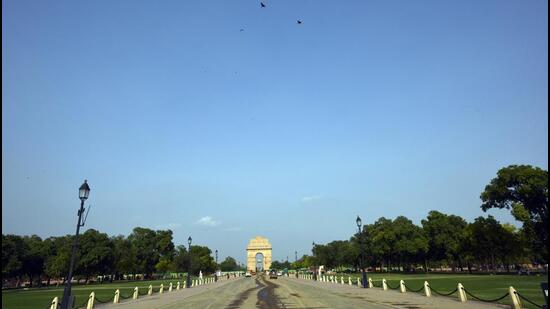
Delhi’s overall air quality index (AQI) was 89 on Tuesday, according to the Central Pollution Control Board’s (CPCB) daily 4pm bulletin, a further improvement from the 136 (moderate) recorded on Monday. The last time Delhi’s AQI was this clean or better was on February 27 (AQI of 92) and January 9 (AQI
Two consecutive thunderstorm spells accompanied by gusty winds since early Monday helped revive Delhi’s chronically bad air to “satisfactory” levels for the first time in nearly three months.
Delhi’s overall air quality index (AQI) was 89 on Tuesday, according to the Central Pollution Control Board’s (CPCB) daily 4pm bulletin, a further improvement from the 136 (moderate) recorded on Monday. The last time Delhi’s AQI was this clean or better was on February 27 (AQI of 92) and January 9 (AQI of 69), as per CPCB’s daily bulletin.
CPCB calculates AQI over a 24-hour average, with an AQI of 50 or lower classified as “good”, between 51 and 100 as ”satisfactory”, between 101 and 200 as “moderate”, between 201 and 300 as “poor”, between 301 and 400 as “very poor” and over 400 as ”severe”.
CPCB data shows that Tuesday was only the fourth ”satisfactory” air day so far this year, with two such days recorded in January, and one in February. Delhi is yet to see a “good” air day this year.
Also read: Delhi-NCR sees fresh late-night rain spell amid outages, flight woes: 10 points
Delhi had an AQI of 91 on January 8, 69 on January 9, and 92 on February 27 – all following spells of rain and strong winds.
On Tuesday, CPCB’s central control room that monitors the 24-hour average PM2.5 and PM10 concentration (fine particulate matter suspended in air) across NCR, showed that the average PM2.5 level at 7pm was 29 micrograms per cubic metre (μg/m3), while the average PM10 concentration was 65μg/m3 – both within the permissible national standards of 60μg/m3 (PM2.5) and 100μg/m3 (PM10).
HT earlier reported on how Delhi has seen more ”poor” and ”very poor” air days since March 1 than ”moderate” or “satisfactory” days, largely owing to a prolonged dry and dusty spell. The latest data shows that between March 1 and May 24, Delhi recorded 64 ”poor” air days and one ”very poor” air day, but just 19 “moderate” air days.
Delhi received no rainfall in March and only 0.3mm of rainfall in April. It received only 3mm of rainfall this month until May 22, but Monday and Tuesday added 26.9mm to that tally.
Experts say summer air pollution in Delhi remains high, largely owing to dust re-suspension and upliftment, with spells of rainfall or strong surface winds required to provide relief.
Also read: Gurugram rains: Waterlogging woes return; 2,500 cops deployed to manage traffic
“Dust is the primary source in summers, but traffic congestion is also back and local sources such as garbage burning and industries in NCR will all play a part. Meteorological factors help Delhi’s air both in summers and winters, but this is not the solution; a sustained plan is needed to consistently achieve more moderate or satisfactory days,” said Dipankar Saha, former head of CPCB’s air laboratory.
Anumita Roychowdhury, executive director, research and advocacy, Centre for Science and Environment (CSE), said while the long-term trend since 2016 shows a reduction in the number of “severe” and “very poor” days, considerable efforts were still needed to improve background emissions. “One cannot rely on meteorological events alone and therefore there is a need to work on sources of pollution and to control emissions at source,” she said.
One Subscription.
Get 360° coverage—from daily headlines
to 100 year archives.
Archives
HT App & Website
Stay updated with all top Cities including, Bengaluru, Delhi, Mumbai and more across India. Stay informed on the latest happenings in World News along with Delhi Election 2025 and Delhi Election Result 2025 Live, New Delhi Election Result Live, Kalkaji Election Result Live at Hindustan Times.
Stay updated with all top Cities including, Bengaluru, Delhi, Mumbai and more across India. Stay informed on the latest happenings in World News along with Delhi Election 2025 and Delhi Election Result 2025 Live, New Delhi Election Result Live, Kalkaji Election Result Live at Hindustan Times.