E-Paper



With NICUs too costly for many, are smaller clinics necessary evil?
The Baby Care New Born Hospital on its website said it is an institute dedicated for neonates specially premature and extremely low birth weight babies.

 Prefer HTon Google


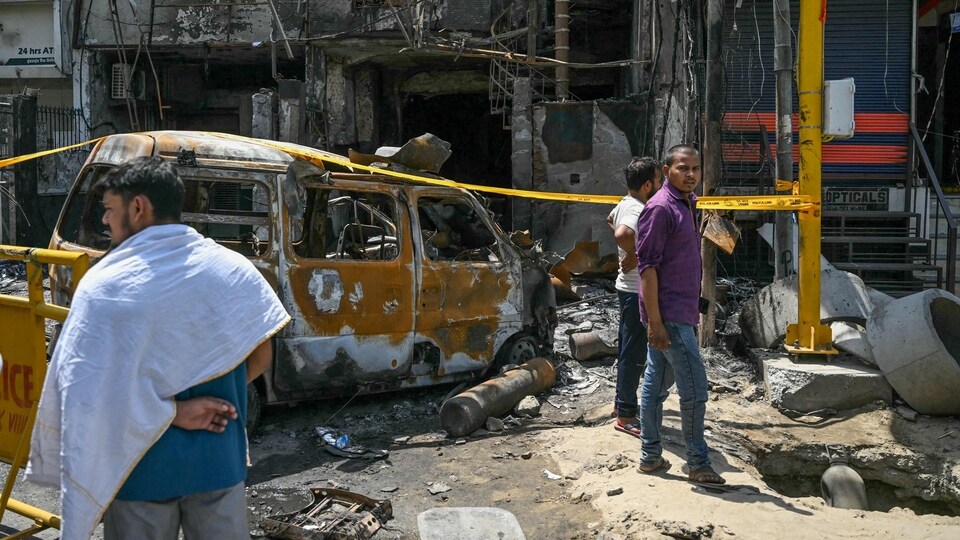
The Baby Care New Born Hospital at Vivek Vihar in east Delhi, where six infants were killed following a fire on Saturday night, is part of a medical industry with scant oversight in the National Capital Region offering neonatal intensive care facilities at relatively lower prices.
The hospital in its website said that it is an institute dedicated “for neonates specially premature and extremely low birth weight babies”. It said that the hospital “is most affordable and economical NICU in whole NCR Delhi without compromising in treatment care”, and has “dedicated and trained staff that are committed to care for these small angels”.
Also Read: Delhi LG, govt order inquiry into children’s hospital fire
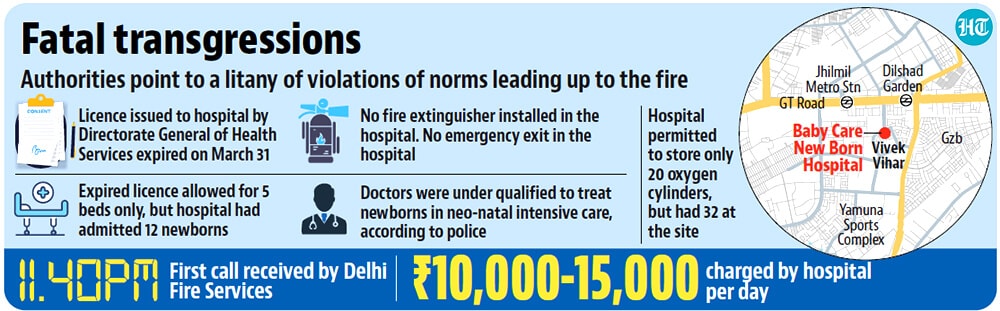
However, investigating agencies have discovered that the hospital’s licence to operate issued by Delhi government’s Directorate General of Health Services had expired on March 31, and even the now-invalid permit only allowed for five beds — less than half of the 12 newborn children admitted at the time of the fire.
The hospital was also operating with “doctors” who had Bachelor of Ayurvedic Medicine and Surgery (BAMS) degrees — not those with medical science degrees of MBBS or MD— and was thus not qualified to treat newborns in neonatal intensive care,according to police.
Experts said that there is a high likelihood that many similar clinics operate across the Delhi and its satellite cities, without proper permissions, infrastructure, and manpower. However, these hospitals do roaring business, primarily because not everyone can afford to pay for high-end neonatal or paediatric intensive care units for sick babies.
The cost of intensive care treatment at any prominent private hospital runs into lakhs of rupees on a daily basis, with a significant chunk of the expenditure not covered under most health insurance schemes. At government hospitals — which cost much less — finding a bed during an emergency can be a herculean task. The wait period for certain procedures may stretch from days to even years at such institutions.
“There is a huge unmet demand for such facilities, which is why the unorganised sector is thriving. I doubt if there will be an exact number available immediately of similar hospitals that are functioning across the city,” said a senior administrative official formerly with the Delhi government’s health services department, requesting anonymity.
A 2020 Lancet study said, “To provide adequate care, India needs 20 000–30 000 level 3 neonatal intensive care unit (NICU) beds and 75 000–100 000 level 2 special newborn care beds. But beds available, especially level 3 NICU beds, are grossly inadequate. It remains common in government hospitals to have up to five sick newborn babies sharing a cot.
“Such facilities are necessary as there is an immense load on private hospitals, but safety standards cannot be compromised… There is absolutely no room for using substandard machines, medicines, working with less staff and not following safety guidelines. There have clearly been a lot of misses but we cannot blame just the hospital, the government is also to be blamed equally. Who is supposed to check these lapses? Who is allowing them to run without adequate permissions/licences?” said Dr Yatin Mehta, chairman of the institute of critical care and anesthesiology at Medanta Hospital.
As temperatures escalated this year, the Union health ministry and NDMA had issued a joint advisory to states and UTs on measures to prevent fires at hospitals. But the official quoted above said, “These kinds of disasters are usually waiting to happen because most people aren’t doing their job properly. There may be advisories in place, but who is there to ensure compliance?”
Another senior official, who works at a government-run children’s hospital, said having accreditation, and conducting fire drills on a regular basis is important.
“You cannot not have safe-guards in place for such sensitive facilities. This incident should be taken as a wake-up call, and not forgotten as we have the tendency to forget and move on. Loopholes need to be plugged, responsibilities must be fixed,” the official said, also requesting anonymity.