Municipal Corporations of Gurugram and Faridabad are all set to establish two waste-to-charcoal plants, also known as green coal plants, in the two districts at a cost of ₹500 crore each, said officials. They added that these plants would convert 1,500 tonne of waste daily into charcoal using indigenous technology.
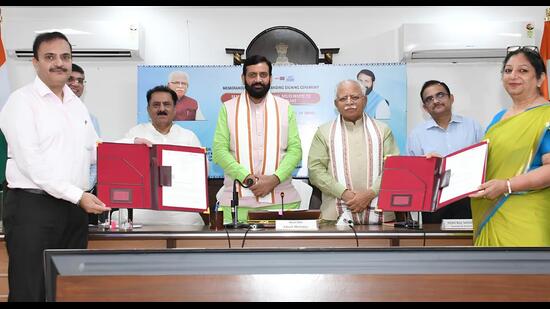
A memorandum of understanding (MoU) was signed between NTPC Vidyut Vyapar Nigam Limited (NVVNL), a wholly owned subsidiary of NTPC Limited, and the Municipal Corporations of Gurugram and Faridabad. The signing ceremony took place in Chandigarh on Saturday, with Union minister Manohar Lal, Haryana chief minister Nayab Singh Saini, and minister of state for urban local bodies Subhash Sudha. The MoU was signed by A. Mona Sreenivas, commissioner of the Municipal Corporation Faridabad; Narhari Singh Banger, MCG commissioner; and Renu Narang, chief executive officer of NVVNL.
According to Saini, the green coal plants will be in Bandhwari, Gurugram, and Motuka, Faridabad, costing approximately ₹500 crore for each facility. These plants will convert 1,500 tonne of daily collected waste into charcoal, he said, adding that the MCG and MCF will provide 20 acres of land each for these plants. “NTPC will soon take possession of the land and start setting up the plants, which are expected to be completed in about 30 months. These plants will be based entirely on indigenous technology,” CM Saini said.
The establishment of these plants aims to support Prime Minister Narendra Modi’s Swachh Bharat campaign, making Gurugram and Faridabad garbage-free, said Saini. “This torrefied charcoal will be used in power generation plants, reducing the use of mineral coal. He stated that this effort will play a crucial role in significantly enhancing urban cleanliness and promoting environmental sustainability in Gurugram and Faridabad,” Saini added.
{{/usCountry}}The establishment of these plants aims to support Prime Minister Narendra Modi’s Swachh Bharat campaign, making Gurugram and Faridabad garbage-free, said Saini. “This torrefied charcoal will be used in power generation plants, reducing the use of mineral coal. He stated that this effort will play a crucial role in significantly enhancing urban cleanliness and promoting environmental sustainability in Gurugram and Faridabad,” Saini added.
{{/usCountry}}Vikas Gupta, former commissioner and secretary of the urban local bodies department said that increasing urbanisation has made waste disposal a major challenge. “To address this problem, we have initiated this step with NVVNL under the guidance of the chief minister. The setting up of these plants in Gurugram and Faridabad will strengthen waste management,” he said.
Meanwhile, Renu Narang, CEO of NVVNL noted that the plants in Haryana would be the largest in India, surpassing the current plant in Varanasi, which produces charcoal from 600 tonne of waste daily. However, the two plants to be established in Haryana will be the largest in India, producing charcoal from 1,500 tonne of waste daily. “If successful, this technology could be implemented in other cities,” she said.
Stay updated with all the Breaking News and Latest News from Mumbai. Click here for comprehensive coverage of top Cities including Bengaluru, Delhi, Hyderabad, and more across India along with Stay informed on the latest happenings in World News.
Stay updated with all the Breaking News and Latest News from Mumbai. Click here for comprehensive coverage of top Cities including Bengaluru, Delhi, Hyderabad, and more across India along with Stay informed on the latest happenings in World News.