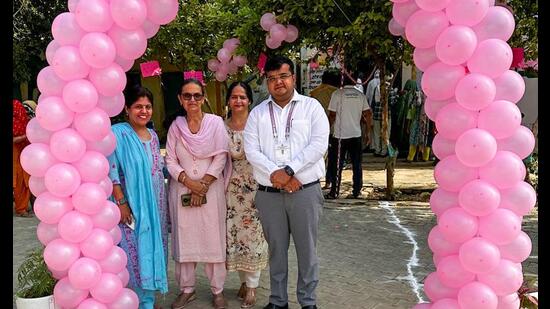
Gurugram’s pink booths struggle with dip in female turnout
Pink booths were female-only arrangements, staffed by female officers to make the process comfortable and secure for women and to ensure that more of them turn up to vote
With the lower voters’ turnout in the district for the assembly polls on Saturday, the Pink booths set up for female voters also saw lower participation. While many women arrived early morning to cast their votes, the booths were mostly found empty during the later hours of the day.
Voters wait outside a pink polling booth to cast their votes during the Haryana assembly election in Gurugram on Saturday. (HT PHOTO)
{{^htLoading}} {{/htLoading}}
Pink booths were female-only arrangements, staffed by female officers to make the process comfortable and secure for women and to ensure that more of them turn up to vote. The district commissioner and election officer, Nishant Yadav, said, “We had set up Pink booths across the four assembly constituencies to promote higher female voter turnout. The booths were decorated to create a vibrant atmosphere and staffed by female officers to make the process more comfortable for women voters. Although we expected a higher turnout, we are pleased with the positive experiences of those who voted.”
Ritu Sirohi, a resident of Palm Drive in Sector 66, praised one such setup. “It was a very pleasant experience. The booth was clean, organized, and having female officers made it feel even more comfortable. I voted for better safety for women and improved healthcare facilities for all,” she said.
{{^htLoading}} {{/htLoading}}
{{^usCountry}}
“The Pink booth initiative is a great idea. It shows that women’s voices matter and that the government is taking steps to encourage us to be part of the process,” said Priya Malhotra, a school teacher who voted in Badshahpur. “I voted for better roads and traffic management. These are small but essential changes that I believe will improve our daily lives,” Malhotra said.
{{/usCountry}}
{{#usCountry}}
“The Pink booth initiative is a great idea. It shows that women’s voices matter and that the government is taking steps to encourage us to be part of the process,” said Priya Malhotra, a school teacher who voted in Badshahpur. “I voted for better roads and traffic management. These are small but essential changes that I believe will improve our daily lives,” Malhotra said.
{{/usCountry}}
Besides the Pink booths, Youth booths and PWD (Persons with Disabilities) booths were also set up to cater to specific voter groups. At these booths, special provisions, such as accessible entry points and assistance for people with disabilities, were made to ensure that every eligible voter had the opportunity to cast their vote.
Leena Dhankhar is Senior Editor and Bureau Chief, Gurugram, at Hindustan Times, where she has spent over 17 years chronicling the transformation of one of India's fastest-growing urban regions. From starting her career as a crime reporter to leading the Gurugram bureau, her journalism has been defined by investigative reporting, in-depth storytelling and an unwavering focus on public interest.
Over nearly two decades, she has reported extensively across crime, politics, civic governance, elections, real estate, environment, courts, sports, education and entertainment, covering Gurugram, Faridabad, Nuh and Palwal. Her reporting has exposed several major scams and systemic failures, including insurance frauds, waste management irregularities, illegal arms manufacturing units in Nuh, illegal mining in the Aravallis, organised crime networks and governance lapses affecting millions of residents.
Known for her investigative work and exclusive stories, Leena has reported on high-impact national issues, including the Nicaragua charter flight carrying Indian migrants that was turned back amid allegations of human trafficking, exposing the growing network of illegal immigration rackets. Her work has also focused on gang wars, prison administration, juvenile crime, women and child protection systems, the functioning of the Juvenile Justice Board and Child Welfare Committee, and environmental challenges such as pollution, waterlogging and deteriorating civic infrastructure.
Beyond hard news, Leena has extensively documented Haryana's rich heritage, forests and wildlife, bringing attention to the state's historical landmarks, biodiversity, conservation efforts and ecological challenges through immersive reportage and feature writing.
Her journalism has consistently gone beyond breaking news. She has documented Gurugram's rapid urbanisation through long-form narratives and enterprise reporting on issues ranging from pothole-ridden roads, flooding and waste management to the changing social fabric of India's Millennium City. She also writes widely read feature columns, including The Outsider, Changemaker, and Concern for Gurugram, profiling people, places and ideas shaping the city's identity.
Leena is the author of Gurugram School Murder, published by Juggernaut Books, a deeply reported account of one of India's most high-profile school murder investigations. She is currently working on her second book, an investigative work exploring some of India's most significant scams and fraud investigations.
Beyond print journalism, she has expanded her storytelling through public speaking and digital media. She is a TEDx speaker and has produced podcasts exploring Gurugram's transformation, civic challenges and untold stories. Her work reflects a commitment to narrative journalism that combines rigorous reporting with compelling storytelling.
A law graduate with an MBA in Human Resources, Leena brings a multidisciplinary perspective to her reporting, particularly on governance, public policy and legal affairs. She has travelled extensively across India to pursue investigative assignments, often reporting from remote locations and conflict-prone areas in search of stories that matter.
Catch every big hit, every wicket with Crickit, a one stop destination for Live Scores, Match Stats, Infographics & much more. Explore now!.