
 E-Paper



Health dept to strengthen ambulance network across Gurugram
Earlier, the father-in-law of the woman, Mahabeer Singh had accused the hospital authorities of not providing any medical transport to Sanju Devi, who was heavily bleeding after delivering her baby at the hospital on September 21.

 Prefer HTon Google


Three days after the family of a pregnant woman alleged that medical staff at Sohna sub-division hospital denied her ambulance service, the health department has taken cognisance of the lack of ambulances across the district. Officials on Thursday said that more emergency response vehicles would be deployed in the coming days to ensure a timely response to emergencies at hospitals.
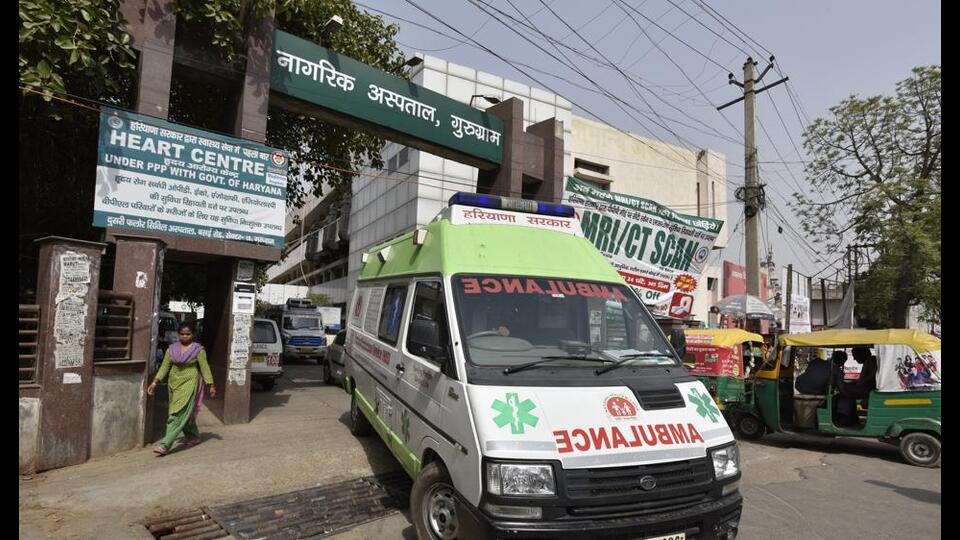
Earlier, the father-in-law of the woman, Mahabeer Singh, a resident of Ward 18 in Sohna, had accused the hospital authorities of not providing any medical transport to Sanju Devi, who was heavily bleeding after delivering her baby at the hospital on September 21. During a ‘Samadhan Shivir’ or grievance redressal camp on Monday, Singh, a labourer by profession, had submitted a formal complaint against the hospital authorities claiming that his daughter-in-law was referred to a hospital in Gurugram while she was in critical condition.
A senior official at the hospital, requesting anonymity, admitted that the two ambulances on standby were not operational. “Ambulance services can be called through 112. Since it would have taken time to arrive from Gurugram, the patients chose to book a private cab instead,” he said. HT team reached out to officials responsible for managing the fleet on Thursday and found out that only 28 ambulances were operational in the district with an anticipated population of above 20 lakh.
“Out of 28 ambulances, seven are equipped with basic life support (BLS), eight with advanced life support (ALS), ten are patient transport ambulances (PTAs) and the remaining three are deployed for non-emergency services,” a senior official said, requesting anonymity.
Senior officials at Civil Hospital in Sector 10A admitted that the ambulances at the hospital are under “heavy load” due to a mismatch between the patient needs and supply. “They are always on call,” he said. According to official data, the district, divided into four zones, with 24-25 primary health centres (PHCs) and community health centres (CHCs), apart from four sub-division and one district hospital.
“Even if we decide to deploy ambulances at each of these facilities, we will fall short. Each ambulance takes at least 10 to 15 minutes to reach the called spot,” the senior official added. According to experts, the lack of an existing network is filled by services offered by private hospitals, daycare centres, Resident Welfare Associations (RWAs), corporate offices, builders, and even quick-commerce companies.
“Only those who can avail the private services are well rooted in the medical response system,” said Dr Sunil Dubey, general manager (emergency and trauma care) at Medanta Medicity. As per Dubey, a technologically empowered control centre with an ability to map live location supported by a dedicated team of emergency responders is the need of the hour.
“Patients should be able to track their ambulances and a healthcare provider to treat them should be present inside the ambulance. Private facilitators like us easily respond to emergencies in five to ten minutes within a range of five to ten kilometres,” he said, adding that the authorities must take note that the “cost of life or disability” is far greater than the cost of running ambulances.
Dr Alka Singh, chief medical officer of Gurugram, said that ambulance services in Sohna were functional. “We are in the process of adding more ambulances to the fleet. In the coming three to four days, more emergency response carriers are expected to start running,” Singh informed.

Stay updated with all the Breaking News and Latest News from Mumbai. Click here for comprehensive coverage of top Cities including Bengaluru, Delhi, Hyderabad, and more across India along with Stay informed on the latest happenings in World News.


