Despite a low student turnout for several years the historic Oriental language departments at Lucknow University continue to operate driven by a century-old founding pledge to preserve classical heritage not primarily for monetary benefit but to impart training in literature, culture and heritage.
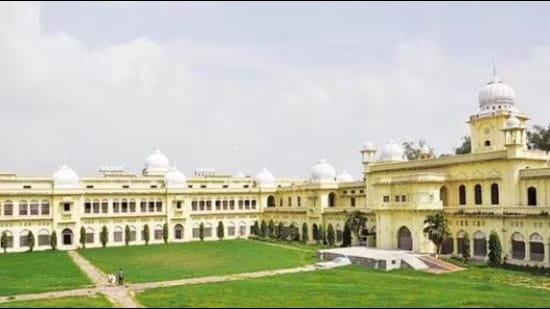
Founded in 1864 under Canning College before Lucknow University’s 1920 establishment, the department of Oriental studies in Sanskrit and the department of Oriental Arabic and Persian are the university’s oldest divisions.
The Oriental Sanskrit department maintained small specialised batches: the Shastri programme enrolled eight in ( academic session 2024-25), nine in (2025-26), and eight students in (2026-27), while the Acharya programme recorded six, four, and two students across those three academic years.
The Oriental Arabic and Persian department recorded 120 students in (2024–25), 145 in (2025–26), and 130 in (2026–27), totaling 395 students over three years. Its core traditional offerings included the Alim programme (64, 77, and 60 students over those respective years) and the Fazil-e-Adab course (45, 50, and 48 students in 2024-25, 2025-26 and 2026-27 respectively).
Despite operating on low fees for decades, tuition and form fees were increased during the vice-chancellorships of Prof R P Singh and Prof Alok Kumar Rai, said Syed Arshad Ali Jafri, coordinator of the Oriental Arabic and Persian department.
{{/usCountry}}Despite operating on low fees for decades, tuition and form fees were increased during the vice-chancellorships of Prof R P Singh and Prof Alok Kumar Rai, said Syed Arshad Ali Jafri, coordinator of the Oriental Arabic and Persian department.
{{/usCountry}}“The oriental courses are run not with any focus on profit or loss but solely for the arrangement made at the time of land acquisition to honour the heritage of Awadh. Teaching still follows the traditional methods. We have alumni heading departments at Jamia Millia Islamia, Aligarh Muslim University, Delhi University, and institutions in Iran, Iraq, and Saudi Arabia, alongside working as BUMS professionals.
“The current vice chancellor is positive about expanding the courses at the university, so we are planning to propose reducing fees and creating a separate Oriental Faculty along with a few more courses which can help in promoting them among youth today,” said Jafri.
Prerna Mathur, coordinator of the Oriental Sanskrit department, emphasised that classical texts (shashtriya granths) are taught strictly in Sanskrit. “Even if the department gets two students, like this year, teaching will continue so that any student who desires to learn the subject gets in-depth training. The cherry on the cake is that the placement rate of the department is 100% across teaching, PCS, civil services, and Army dharm guru roles. Along with an existing PG Diploma in Karmakand we are planning to propose a course in Marm Chikitsa (Ayurveda) to remain relevant to the young generation,” said Mathur.
According to historian Roshan Taqui, the Oriental departments were formally established in 1921 after the university’s founding to honour the heritage of Awadh. “Canning College originally operated out of Qaiserbagh before moving to Badshah Bagh, a former property of Nasir-ud-Din Haidar that passed to the Raja of Kapurthala after 1857. The land acquisition was formalised through an agreement with the Taluq-daran-e-Awadh (Anjuman-e-Hind Awadh), including the Raja of Kapurthala and Raja Mohammad Ali Mohammad Khan of Mahmudabad, legally binding the university to maintain Oriental learning in perpetuity,” said Taqui.