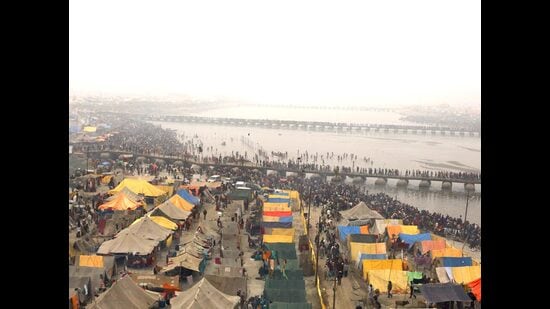
Irrigation dept boosts Ganga inflows for Mahakumbh Mela, releasing 2,000 cusecs daily from Tehri Dam and 5,000 from Narora Barrage starting December 24.
As part of the preparation for the upcoming Mahakumbh Mela, the state irrigation department has decided to ramp up inflows into the Ganga to ensure adequate water supply during the festival, which is set to begin in January and continue till March 30.
(File)
{{^htLoading}} {{/htLoading}}
The Tehri Dam has begun releasing 2,000 cusecs daily into the Ganga to augment the river’s water levels, starting December 15. Meanwhile, the Narora Barrage will release 5,000 cusecs per day downstream towards Prayagraj from December 24, according to officials. This increased water supply will continue till February 26.
Rajnish Yadav, the executive engineer (Barrage section) of the irrigation department in Kanpur, said that the department has prioritised the water supply for the festival. “Also, all the water from the Kanpur Barrage will be sent downstream to ensure an adequate flow of the Ganga during Mahakumbh,” Yadav added.
The Kanpur Barrage has been releasing significant amounts of water into the Ganga. On December 19, the barrage released 4,124 cusecs, while on December 18, it released 5,105 cusecs. The highest release of 13,865 cusecs was recorded on December 1.
{{^htLoading}} {{/htLoading}}
{{^usCountry}}
Water released from the Narora Barrage takes approximately 10 days to reach the confluence at Sangam in Prayagraj.
{{/usCountry}}
{{#usCountry}}
Water released from the Narora Barrage takes approximately 10 days to reach the confluence at Sangam in Prayagraj.
{{/usCountry}}
The river also receives water from the Ramganga River in Kannauj and the Garra River in Hardoi during the dry season. However, these rivers carry less water during the winter months.
Kanpur’s water supply requires only 40 cusecs, and the remaining water will be diverted to Prayagraj to ensure an adequate flow during the Maha Kumbh festival.
Haidar Naqvi is an Assistant Editor with the Hindustan Times in Kanpur and has been with the newspaper since May 1997, after beginning his journalism career with The Times of India. Over more than three decades, he has reported on terrorism, internal security, politics, governance and public affairs, with a particular focus on the changing nature of extremist movements in India.From 2008 to 2011, Haidar was part of the Hindustan Times National Reporting Team, contributing to coverage of some of the country's most significant security stories. He was among the reporters who covered the 26/11 Mumbai terror attacks as they unfolded and continued reporting on the investigation that exposed the conspiracy behind them.His reporting has followed the rise and evolution of the Students Islamic Movement of India (SIMI), the Indian Mujahideen and India's counter-terrorism response, alongside extensive coverage of organised crime and the underworld. He has also reported on Indian Mujahideen serial blasts, the Maoist insurgency, communal riots, parliamentary and assembly elections, and major political developments. Over the years, he has interviewed political leaders, senior police officers, intelligence officials and policymakers, while reporting from communities affected by violence, conflict and public policy.Beyond national security, Haidar has covered politics, minority affairs, governance, wildlife and human-interest stories across Central Uttar Pradesh and Bundelkhand. A recipient of the coveted Hindustan Times' Star Award, he brings historical perspective, field experience and institutional knowledge to reporting on the intersection of security, governance and society.