Raising questions over safety and durability, a crack in a crash barrier on a bridge and yet another road subsidence on a nearly 10-metre stretch on Tuesday are the latest points of concern in an expanding list of defects—from road settlements and failed repairs to cracked dividers, deteriorating concrete work and damaged culvert walls —on the ₹4,200-crore Lucknow-Kanpur Expressway, barely a month after opening to traffic.
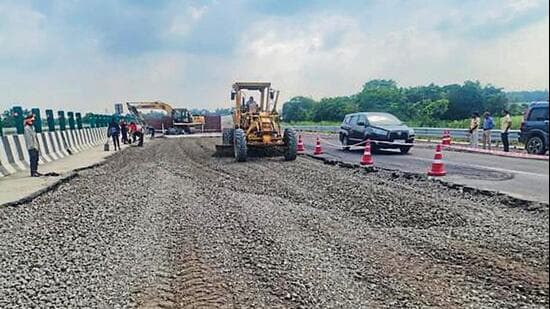
Between July 13 and August 11, road depressions, subsidence or failure of patchwork have been reported at around 45 locations along the 45-km greenfield section. More than 40 locations have already been repaired, NHAI officials said, while work was still underway at five locations on Tuesday.
On Tuesday, a nearly 10-metre stretch of the carriageway sank near Hasnapur at km 29.84.
The latest damage occurred on the Kanpur-Lucknow carriageway, where patchwork carried out at several earlier failure points has also started peeling off. With repair work underway, the movement of heavy vehicles from Kanpur towards Lucknow has been restricted at the affected stretch.
Soon after the subsidence was reported on Tuesday afternoon, the repair team reached the spot and excavated the affected portion, along with a section of the road around it, to undertake reconstruction. Officials said the stretch was repaired by late evening.
On the same carriageway, multiple locations between km 32.8 and km 33.1 are undergoing repairs after the bituminous surface started coming off at intervals. At some points, the road has been dug up to a depth of nearly one foot before being relaid.
{{/usCountry}}On the same carriageway, multiple locations between km 32.8 and km 33.1 are undergoing repairs after the bituminous surface started coming off at intervals. At some points, the road has been dug up to a depth of nearly one foot before being relaid.
{{/usCountry}}At km 33.5, nearly 150 metres of the road is also being reconstructed after the bituminous layer reportedly began peeling off.
The concerns extend to the other end of the expressway as well. At km 63.9, a stretch that had sunk three days ago and was subsequently reconstructed is already showing signs of distress. On Tuesday, the newly laid bituminous surface was found peeling off at several places. The damage is particularly visible in the middle lane, prompting authorities to allow traffic through the area with caution.
The National Highways Authority of India (NHAI), however, said corrective work was being carried out. Gautam Vishal, NHAI Lucknow regional officer and chief general manager, said the subsided portion had been repaired and patchwork had been completed at most of the affected locations.
A team from IIT Kharagpur has completed its field investigation and returned with samples, photographs and video recordings from various locations. The team is expected to submit its report within seven days.
At km 30.1 near Sohrawan, a crack appeared in the crash barrier of the bridge over Chiraiya Nala on the Kanpur-bound carriageway. The roughly three-foot-high barrier has a visible crack extending about 2.25 feet, with the damage appearing deep on close inspection.
The location has heightened concern because vehicles on the expressway can travel at speeds of up to 100 kmph. Crash barriers are intended to contain and redirect an errant vehicle and prevent it from leaving the carriageway. Any structural weakness in such a barrier could compromise its ability to perform that function during a high-impact collision, particularly on a bridge.
The NHAI, however, has maintained that the crack is old. This has raised a different question: if the defect was already known, why was it allowed to remain on a high-speed bridge without repair?
At several locations, concrete work along the median has started deteriorating, with plaster coming off and portions of crash barriers developing cracks.
Cracks have been reported around km 55.4, between km 55.5 and 55.6, and between km 44.6 and 44.7. Deep cracks have also appeared on culvert walls between km 56.4 and 56.5 and near km 53, where the adjoining road is also showing signs of settlement.
Expansion joints—critical points where bridges and culverts meet the road—have also emerged as trouble spots. Depressions have been reported at several such locations, with some developing potholes nearly two feet wide and six inches deep. Vehicles are being jolted while crossing these uneven joints.
Drainage has emerged as another concern. At km 44.7 on the Unnao-Lucknow carriageway, drainage arrangements are reportedly missing at four locations.
Road settlement has also been reported at three locations between km 49 and 60. At Ummad Kheda and Israel Kheda, patchwork carried out only two days earlier has already started coming off, raising questions about the durability of the repairs.
Between km 29.3 and 39.8, repair work is continuing at multiple points. At some locations, barricading has occupied one or two lanes, potentially affecting traffic movement on the recently opened expressway.
Gautam Vishal said: “The IIT team has returned with samples from various sites. It has collected more than 50 samples and taken photographs and videos for investigation and to corroborate the findings with laboratory tests. Advanced tests will be conducted to ensure the safety of passengers using the expressway. If anything adverse is found in the report, further action will be taken against the contractor.”