Chief minister Yogi Adityanath on Monday claimed that a part of the money Indians spend on foreign goods is eventually used to fuel terrorism and destabilise the country as he appealed to ration shop dealers to promote indigenous and locally made products through the state’s ‘Annapurna Bhavans’.
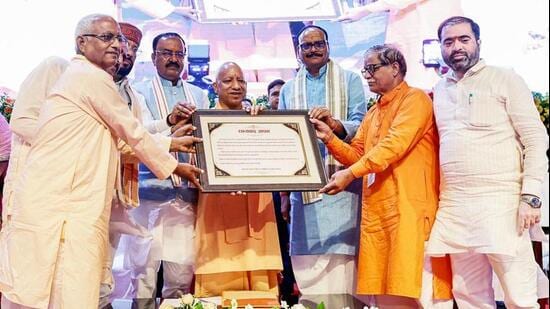
He was speaking at an event in the state capital where he launched an electronic point of sale (e-PoS)- based feedback system for fair price shop dealers under the single-stage door-step delivery system.
“When our money goes abroad, a part of it is spent against us to fuel terrorism and destabilise India,” Adityanath said.
The chief minister urged ration dealers to use their shops and warehouses not only for foodgrain distribution but also to promote local products. He said ration distribution took only seven to 10 days of the month and the warehouses could be used during the remaining period to generate additional income.
One District One Product (ODOP) items and locally made goods, he said, could be displayed and sold during festivals such as Holi and Diwali.
“Give priority to swadeshi and work towards making local global,” Adityanath said, adding that such an initiative could begin at the village level and help strengthen local artisans, craftsmen and the wider economy.
{{/usCountry}}“Give priority to swadeshi and work towards making local global,” Adityanath said, adding that such an initiative could begin at the village level and help strengthen local artisans, craftsmen and the wider economy.
{{/usCountry}}The chief minister also announced a major financial benefit for more than 78,000 fair price shop dealers in the state, increasing their margin from ₹90 to ₹125 per quintal. He said the ₹35 increase included ₹10 from the Centre and ₹25 from the state government. The state has also written to the Centre seeking another ₹25 increase, he said.
He said an average dealer received around 100 quintals of foodgrain every month. At the earlier rate, the monthly margin was around ₹12,750, which would rise to ₹16,250 at the new rate, apart from earnings from other permitted sales.
The chief minister also claimed that the public distribution system had undergone a major transformation since 2017. He said around 300 of every 1,000 complaints received during Janata Darshan in 2017 were related to irregularities in ration distribution, whereas “now not a single complaint comes”.
He credited e-PoS machines and single-stage door-step delivery with improving transparency by eliminating intermediaries between FCI godowns and fair price shops.
“Before 2017, ration cards of poor people were kept by people in power, leaving beneficiaries without food,” Adityanath alleged, without naming the previous Samajwadi Party government.
He said 15 crore people in Uttar Pradesh were now receiving free ration continuously under the Pradhan Mantri Garib Kalyan Anna Yojana.
The government, he said, had also provided free LPG connections to two crore families and electricity connections to 1.53 crore families, while 10,000 ration shops were being developed as Annapurna Bhavans.
Adityanath said the new system had also improved the image of ration dealers, who, according to him, were earlier blamed for irregularities arising from failures in the supply system. During the Covid-19 pandemic, he said, dealers continued distributing ration, including pulses, salt and edible oil, without major complaints.
The government is allowing fair price shops to sell 39 categories of items, barring intoxicating or inflammable substances and goods contrary to law and public interest.
He also linked the reforms to a broader change in Uttar Pradesh’s image, saying the state had moved from being viewed with suspicion to being seen with greater respect over the past nine-and-a-half years.
At the event, representatives of ration dealer organisations handed over a letter of thanks to the chief minister for increasing their margin.