
 E-Paper



Park Road: 900-m ‘choked artery’ in the heart of Lucknow
Wider footpaths as part of LMC project have narrowed the road, leaving vehicles struggling to move through the already high-rush zone

 Prefer HTon Google


LUCKNOW A crucial 900-metre two-lane stretch near Hazratganj has become narrower after the recent CM Grid scheme, creating daily traffic congestion and raising serious concerns about the Lucknow Municipal Corporation’s (LMC) planning. Despite the city’s Comprehensive Mobility Plan (CMP) emphasising wider, smoother roads, the upgraded footpaths and utility provisions under the project have reduced the motorable width, choking a vital link in the state capital.
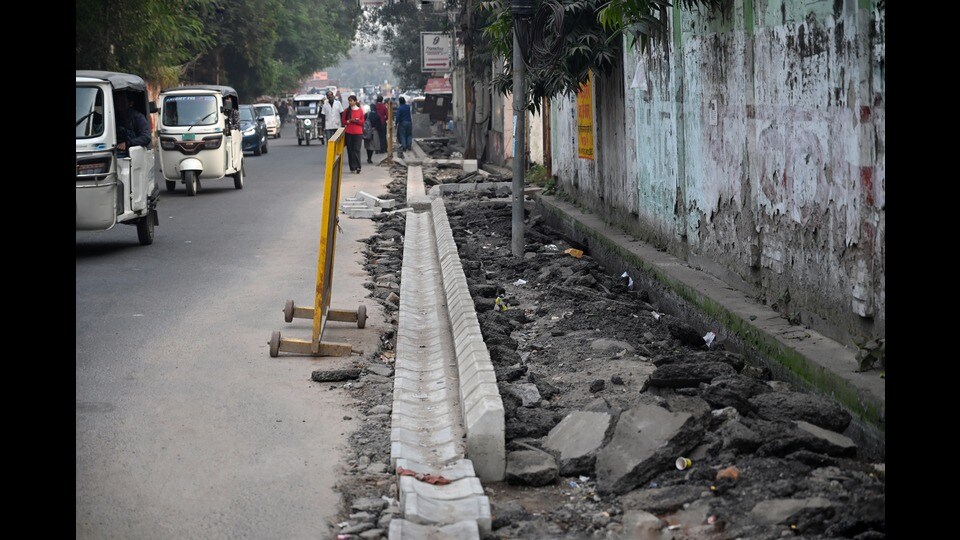
A reality check by HT on Thursday found that the Park Road stretch leading to Hazratganj’s main intersection has turned into a congested pocket since LMC constructed new footpaths. Commuters said the footpaths, now significantly wider, have shrunk the road space, leaving vehicles struggling to move through what was already a high-rush zone.
While the new infrastructure funded under the CM Grid project aims to upgrade drainage and improve pedestrian mobility, the redesigned road has become a bottleneck, especially during afternoon peak hours.
Abhimanyu, who runs a medical shop oppsite a hospital on the stretch, said broader footpaths have disrupted smooth movement. “Earlier, even a narrower footpath allowed people to walk comfortably without affecting traffic. Now, the road has lost crucial width and commuters face constant trouble,” he said.
Residents pointed out that the road serves multiple high-load purposes. It connects Hazratganj with the 1090 intersection, Narhi and adjoining localities, and also caters to emergency traffic from Dr Shyama Prasad Mukherjee (Civil) Hospital. With ambulances frequently using this route, the reduced width increases response time and poses safety risks.
“It’s a planning setback. The objective should be smooth mobility first, especially on a stretch having a hospital,” said Amit Bhargava, a resident of Narhi. He added that the new design “will force people to avoid the route altogether” once traffic pressure rises further.
The CM Grid project aims to resolve long-standing issues such as drainage failure, waterlogging, lack of pathways and poor lighting. However, residents argue that the LMC failed to balance pedestrian comfort with vehicular needs on one of the city’s busiest stretches.
They said the project should have prioritised widening the road or at least retained the existing width while improving footpaths. “A mobility plan should enhance movement, not restrict it. Here, the footpath expansion has directly led to road contraction,” said a commuter.
LMC defends design
LMC executive engineer Atul Mishra defended the project’s design, saying the stretch required new sewer lines, stormwater drains and consolidated pedestrian pathways. “We are laying new sewer lines wherever they were missing. A dedicated stormwater line is being installed. At the same time, continuous pedestrian footpaths are necessary because the road is for all,” he said.
Mishra emphasised that the project focuses on creating orderly infrastructure, including on-site parking spaces to reduce roadside encroachments. He added that the next stage will involve removing overhead electricity and telecom cables and routing them underground, which will declutter the corridor.
Despite the LMC’s explanation, commuters remain worried that the redesigned road will permanently worsen congestion on a stretch already under pressure. They fear the reduced width will hamper mobility during peak hours, hinder emergency response and add to traffic chaos in the city’s core.
As Lucknow continues to expand its mobility network, the widening gap between planning intent and on-ground experience on this Hazratganj stretch has again highlighted the need for road-first, people-centred urban design that ensures safety, efficiency, and accessibility for all.


