Even as Uttar Pradesh boasts of the country’s longest expressway network, a spate of recurring crashes involving long-distance and sleeper buses on these high-speed corridors has put vehicle fitness checks and enforcement mechanisms under sharp scrutiny.
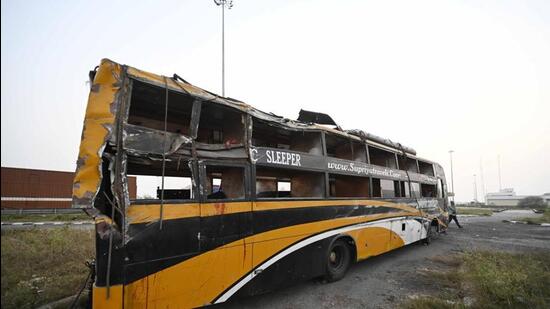
Following the mishaps, questions are being raised about whether monitoring systems have kept pace with rapid infrastructure expansion. These expressways form the backbone of inter-state bus movement between Delhi and eastern states such as Bihar and Jharkhand.
Longest network, maximum exposure
Uttar Pradesh currently has five functional expressways – Yamuna Expressway (165 km), Agra-Lucknow Expressway (302 km), Purvanchal Expressway (340 km), Bundelkhand Expressway (296 km) and Gorakhpur Link Expressway (91 km).
Roughly 800 km of this expressway network forms the principal high-speed spine used by private and sleeper buses travelling overnight from Delhi towards eastern Uttar Pradesh before crossing into Bihar and Jharkhand. Although these buses originate and terminate outside the state, the longest uninterrupted and speed-intensive portion of the journey is often covered within Uttar Pradesh, making it the key enforcement stakeholder during the most critical segment of travel.
Accidents despite controlled access
{{/usCountry}}Accidents despite controlled access
{{/usCountry}}According to official data for 2023, Uttar Pradesh recorded around 44,000 road accidents, resulting in 23,652 deaths. While expressways accounted for about 1.8% of total fatalities, lower than national and state highways, experts point out that crashes on controlled-access corridors tend to be more severe due to higher speeds and the enforcement department’s limited workforce.
Recent accidents involving double-decker sleeper buses on the Purvanchal expressways have reignited concerns over mechanical fitness and repeat violations. Rohit Baluja, president of the Road Traffic Institute, said expressways are engineered for uninterrupted high-speed travel, but that design demands stricter scrutiny of long-distance commercial vehicles. He further noted that since all buses mandatorily halt at toll plazas, these points can serve as effective enforcement nodes.
Baluja said one of the biggest gaps is the non-publication of bus codes and compliance records, which limits transparency and makes it difficult to track repeat offenders. The expert also flagged acute manpower shortages within the transport department, saying the available enforcement workforce is too small compared to the scale of traffic moving across the state’s expressway network.
Fitness and repeat violations under lens
Preliminary investigations into these recent crashes revealed that the buses had accumulated multiple challans prior to the accidents. This has prompted debate on whether repeated violations should automatically trigger stricter action, including suspension of permits or immediate seizure.
Transport commissioner Kinjal Singh maintained that regular checks are conducted, but said enforcement teams face practical constraints. Buses cannot be randomly stopped on expressways due to safety protocols and can only be inspected at designated points.
Singh also cited logistical challenges in shifting passengers immediately if overloaded vehicles are seized mid-route. However, she added that fresh directions have now been issued for seizure of serious violators.
With the expressway network set to expand to 2,654 km, the central question remains whether fitness audits and compliance enforcement are scaling up at the same pace as infrastructure growth.
Currently, five expressway projects are operational in UP, crisscrossing more than two dozen districts. The upcoming seven new expressways will interlink about 56 districts or 75% of the total 75 districts. The operational dates for these expressways are not finalised yet.
The seven proposed expressways are: Chitrakoot Link Expressway (120 km), Jhansi Link Expressway (100 km), Jewar Link Expressway (76 km), Vindhya Expressway (320 km), Vindhya Purvanchal Link Expressway (100 km), Agra Lucknow Expressway-Purvanchal Expressway Link (60 km) and Agra Lucknow Expressway-Ganga Expressway Link (90 km).