
 E-Paper



UP Diwas: From litti-chokha to Banarasi paan, UP’s flavours a big draw
Amit Shah launches ‘One District–One Cuisine’ scheme to give global identity to 75 district specialities


Union home minister Amit Shah launched the ‘One District–One Cuisine’ (ODOC) scheme at the Uttar Pradesh Diwas celebrations at Rashtra Prerna Sthal, on Saturday, marking a new push to promote and preserve the state’s rich and diverse culinary heritage.
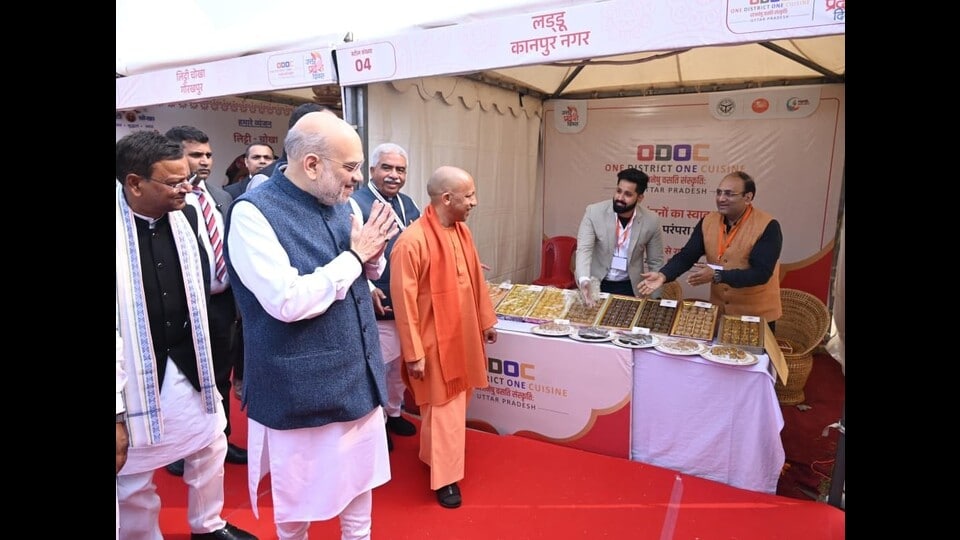
Modelled on the successful ‘One District, One Product’ (ODOP) programme, the ODOC initiative aims to identify, preserve and promote 75 traditional cuisines and food products — one from each district of Uttar Pradesh, seeking to give district-specific food and beverage specialities a distinct identity, while opening avenues for branding, employment and culinary tourism.
The ODOC food court quickly emerged as one of the biggest crowd-pullers on the opening day. Though only 35 stalls were operational — against the proposed 75 — visitors thronged the section to sample signature dishes from across the state.
A wide range of sweets and savouries showcased the culinary map of Uttar Pradesh. Lucknow offered rewdi and gajak, Auraiya presented balushahi, Agra drew crowds with its famous petha, and Unnao served kala jamun. Bareilly displayed sewaiyan and barfi, while Kanpur City’s samosas remained a popular snack. Varanasi stood out with three stalls offering Banarasi paan, tiranga barfi, kachori and thandai. Meerut’s gajak also found many takers.
One of the unique attractions was Maharajganj’s ‘Ram Katori’. Stall operator Sudish Kumar explained that the edible bowl is made from refined flour, fried in ghee and filled with khoya, a preparation that piqued visitors’ curiosity and drew long queues.
Moradabad’s famous Moradabadi dal also saw brisk sales. Vendor Sonu Kashyap said he had sold nearly 100 bowls by the afternoon. “The response has been encouraging since morning,” he said.
Interestingly, the Gorakhpur stall featured litti-chokha, a dish often associated with neighbouring Bihar. Entrepreneur Gangadhar Dube, who runs multiple outlets in Gorakhpur, said he left a career in IT to pursue his passion for food. “I started a litti-chokha van on an experimental basis. People loved it, and now it has become my full-time business,” he said.
The scheme also generated excitement beyond the venue. Ashok Kumar, MLA from Salon in Amethi district, posted on X congratulating residents of Rae Bareli after the district’s famous jalebi was included under the ODOC initiative, calling it a matter of pride for the region’s culinary identity.
Officials said ODOC is designed to go beyond exhibitions. Its objectives include documentation and preservation of traditional recipes, registration of artisans and halwais, quality standardisation, branding and marketing, and achieving national and international recognition for regional foods.
Artisans will receive training in food packaging, improving shelf life and safe transportation in collaboration with the Indian Institute of Packaging. Entrepreneurs will be encouraged to obtain FSSAI certification, and traditional vendors will be linked to e-commerce platforms. GI tagging of select cuisines is also being planned to ensure authenticity and global acceptance.
The tourism department will also promote ODOC by setting up food stalls at major tourist destinations, religious centres and festivals, offering visitors a single platform to experience Uttar Pradesh’s diverse flavours.
Building on the success of ODOP, officials said the ODOC scheme is expected to generate employment at the grassroots level, support MSMEs and give Uttar Pradesh’s traditional cuisines a wider national and global reach.


