Mumbai: In the last two weeks, as heavy rains wreaked havoc in Mumbai, the city also witnessed the fall of at least four massive trees, all seemingly healthy at the outset, leading to the death of two people and several damaged vehicles.
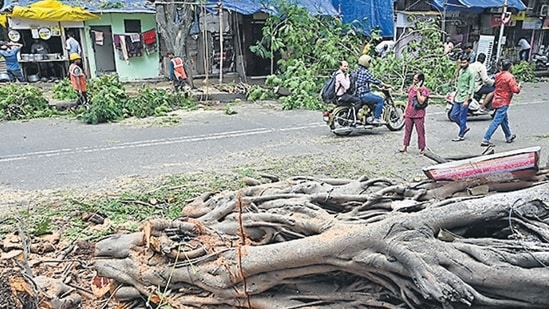
When quizzed, officials from the garden and tree department of the Brihanmumbai Municipal Corporation (BMC) admitted that the root cause of the tree falls was the rampant concretisation and road work afoot in the city.
A stage had been built near the banyan tree that killed 45-year-old Amit Jagtap on July 1 at Worli’s BDD Chawl, concretising the vicinity of its base. Another banyan tree fell in Parel the very next day, killing 57-year-old Varsha Mestri. Officials blamed road digging and using stamped concrete on footpaths for the fall of the three-decade-old tree, whose roots were covered in cement.
These are just two of the dozens of tree-fall cases in the last two weeks. At least 40 trees fell in the July 8 deluge, when Mumbai recorded its highest one-day rainfall since 2019. Fortunately, there were no reported deaths.
HT spoke to two tree experts—Vaibhav Raje, the arborist behind Treecotech, an arboriculture consultancy, and Kishor Rithe, the director of the Bombay Natural History Society (BNHS)—to understand what ails Mumbai’s trees.
{{/usCountry}}HT spoke to two tree experts—Vaibhav Raje, the arborist behind Treecotech, an arboriculture consultancy, and Kishor Rithe, the director of the Bombay Natural History Society (BNHS)—to understand what ails Mumbai’s trees.
{{/usCountry}}Concretisation
Concrete is an impermeable substance that blocks air, moisture and nutrients from reaching the tree’s roots, which in turn weakens the tree, said Raje, adding that cement, asphalt, and other road materials have the same effect.
“Concretisation does not allow the rainwater to percolate down and recharge the aquifers, which are the source for the trees to get water and nutrition from the soil,” said Rithe. Without this, the root system of trees weakens, eating into their strength. Dying a slow death, they then become vulnerable to storms and pose a danger to human life and property.
Weak roots, which do not transport vitals to the tree’s trunk, branches, and leaves, often lead to a hollow trunk. This creates the impression that the tree is sturdy, even though the internal condition says otherwise. Fungus infections can also contribute to hollow trunks; and some trees, like the cotton tree and Spathodea tree, naturally become hollow with age.
As a safeguard, in January this year, the National Green Tribunal (NGT) ordered that a one-metre radius around the base of trees be kept clear during concretisation. But this may not be enough for all trees, warned the experts. “A one-metre radius may be enough for newer trees but not for old trees with wide girth. To support thick trunks, roots spread far and wide,” said Raje.
Rithe concurred, saying that space needs to be maintained in proportion to the tree’s girth/trunk. “Some trees, over the period of their growth, require more space, which the corporation should provide by clearing off the concrete. But this is not followed,” he said. “The township plan must have soak pits of appropriate size after every 50-100 metres along both sides of the road, looking at the runoff of the rainwater. This is mostly ignored.”
Concretisation, however, isn’t the sole culprit. During road work, construction and the laying of utilities, tree roots that come in the way are hacked off mercilessly, said Raje. “This greatly affects tree health. If trimming of tree branches requires permission, why doesn’t hacking tree roots?”
Prevention
With the heavy cost that comes along with tree falls, prevention becomes necessary.
Rithe said the tree department must inspect every tree in its jurisdiction before the monsoon and identify those that pose a danger to human life or property. The branches of these trees should be trimmed, and the dead ones should be cut. Trees are more vulnerable during the monsoon season, not only because of fast winds that threaten to shake them from their base but also because rain adds to the weight of the trees, increasing the burden on their roots.
Raje recommends a risk assessment for every tree to be carried out every year. “The first part of the assessment is visual, inspecting the external tree to check its condition,” he said. “The next part uses devices to check its internal health, using sound instruments to check how much is hollow and dead wood.” The assessment grades the tree according to its risk—high, medium, or low—after which further action can be taken.
Trimming
“Trees are wiser than humans,” said Rithe. “They grow balancing their weight, upward as well as underneath. We can see the branching, but not the root system underneath.” But with the curtailment of roots, and to possibly minimise the burden of trees, they can be trimmed—with a caveat that it’s done scientifically.
To begin with, not all trees need to be trimmed, and certainly not every year, said Raje, pointing at the BMC’s tree trimming rampage before every monsoon. He also criticised the civic body for using saws to hack trees. “There is special equipment available for the selective and scientific pruning of trees. But the BMC’s contractors hack at the branches indiscriminately, leaving only some foliage at the top. This is harmful to the structure of the trees.”
Other measures to prevent tree falls include improving their nutrition and avoiding harming them.
Stay updated with all the Breaking News and Latest News from Mumbai. Click here for comprehensive coverage of top Cities including Bengaluru, Delhi, Hyderabad, and more across India along with Stay informed on the latest happenings in World News.
Stay updated with all the Breaking News and Latest News from Mumbai. Click here for comprehensive coverage of top Cities including Bengaluru, Delhi, Hyderabad, and more across India along with Stay informed on the latest happenings in World News.