With 32 of the state’s 36 districts reeling under an acute water shortage due to deficient rainfall, the Maharashtra government on Saturday declared a drought in 265 of the state’s 358 talukas (tehsils or sub-districts), accounting for 74% of the talukas. The decision was taken after the prevailing situation fulfilled the Trigger-I criteria under the Drought Management Code. According to Maharashtra’s drought manual, Trigger-I is activated when an area experiences dry spell for more than 21 days and the cumulative rainfall in June-July is below 50% and same in June-September is below 75%.
The decision was based on the agriculture commissioner’s assessment of rainfall deficiency and other drought-related indicators up to September 24.
The much-awaited government resolution (GR) was issued on Saturday, two days after chief minister Devendra Fadnavis and deputy chief minister Eknath Shinde toured some of the worst-affected villages. The GR also underscored a package of 12 measures and concessions for farmers in the affected talukas.
Also Read | Weak rains leave a trail of wilted crops, dry plots
According to the government officials, drought is officially announced only when Trigger-2 conditions are met. However, after his tour of the severely parched regions, the chief minister formally reclassified the state’s condition from ‘drought-like’ to a full ‘drought’ situation. “Trigger-2, which takes into account groundwater levels, soil wetness index, sowing percentage and the crop distress index, will be assessed after September 30,” said an official from the Relief and Rehabilitation Department.
The situation is being described as one of the worst in recent years, with comparisons even being drawn with the 1972 drought, when the state faced acute shortages of water and food grains. The state government and experts have warned that the next nine months could be a challenge if the retreating monsoon does not bring sufficient rainfall over the next two weeks.
{{/usCountry}}The situation is being described as one of the worst in recent years, with comparisons even being drawn with the 1972 drought, when the state faced acute shortages of water and food grains. The state government and experts have warned that the next nine months could be a challenge if the retreating monsoon does not bring sufficient rainfall over the next two weeks.
{{/usCountry}}After the GR was issued, Fadnavis directed respective district collectors to immediately begin on-the-spot crop damage assessments in the affected talukas. “Immediate surveys will have to be conducted in the talukas where drought-like conditions have been declared. The revenue and agriculture departments, and all other concerned agencies must work sensitively and in coordination for this purpose,” said Fadnavis, in a press statement issued by the chief minister’s office.
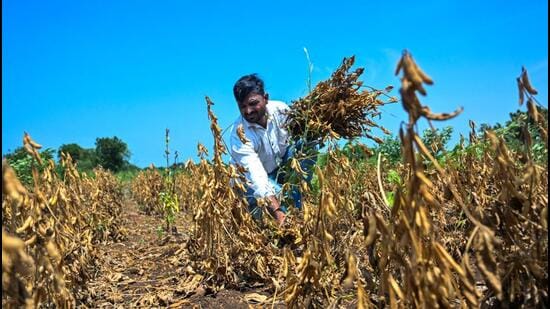
The GR, however, has not announced crop-loss compensation yet. It states that assistance to farmers for damage to kharif crops in the 265 affected talukas will be announced through a separate government decision after completion of the prescribed procedure.
Also Read | Actual aid decision for drought-hit farmers after ground-level assessment: Sunetra Pawar
Opposition speaks up
The Opposition, however, has raised questions over the implementation of the relief measures. “Apart from relief to farmers, the government should also announce relief for urban parts of the state, as inflation is bound to increase and industrial areas are also likely to bear the impact of the drought,” said Shiv Sena (UBT) leader Aaditya Thackeray.
Farm activist and former MP Raju Shetti said, “Farmers should immediately get the money. The state government had announced a relief package of ₹31,000 crore after last year’s downpour, but farmers have hardly received any of it.”
“With kharif crops destroyed and acute shortages of water and fodder, the government must provide immediate and substantial assistance, including ₹1 lakh per hectare directly into farmers’ accounts,” said Congress state president Harshvardhan Sapkal.
Also Read | Maharashtra govt must focus on drought relief now and ensure aid for every affected farmer: Aaditya
The Akhil Bharatiya Kisan Sabha (ABKS) said the announcement lacked concrete measures to provide immediate relief to farmers. “The drought declaration must not be used to keep farmers away from substantial assistance. They lost the kharif crop last year due to excessive rain and have now suffered another crop failure because of deficient rainfall, leaving them in an unprecedented financial crisis. The incentive for regular loan payers should be increased to ₹2 lakh, instead of limiting assistance to ₹50,000,” said Ajit Nawale of the ABKS.
EMBED
HL
Min stirs controversy
Cooperation minister Babasaheb Patil created a stir as he said that the actual relief may be delayed due to the technical glitches. Speaking in Pathri, Parbhani district, the minister said: “While no farmer will be left out, there are technical difficulties in distributing the assistance directly, which may take some time.
Sena (UBT) leader Aaditya Thackeray called it a “cruel joke on the farmers”.
Stay updated with all the Breaking News and Latest News from Mumbai. Click here for comprehensive coverage of top Cities including Bengaluru, Delhi, Hyderabad, and more across India along with Stay informed on the latest happenings in World News.
Stay updated with all the Breaking News and Latest News from Mumbai. Click here for comprehensive coverage of top Cities including Bengaluru, Delhi, Hyderabad, and more across India along with Stay informed on the latest happenings in World News.