Mumbai: Mechanical road sweepers, water cannons and anti-smog guns —equipment that is commonly used in India’s capital city to stave off air pollution during winters may soon become regular fixtures in Maharashtra’s non-attainment cities to fight hazardous air quality.
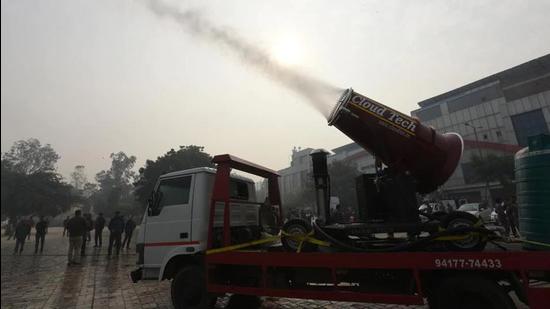
Nearly all Urban Local Bodies (ULBs) have proposed the use of these measures as part of their respective action plans to curb air pollution, officials with the Maharashtra Pollution Control Board (MPCB) confirmed.
These measures will be funded via the Centre’s National Clean Air Program (NCAP), and using funds allocated to Maharashtra at the recommendation of the 15th Finance Commission to tackle air pollution in non-attainment cities, where pollution levels exceed permissible limits as set out in the National Ambient Air Quality Standards (NAAQS).
“Some ULBs, like Navi Mumbai, are already in the tendering process to procure mechanical road sweeping machines using already received NCAP funds. All 25 non-attainment cities and 5 cantonment boards in the state have proposed to use these measures, and the protocol for the same is given in Maharashtra’s Graded Response Action Plan, which ULBs will need to start implementing at the earliest. Water sprinkling, mechanised road sweeping and anti-smog guns will be a routine action when air quality dips,” said a sub-regional officer with the MPCB stationed in the Mumbai Metropolitan Region.
While ULBs like the Navi Mumbai Municipal Corporation and the Brihanmumbai Municipal Corporation are already carrying out mechanised road sweeping to a degree, the machines being used are outdated, officials said. “We are now in the process of procuring two better machines which can have an impact on air quality. Other measures that will be implemented at a ULB level include creating green corridors along roads with heavy traffic volume, and formation of mobile response teams to patrol the city and pick out any GRAP violations,” said Abhijit Bangar, Navi Mumbai municipal commissioner.
{{/usCountry}}While ULBs like the Navi Mumbai Municipal Corporation and the Brihanmumbai Municipal Corporation are already carrying out mechanised road sweeping to a degree, the machines being used are outdated, officials said. “We are now in the process of procuring two better machines which can have an impact on air quality. Other measures that will be implemented at a ULB level include creating green corridors along roads with heavy traffic volume, and formation of mobile response teams to patrol the city and pick out any GRAP violations,” said Abhijit Bangar, Navi Mumbai municipal commissioner.
{{/usCountry}}We had reported, on December 20, the Maharashtra government’s plans to implement an emergency response system, along the lines of Delhi’s graded action plan to combat air pollution. The GRAP is a set of measures that are triggered in phases as air quality deteriorates. For example, when the Air Quality Index (AQI) in Delhi-NCR hits the ‘severe’ category, concerning municipal corporations in Delhi, Haryana and Uttar Pradesh impose bans on polluting activities such as construction, operation of cement mix plants and running diesel generators, and step-up patrolling for open burning.
For the state, MPCB has categorised air quality in four stages (from ‘moderate’ to ‘emergency’) based on the daily concentration of particulate matter pollutants PM2.5 and PM10. Activities like water sprinkling, dust sweeping and deployment of anti-smog guns will be put into action when air quality touches the ‘severe’ category for a period of 48 hours, i.e. when PM2.5 levels exceed 215ug/m3 and PM10 exceeds 431ug/m3.
“These measures fall entirely under the ‘dust mitigation’ component of city-level action plans. The other components are electrifying public transport, regulating industries and expanding on the state’s air quality monitoring network,” said the MPCB official cited above.
Sachin Panwar, an independent air quality expert certified by the Quality Council of India, said, “GRAP has had little efficacy in north Indian states, and dust control measures in particular have shown little to no measurable improvement. The focus must be on controlling pollutants at source.”
Stay updated with all the Breaking News and Latest News from Mumbai. Click here for comprehensive coverage of top Cities including Bengaluru, Delhi, Hyderabad, and more across India along with Stay informed on the latest happenings in World News.
Stay updated with all the Breaking News and Latest News from Mumbai. Click here for comprehensive coverage of top Cities including Bengaluru, Delhi, Hyderabad, and more across India along with Stay informed on the latest happenings in World News.