In a city overrun with glitz and glamour, glint and glimmer, next week will witness a celebration of a decidedly different nature: the commemoration of freedom fighter, political activist and Gandhian Dr GG Parikh, a longtime resident of Tardeo, who will achieve the high watermark of turning a hundred years old, in a life distinguished by integrity, selfless service and commitment to the greater good.
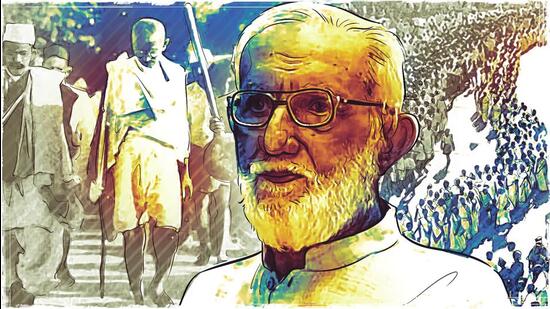
To be held at the University Convocation Hall, the evening will feature a keynote lecture by author, historian and grandson of Mahatma Gandhi, Rajmohan Gandhi, in the presence of chief guest, veteran politician Sharad Pawar and other admirers of the centenarian. It will shed light on his inspiring life and legacy.
Born in 1924, Dr Parikh, or ‘GG’ as he is affectionately referred to, was present at the August Kranti Marg when Mahatma Gandhi delivered his historic Quit India Speech in 1942, calling for a nationwide stir against British rule in India.
Organised by the All India Congress Committee, it had been a watershed moment in the freedom struggle and along with hundreds of nationalists, GG had been promptly arrested for his participation and incarcerated in a jail in Worli for ten months.
As a young man, GG’s socialist leanings and belief in Gandhi’s teachings had led him to join the Congress Socialist Party, but when it parted ways with the mothership in 1948, he departed along with his comrades, to form the Socialist Party of India, actively participating in its founding conference in Nashik and remaining a loyal soldier to the cause, right up till the time, when after many variations and modifications it had merged into the Janata Party in 1977.
{{/usCountry}}As a young man, GG’s socialist leanings and belief in Gandhi’s teachings had led him to join the Congress Socialist Party, but when it parted ways with the mothership in 1948, he departed along with his comrades, to form the Socialist Party of India, actively participating in its founding conference in Nashik and remaining a loyal soldier to the cause, right up till the time, when after many variations and modifications it had merged into the Janata Party in 1977.
{{/usCountry}}For his activism during the Emergency and his association with the firebrand leader George Fernandes, GG was arrested on October 23, 1975, making him one of those rare individuals to be at the receiving end of two extreme acts of authoritarianism, in the country’s darkest chapters.
***
When I meet him at his modest, book-cramped apartment at Grant Road, Parikh’s recollection of those heady times is still vivid. An unfortunate railway accident, sustained in his seventies, has made sitting up difficult but hasn’t prevented the stalwart from pursuing a rigorous daily activity that would put a twenty-year-old to shame.
Reclining in bed, his eyes still light up with the fire of idealism, when he recalls Gandhi’s warnings that the Congress would do well to watch out for power going to its collective head once Freedom had been achieved. “He was concerned that the White Imperialist should not be replaced by his Indian counterpart,” says GG. “But after Independence when Nehru moved into Teen Murti Bhavan, which had been built by the British as the residence of the Commander-in-Chief of the British Indian Army, I could see the writing on the wall “he says. Thus began his career in political activism and a lifetime of fighting social oppression, injustice and inequality wherever he encountered it. Even today, that zeal and outspokenness hasn’t dimmed and he refers to India’s current political scenario as ‘an undeclared Emergency’.
***
The son of a doctor, GG’s high-mindedness had been a result of the heady idealism of his era “I remember as children, we would sit for hours discussing how we would assassinate an Englishman,” he laughs “None of us had ever set eyes on one, or had any idea how we were going to achieve this goal, but because the atmosphere was rife with the heroism of Bhagat Singh, we too were inspired to think along those lines,” he says. “So, we spent hours discussing how we had to strengthen our bodies to be able to swim across mighty rivers and sleep on prison floors,” he says, with characteristic self-deprecation.
Even a few minutes spent with GG is enough to see that like all truly worthwhile individuals, he does not take himself or his achievements too seriously. Having never sought the limelight or pursued power and pelf, it is obvious that he regards the fuss surrounding his achieving centenarian status with a pinch of salt too. This disregard for self-glorification and the outward appearances of status and authority have ensured that GG never ran for office or joined electoral politics even though he had many opportunities to do so, “Real social reform can never be achieved through political power,” he tells me over his favourite lemon tea, “Real reform can only come through moral authority, the kind that Mahatma Gandhi, Nelson Mandela and Martin Luther King possessed. ”
***
Given how dear the values of socialism and Gandhi’s tenets are to GG, it is not surprising that along with his lifelong dedicated practice as a doctor, he has devoted his life to the upliftment of rural India. In 1961 when Maharashtra was being torn apart by communal tensions, he started the Yusuf Meherally Centre, named after his hero, the trade unionist and socialist leader, with the objective of integrating and uniting people.
In 1967, the Centre opened a branch in Tara, Raigad, where it functions from a 15-acre campus running a 20-bed hospital, two free High Schools (Urdu and Marathi medium), a hostel for economically- poor girl students, and various rural development initiatives. GG’s late wife Mangalaben Parikh had played a pivotal role in its setting
up and despite his age and difficulty in walking, even today GG travels the 90km journey almost daily to oversee its functioning. “Over time the centre started working on the problems that were emerging from rapid urbanisation happening in Mumbai,” he says.” We concluded that the solutions to the problems of urbanisation lie not in the cities but in the hinterland. Rural areas need to develop and have basic amenities so that people stay there. No one should have to leave their village because they have no other option, it should be the responsibility of city dwellers to ensure this,” says the stalwart, who at over six feet and clad in his usual attire of homespun khadi, is a dead-ringer for Abdul Ghaffar Khan, ‘The Frontier Gandhi,’ another icon of an altogether more exhilarating age.
Stay updated with all the Breaking News and Latest News from Mumbai. Click here for comprehensive coverage of top Cities including Bengaluru, Delhi, Hyderabad, and more across India along with Stay informed on the latest happenings in World News.
Stay updated with all the Breaking News and Latest News from Mumbai. Click here for comprehensive coverage of top Cities including Bengaluru, Delhi, Hyderabad, and more across India along with Stay informed on the latest happenings in World News.