“After witnessing the suffering that the virus has caused over the past year, I am thankful to god for saving our lives,” said the 70-year-old, who, one year on, still refuses to divulge his name for fear of being stigmatized.
The Andheri-resident and his 68-year-old wife were the first two cases of Covid-19 detected in Mumbai on March 11. They had only just returned from Dubai.
The senior citizens did not want to be named because they haven’t told members of their extended families that they tested positive for Sars-CoV-2. “We belong to a village in Gujarat and a majority of our family members still stay there. I didn’t know how they would react to us being affected by Covid-19, and I didn’t want us to get stigmatised for it. We never told them then [when it happened], and it is too late to inform them now. We’ve let it slip, we’ve let it stay under the carpet,” he said.
Last year, the husband and wife, visited Dubai and Abu Dhabi on a six-day tour with 40 other people from the state. Their flight landed at the Chhatrapati Shivaji International Airport in Mumbai on March 1 from where the group dispersed to their homes in Mumbai, Pune, Beed and Nagpur.
{{/usCountry}}Last year, the husband and wife, visited Dubai and Abu Dhabi on a six-day tour with 40 other people from the state. Their flight landed at the Chhatrapati Shivaji International Airport in Mumbai on March 1 from where the group dispersed to their homes in Mumbai, Pune, Beed and Nagpur.
{{/usCountry}}Eight days later, a couple from the same group who had taken a taxi to Pune, tested positive for coronavirus disease, making them the first two patients in the state. It turned out that the rest of the 40 were infected too.
****
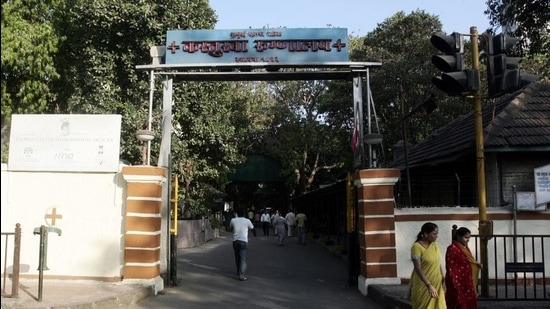
On March 10, the Brihanmumbai Municipal Corporation (BMC) made a call to the couple’s Andheri residence. The city municipal body was conducting a contact tracing exercise in an attempt to track down all the people who had travelled with the Pune couple. The officials asked the husband and wife to report to Kasturba Hospital, immediately.
The wife, already a patient of diabetes and hypertension, felt afraid. For the past three days, she had been experiencing breathlessness, cough, fever and a loss of appetite. But she didn’t hide these symptoms from the civic authorities; they made their way to the city’s only infectious diseases hospital the same day. In the afternoon, their swab samples were collected and sent to the National Institute of Virology (NIV) in Pune. The couple was put under quarantine in a hospital ward.
****
By February 2020, international flyers entering Mumbai and exhibiting symptoms were already being quarantined in the isolation ward of Kasturba hospital until their swab reports, sent to NIV, like returned negative for the virus. On February 3, the Indian Council of Medical Research, the nodal central agency overseeing the country’s response to the virus, allowed Kasturba hospital to conduct its own Covid-19 tests, making it the first civic-run testing centre in the state. However, it still needed to send its samples to NAV for confirmation of results.
“We have a state-level testing facility where we have been analysing samples such as HIV, E-coli and other viral infections for years. Once a team of experts from the central government inspected the lab infrastructure, they immediately selected us for the testing,” said Dr Chandrakant Pawar, the medical superintendent of the hospital.
The leafy campus located in Byculla had 150 beds for patients of infectious diseases, who needed to be quarantined or isolated. Of these, the hospital initially reserved 20 to quarantine possible Covid patients. Within a month, the hospital raised the number of beds to 275; till date, it has treated over 4,000 Covid patients.
That sort of scaling up was only possible, Pawar said, because the hospital recruited health care staff. “We had to get resident doctors from other hospitals. We increased the number of doctors from 8 to 30 and recruited around 200 additional nurses.”
Everyone worked round the clock. Till July, the hospital even put up their staff members in hotels and lodges in case they were worried about returning home to their families.
The 129-year old hospital is no stranger to pandemics. Established in 1892 as the Arthur road hospital or City hospital, it was built as a sanatorium for people suffering from infectious diseases. In 1896, when the bubonic plague first hit what was then Bombay, spreading through Nowroji slums in Mandvi and infecting thousands, the hospital began admitting affected patients. The medical superintendent at the time, Nasserwanji Hormusji Choksy, received a title from the British for his tireless work during this pandemic.
Later, the hospital treated patients affected by the Influenza pandemic in 1917-18, which hit the residents, particularly the poor, hard. Millions died in the city, although there are no records of how many were actually affected.
Since then, the hospital has always risen to help the city whenever it has come under attack of microorganisms. In 2009, when the H1N1 pandemic struck, the hospital was one of the main centres providing isolation wards and treatment facilities for the affected patients in Mumbai.
It’s no surprise then that the hospital’s wards are named after diseases. There’s a swine flu ward, a chickenpox ward, a jaundice ward, and even an isolation ward named after Ebola.
“The hospital has been a safe haven for Mumbai residents whenever the city has witnessed any infectious diseases outbreak. Every staff member is trained to handle such patients in sudden crisis,” said Dr Jayanthi S Shastri, in-charge of the molecular diagnostic laboratory at the hospital.
It was Shastri who received the call from NIV on March 11 confirming that the Andheri couple was Covid positive.
***
After five days of quarantine, the wife recovered, and tested negative. She was shifted to the outer wing of the ward. The husband, also a diabetic, remained in quarantine with another patient. “Though I had fever and body ache, I was feeling fine until I started vomiting on the ninth day of my quarantine. That continued for another day,” he said.
His oxygen saturation levels dropped to below 80%, but the husband didn’t require ventilator support or a stay in the Intensive Care Unit.
While both were treated with a drug combination of hydroxychloroquine, Tamiflu and Lopinavir, the husband was administered with an additional antibiotic injection since he had developed fluids in his right lung due to pneumonia.
“They were the first patients to be treated with a drug combination of hydroxychloroquine, Tamiflu and Lopinavir. Although there is no specific evidence about the effectiveness of the drugs, we used the drugs as an experiment which actually worked,” a doctor from the hospital who was involved in her treatment had told HT in April last year.
At the time of treating the husband-wife duo, knowledge about the virus and how to treat it was limited, so doctors used a combination of drugs—Tamiflu (oseltamivir or Fluvir), an antiviral used in treatment of swine flu; hydroxychloroquine, a medicine used to prevent and treat malaria; and anti-human immunodeficiency virus (HIV) drug Lopinavir. With growing research across the globe, doctors added Tocilizumab and the antiviral, Remdesivir, in the regime. Later, steroid and blood thinners were also added to the list, along with vitamins. Convalescent plasma therapy also gained popularity among doctors over the following months.
At present, hydroxychloroquine and Tocilizumab have lost its shine, but doctors still use a cocktail of other drugs for treatment.
It was only midway through their stay that the seriousness of being infected with Sars-CoV-2 dawned upon them. On March 17, a 64-year-old man, who was also admitted to Kasturba and quarantined, succumbed to the infection becoming the first casualty of the pandemic in Mumbai.
“Till then, I thought the virus is not deadly. But when I saw the ward boy carrying away the body wrapped in a white plastic bag, my heart sank,” the husband recalled. “For the first time, I felt scared.”
***
“We are either provided with the old HIV PPE [Personal Protective Equipment] kits or donated kits which are of poor quality. These don’t even cover the whole body. The upper body cover is too thin to stop any possible contact of the virus to the skin. All doctors and nurses are given proper high quality PPE,” a staffer said during a protest that a group of them had held last April. Following the protest, city mayor Kishori Pednekar also visited the hospital.
Even as Kasturba hospital grappled with the same shortage of PPE kits that health care and frontline workers around the country were facing at the start of April, the civic body converted Seven Hills, a private hospital in Marol into a Dedicated Covid Care Hospital. Later, the civic-run BYL Nair hospital was also converted into a dedicated Covid hospital. This was done to ease the burden on Kasturba and King Edward Memorial (KEM) hospital, Parel, both of which had become the ports of call for severe patients.
When experts from the central government visited the hospital in May, they observed that the hospital lacked a negative pressure room, UV lights, high-efficiency particulate air (or HEPA) filters, and an anteroom (sort of an in-between chamber) between the patient’s area and general corridor. Despite these infrastructural shortfalls, Kasturba continued to treat a large volume of patients. The footfall of suspected Covid-19 patients in the hospital’s outpatient department that once ranged at 1,200 on an average a day has now fallen to 50.
Last month, the BMC declared that it would make a separate building with a 150-bed facility in preparation for another pandemic.
“We need a state-of-the-art hospital for infectious diseases, so we would try to make a centralised hospital for future usage. The new building will have all advanced facilities for immediate usage of patients,” said Suresh Kakani, additional commissioner, BMC, while speaking during the budget announcement.
***
On March 24, the husband and wife were discharged. They had spent 14 days at the hospital. When they returned home, neighbours came forward to help them get down from the ambulance.
“The hospital staff was extremely kind. After we got back home, we were still very weak. Our neighbours carried me on a plastic chair to the house. I was down with a stomach infection and my husband used to get breathless. It’s our neighbours who gave us food for a week until we improved,” said the wife.
“On the first day of our quarantine, the ward had only 20 beds. But when we left 14 days later, the ward had more than 50 beds with around 25 suspected patients,” the husband said.
The couple’s children, a daughter and son, live abroad and could not visit as all international and domestic flights had been shut down.
As it turns out, the daughter, a resident of Singapore now, had interned at Kasturba hospital as a medical student two decades ago. “My daughter said we were in the best hands and I shouldn’t worry,” the 70-year-old said.
Stay updated with all the Breaking News and Latest News from Mumbai. Click here for comprehensive coverage of top Cities including Bengaluru, Delhi, Hyderabad, and more across India along with Stay informed on the latest happenings in World News.
Stay updated with all the Breaking News and Latest News from Mumbai. Click here for comprehensive coverage of top Cities including Bengaluru, Delhi, Hyderabad, and more across India along with Stay informed on the latest happenings in World News.