Mumbai: More than half of Mumbai’s slum land is in the redevelopment pipeline.
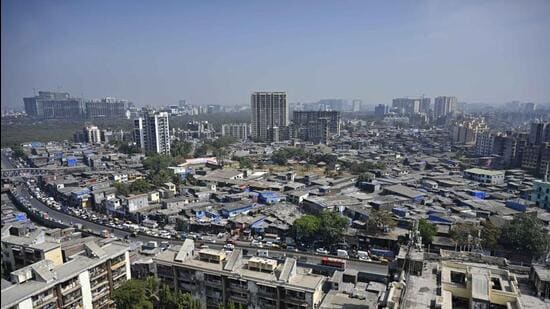
Data accessed by HT from the Slum Rehabilitation Authority (SRA) shows that projects covering 2,751 acres of land—an area larger than the Mumbai Port Authority’s (MbPA) total land bank (2,333 acres) and almost as large as the Navi Mumbai International Airport (2,866 acres)—are either under construction or stalled, underscoring the unprecedented scale of the city’s slum redevelopment drive.
The 2,751 acres account for 56.35% of Mumbai’s total 4,882 acres of slum land. Of this, 2,156 acres are actively being redeveloped, while projects spanning 595 acres have stalled. The slum area under redevelopment is nearly eight times the size of London’s Hyde Park (350 acres) and more than three times New York’s Central Park (843 acres).
“There is a huge spurt in the number of projects as well as the total acres under redevelopment,” said Pankaj Kapoor, founder and managing director of real estate research company Liases Foras. “This has happened due to multiple factors, including policy interventions favouring revamp of such colonies, a dearth of land availability within Greater Mumbai limits, the opportunities Mumbai’s real estate provides, and most importantly, several of the slum colonies are on good and premium locations.”
There are currently 1,202 active redevelopment projects involving 321,858 hutments across Mumbai. These projects account for 44.16% of the city’s total slum land. There are also 271 stalled projects, involving 89,153 hutments. Together, active and stalled projects cover 56.35% of Mumbai’s slum land.
{{/usCountry}}There are currently 1,202 active redevelopment projects involving 321,858 hutments across Mumbai. These projects account for 44.16% of the city’s total slum land. There are also 271 stalled projects, involving 89,153 hutments. Together, active and stalled projects cover 56.35% of Mumbai’s slum land.
{{/usCountry}}Significant risks
Kapoor cautioned that the pace of redevelopment also brings significant risks. “Going by the historic numbers, usually, 20-25% of the real estate projects get stalled. However, in the case of slum revamp ones, the rate of stalled projects is higher. This indicates an unsafe and risky horizon ahead,” he said.
A careful look at the data reveals that the 271 stalled projects have relatively sparse slum concentrations. Regulations permit free-sale components proportionate to the eligible shanties. “Perhaps, that could be one of the reasons for the higher number of stalled projects, as these may have become unfeasible for the developers,” said Kapoor
Even as redevelopment gathers pace, thousands of families continue to await rehabilitation. There are around 285,000 slums spread across 607 proposed projects, covering 1,015 acres. In comparison, in the 30 years since the SRA was established in 1995, 631 projects covering 556 acres have been completed, resulting in the rehabilitation of 294,000 families. The future of another 309,989 hutments spread across 560 acres still remains undecided.
Social activist Medha Patkar, founder of the Ghar Bachao Ghar Banao Andolan, welcomed the unprecedented scale of redevelopment but stressed that the process must remain centred on residents’ rights. “People in the slums should first be provided permanent accommodation, which the law already permits. However, the rent paid during project implementation should match micro market standards,” she said.
Patkar also said her organisation frequently receives complaints from slum dwellers alleging that structures are demolished without verification of eligibility documents. “People residing in such colonies are an integral part of Mumbai’s economy. Hence, the eligibility cut-off date should also be extended from the current January 1, 2000,” she said.
‘Slum-free Mumbai’
The redevelopment drive is part of the Maharashtra government’s push towards creating a “slum-free Mumbai”. The SRA currently has 607 projects in the pipeline, including 19 cluster redevelopment schemes, each spanning at least 50 acres.
The first of these cluster redevelopment projects has already been awarded to Reliance Industries’ real estate arm, Reliance 4IR Realty Development Ltd, in partnership with Mahadev Realtors from the Aspect Group. The project, located at Juhu Lane-Gilbert Hill in Andheri West, spans 101.36 acres and involves the rehabilitation of more than 28,000 slum dwellers.
Calling the project a landmark in Mumbai’s redevelopment journey, SRA chief executive Mahendra Kalyankar said, “The Juhu Lane’s slum cluster’s successful tendering process marks a watershed moment in Mumbai’s redevelopment journey. The enthusiastic participation of leading corporate groups is a strong endorsement of the government’s vision and the credibility of the SRA’s redevelopment framework. This project will become a model for future cluster redevelopment projects across Mumbai.”
The momentum is expected to continue. Three more cluster redevelopment proposals have already been submitted to the state government for approval. These include projects at Antop Hill spanning 450 acres, Majaswadi in Jogeshwari East covering 260 acres, and Behrampada in Bandra East spread across 140 acres, signalling that Mumbai’s largest-ever slum redevelopment exercise is poised to expand even further.
“With multiple rehabilitation and reconstruction projects progressing simultaneously, we are witnessing a decisive shift towards a more structured and scalable redevelopment model. Cluster redevelopment has the potential to address long-standing issues associated with fragmented redevelopment by enabling better planning, modern infrastructure, wider roads, enhanced social amenities and improved quality of life for residents,” said Shraddha Kedia-Agarwal, director, Transcon Developers.
“As policy support strengthens and approvals become more streamlined, we expect greater participation from credible developers, ultimately accelerating the pace of housing delivery and inclusive urban renewal across the city,” she added.
Rajiv Agrawal, promoter and co-founder of Saarathi Realtors & Associates, involved in over 15 slum redevelopment projects, said, “For years, SRA was the sole nodal agency, which often led to limitations in scale and pace. After policy amendments, including cluster redevelopment, the government aims to actually make Mumbai slum free and unlock hundreds of acres of underutilised land.”
Stay updated with all the Breaking News and Latest News from Mumbai. Click here for comprehensive coverage of top Cities including Bengaluru, Delhi, Hyderabad, and more across India along with Stay informed on the latest happenings in World News.
Stay updated with all the Breaking News and Latest News from Mumbai. Click here for comprehensive coverage of top Cities including Bengaluru, Delhi, Hyderabad, and more across India along with Stay informed on the latest happenings in World News.