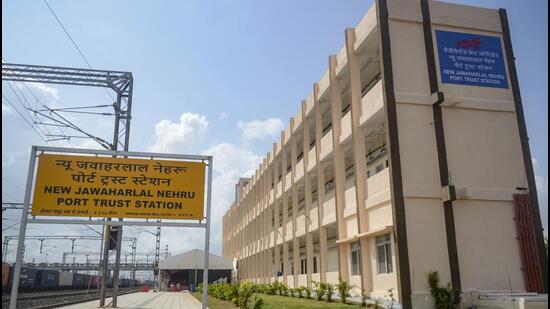
URAN: Prime Minister Narendra Modi on Tuesday commissioned the final three sections of the Western Dedicated Freight Corridor (WDFC), which connects New Dadri in Uttar Pradesh with New JNPT in Maharashtra, providing the Jawaharlal Nehru Port Authority (JNPA) with a direct dedicated freight connection to north India.
Speaking on the occasion, he said, “Earlier, passenger trains and goods trains ran on the same track. The DFC has changed this…This corridor, these goods trains – fuel is saved, fare is saved, time is saved and the environment benefits.”
The prime minister inaugurated the three sections – New Saphale-New JNPT, New Umbergaon-New Saphale and New Sanand (North)-New Makarpura, together covering 326 km and costing ₹20,700 crore – from Vadodara via video conferencing. Maharashtra Governor Jishnu Dev Varma, Chief Minister Devendra Fadnavis and Deputy Chief Ministers Eknath Shinde and Sunetra Pawar were present at the inaugural event at JNPA.
With the commissioning of the three sections, India’s 2,843-km Dedicated Freight Corridor (DFC) is now operational, comprising the 1,506-km western corridor and 1,337-km eastern corridor. The corridors now carry around 443 freight trains daily.
“Today, the Eastern and Western DFC have become the main foundation of the country’s trade. They are the lifeline for accelerating the journey towards a Viksit Bharat,” Modi said. He described completion of the two corridors as a historic achievement for 21st-century India and linked it to his Gati Shakti push for faster connectivity.
{{/usCountry}}“Today, the Eastern and Western DFC have become the main foundation of the country’s trade. They are the lifeline for accelerating the journey towards a Viksit Bharat,” Modi said. He described completion of the two corridors as a historic achievement for 21st-century India and linked it to his Gati Shakti push for faster connectivity.
{{/usCountry}}The prime minister said that the freight corridor had brought down the time taken to cover 100 km from about 6.5 hours to nearly half – cargo that would take around 30 hours by truck could, in suitable cases, move through the dedicated corridor in 10-12 hours, he noted.
Faster freight movement would help farmers by allowing fruits, vegetables, flowers and other perishables to reach markets on time, Modi said, referring to a double-stack train between JNPA and Vadodara, which carries cargo equivalent to more than 250 trucks.
Fadnavis described the commissioning as a “revolution in the country’s logistics sector” and said that JNPA would benefit the most.
“Cargo that used to take three days will now move in around 12 hours,” he said. The nearly one-km-long double-stack trains would also reduce fuel consumption, pollution and road congestion.
Fadnavis put India’s logistics cost at about 14% of the GDP against 7% in China and said it had fallen to around 10% over the past decade. With the DFC, he said, logistics costs could come down to nearly 7%, helping India compete with China and participate more strongly in global supply chains.
“This is very important for Maharashtra. Its last destination is JNPT,” Fadnavis said, adding that the port would be able to handle more than one million TEUs (twenty-foot equivalent units). Export-oriented industries in Maharashtra would become globally competitive and generate large-scale employment, he said.
‘Only files were moving earlier’
Attacking previous governments over delays in the DFC, conceived in 2004, Modi claimed that not even one kilometre of the project had been completed when his government assumed power in 2014. He also claimed that had the country continued to be run in the same manner, the work might not have been completed even after “three or four generations”.
Modi said that although a special company was formed in 2006 to execute the project, until 2014, the files merely shuttled back and forth, from one table to another.
“The files were not fortunate enough to get a dedicated corridor. They remained stuck, hanging and wandering,” he said. Completion of the DFC was proof that the country’s “work culture” had transformed over the past 12 years, he noted.
Modi also took a swipe at Congress leader Rahul Gandhi’s “Chhatron Ki Goonj” campaign, referring to it as “jhooth ki goonj” (echo of lies). Modi said those trying to mislead people through the “echo of lies” could be found at every street corner, but India’s youth would move forward with the “resounding call of truth”.
Stay updated with all the Breaking News and Latest News from Mumbai. Click here for comprehensive coverage of top Cities including Bengaluru, Delhi, Hyderabad, and more across India along with Stay informed on the latest happenings in World News.
Stay updated with all the Breaking News and Latest News from Mumbai. Click here for comprehensive coverage of top Cities including Bengaluru, Delhi, Hyderabad, and more across India along with Stay informed on the latest happenings in World News.