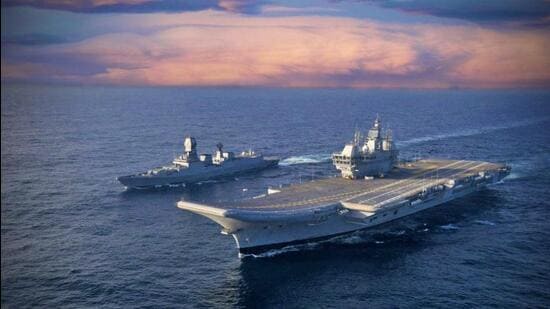
Prime Minister Narendra Modi’s vision to incorporate Chhatrapati Shivaji’s naval ensign, Akshoni, in the INS Vikrant, is fitting as the Maratha warrior was the first ruler in medieval Indian history to create indigenous warships.
We need to go a little before Shivaji’s time to put his vision in perspective. Through the 16th and early 17th century the Portuguese, Dutch and the British arrived in India via the sea and ended up colonising the region. Imagine the time – Europeans staking claim to a land, bartering it among themselves, while the voiceless locals thrown into bewilderment. The local people had no armoury to either protect themselves or to stop the Europeans from entering their land.
It was in the backdrop of this that, in the 17th century, Shivaji Maharaj declared the creation of a naval fleet that would mark a new beginning for the Marathas. He used the local population – Hindus as well as Muslims – to train under Portuguese engineers hired by him, to create a sophisticated fleet — it started with 10-15 small and mid-sized ships and expanded over the next 15 years to a full-fledged flotilla of 350 ships.
Special among his warships was Sanghameshwari. It was designed such that it could trawl through the shallows. The much-bigger British ships, on the other hand, had to remain in the deep sea. They could not chase away Shivaji’s warship. So, it was easy for Shivaji’s army to attack them and get away. Following a defeat in 1679, the British governor wrote to the East India Company trust at the time speaking about Shivaji’s naval power. He has ships, he wrote, “that can go where we cannot go”.
{{/usCountry}}Special among his warships was Sanghameshwari. It was designed such that it could trawl through the shallows. The much-bigger British ships, on the other hand, had to remain in the deep sea. They could not chase away Shivaji’s warship. So, it was easy for Shivaji’s army to attack them and get away. Following a defeat in 1679, the British governor wrote to the East India Company trust at the time speaking about Shivaji’s naval power. He has ships, he wrote, “that can go where we cannot go”.
{{/usCountry}}Two instances illustrate how Shivaji used his naval fleet. In 1665, Basrur in Karnataka was ruled by a local noble Shivappa Naik. After his death, a Portuguese captain Manuel Silvera attacked Basrur. The queen turned to Shivaji for help, calling him her brother. Shivaji attacked the Portuguese led by Silvera, with a fleet of 85 warships and a naval force of 3,000 on February 8, 1665, and defeated the Portuguese.
In 1679, Shivaji planned to build a fort in Khanderi very close to Bombay but when his men started constructing the fort, the British, under Lieutenant Francis Thor, attacked the Marathas but were defeated. It was at this time that the Marathas deployed Sanghameshwari. The Anglo-Maratha war continued over three to four months even as the fort was being constructed alongside. Twenty Englishmen were captured by the Marathas in this battle.
After Shivaji’s death in 1680, his sons Sambhaji and Rajaram took the Maratha flag forward. Kanhoji Angre was made the naval chief in 1693 by Chhatrapati Rajaram, and he controlled Konkan from 1693 to 1730. He fought several wars with the Dutch and the English, defeating them every time. It is in his memory that the Bombay Port Trust is called the Kanhoji Angre Trust. The new naval insignia is, therefore, befitting of that rich maritime heritage.
(Pandurang Balkawade is a well-known historian and secretary of Bharat Itihas Sanshodhak Mandal, Pune)
Stay updated with all the Breaking News and Latest News from Mumbai. Click here for comprehensive coverage of top Cities including Bengaluru, Delhi, Hyderabad, and more across India along with Stay informed on the latest happenings in World News.
Stay updated with all the Breaking News and Latest News from Mumbai. Click here for comprehensive coverage of top Cities including Bengaluru, Delhi, Hyderabad, and more across India along with Stay informed on the latest happenings in World News.