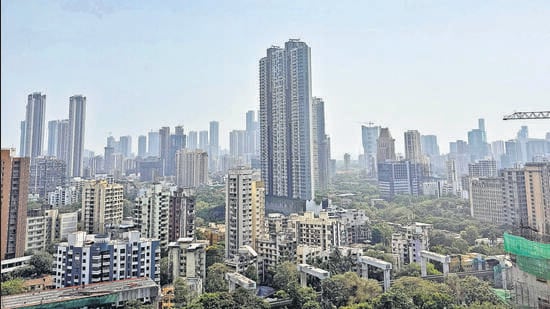
MUMBAI: Mumbai is in the throes of a ‘quickie’ orgasm. Shiny cars whizzing over viaducts, linkways and crown-jewel coastal road, all conveying the illusion of having arrived at the future. However, as it turns into an ‘elevated’ city, the roads below sink deeper into squalor. Civic hopes get buried under the broken pavements, garbage and encroachments. Less obviously and more irreplaceably, history too.
PREMIUM
Mumbai, India - May 9, 2026: Top View of Parel in Mumbai, India, on Saturday, May 9, 2026. (Photo by Anshuman Poyrekar/Hindustan Times) (Anshuman Poyrekar/HT Photo)
{{^htLoading}} {{/htLoading}}
All roads have a back story, but some are custodians of a broader sweep. The past, colonial
Acharya Donde Road, named after the teacher and labour leader, now stands in the shadow of the Sewri-Worli Connector. Yet the road remains a corridor of layered histories
My epiphany came from a Khaki tours walk, revealing the multi-layered significance of my hitherto despaired-of address. It offers Raj glory and native munificence; industrial gallop and trade-union reins; 1680 fort and 6th century statuary. This surely is the urban equivalent of Thomas Gray’s ‘Full many a gem of purest ray serene, the dark unfathomed caves of ocean bear.’ The ‘elegy’ has a ‘churchyard’ too, the serene, 1865, still-functioning, 40-acre old European Cemetery; our own poet Dom Moraes rests here, along with the graves of Gateway of India architect George Wittet, an enclave for the Silesian padres of Don Bosco -- and one devoted to the Italian prisoners of WWII.
Knowing Acharya Donde
{{^htLoading}} {{/htLoading}}
For starters, my ‘Acharya Donde who?’ snobbery beat a blushing retreat to discover how worthy this teacher, labour-movement pioneer, civic leader was of the renaming honour.
An imaginative street design could reveal the road’s secular and sacred built legacy, the cultural and militant ethos of the mills that gave Mumbai its name, fame and future real-estate bonanza. Collectively, its marvels dwarf the imminent hi-tech giant above. Along with our admirable revival architects, Bharat Gothoskar and his Khaki team should be coopted to share their engaging facts and anecdotes. It would have to be more substantive than the evocative etchings commissioned by Pranav Naik on the ‘One Green Mile’ flyover pillars of Lower Parel.
Working-class institutions, including Haffkine’s plague research legacy.
Acharya Donde Road was the former ‘Queensway’, ‘consort’ of the grander Kingsway (now Ambedkar Road). Albert Edward, Prince of Wales (the same King Edward of KEM hospital), was the first British royal to visit this area – crowned by the Governor’s residence -- at the start of his 1875-76 India tour. He then ‘took the train’ to Poona from Parel station.
Obscured memories
{{^htLoading}} {{/htLoading}}
The first horse-drawn trams rumbled from what’s still locally called Parel TT (tram terminus) to Colaba; the Poybawdi School perpetuates the well and trough built to water the steeds – 900 of them! It was also the first well opened to Dalits, courtesy the efforts of Dr Ambedkar. The horse-power of the mills remains in the signature chawls, now occupied by the descendants of the migrant thousands whose sweat had spun the city of gold.
The community life and shared struggles had coalesced into the ‘Girangaon’ culture which sustained trade-union activities. Parel served as a key centre during the defining 1928 general strike with meetings, protests, and strategy sessions within its neighbourhoods. You might still hear the phantom slogans amidst historic Kamgar Maidan’s now-passion, cricket.
{{^htLoading}} {{/htLoading}}
You might still hear the phantom slogans amidst historic Kamgar Maidan’s now-passion, cricket.
Mumbai’s iconic hospitals were built for this working-class neighbourhood. KEM & GS Medical College; the two Jerbai Wadia bequests for women and children; close by, arguably best-known example of Parsi visionary munificence, the Tata Memorial Centre. More complex than cancer’s attack is the place from where Ukrainian-French Waldemar Haffkine’s vaccine finally subjugated the 1896 Bombay plague epidemic -- 13th century Parali Vaijanath temple to 1719 Franciscan monastery to Governor’s Hornby’s ‘Sans Pareil’ mansion to present bio-centre.
{{^htLoading}} {{/htLoading}}
Giving life, not just saving it, is the National Institute of Reproductive Research. Amidst these greats, the unsung Haji Bachooali hospital began in 1914 as a chawl clinic by three doctors to provide eye care to the poor for a token one rupee. A moo away, the Bai Sakarbai Petit Animal hospital --veterinary college attached—treats 10,000 creatures big and small each year.
Most spectacular and least visible is the sacred trove of Parel village tucked behind the rockface flanking Acharya Donde Road. Since the top of this Golanji Hill will be at eye-level of those zipping down the new SWL, their attention can be drawn to its unique statuary – providing salutary distraction from the tenements clinging to the edge.
{{^htLoading}} {{/htLoading}}
Of greatest antiquity is the 5th/ 6th century, three-metre high, monolithic bas-relief of Shiva’s saptamurti form. It emerged in late 1931 during the laying of the pucca road from Parel TT to Sewri (Shivadi). On the insistence of locals, it was enshrined in the area’s simple Baradevi temple, not carted off to a grand museum. Shiva and Shakti in symbolic form grace the nearby Vaijanath mandir, a union of linga and yoni representing the oneness of male and female. Matted-mane lions repose in 13th-century Chandika Temple; even, a cenotaph precursor, a Veergal honouring fallen warriors. The hill’s forested past is marked by the Wagheshwari temple with its devi astride a fierce tiger-like form.
The hill’s forested past is marked by the Wagheshwari temple with its devi astride a fierce tiger-like form.
The signage could show that the area’s protectors are not only divine. Sewri Fort, 1680 stands sentinel top the equally steep black precipice rising from the opposite side of Acharya Donde Road. The British built it to safeguard their dowry acquisition from relentless attacks by the sea-faring Siddhis.
{{^htLoading}} {{/htLoading}}
Signposting this rainbow heritage would uplift the area’s low-end reputation. Bring lost pride to the struggling old residents. Give pause to the disdainful arriviste in their gated ivory towers. Add more truth to the blandishments offered by the builder barons now rushing here to seize the sudden connectivity. Newish municipal commissioner, her F South satrap, corporator and MLA-LAD fund could turn this into an innovative showpiece. Renewal is less demanding than ‘redevelopment’. Prettier too.
All Access. One Subscription.
Get 360° coverage—from daily headlines to 100 year archives.