Assam and Arunachal Pradesh governments on Wednesday agreed to set up district level committees headed by cabinet ministers to end the decades old border dispute between them in a time-bound manner—a move similar to the one Assam and Meghalaya had agreed earlier.
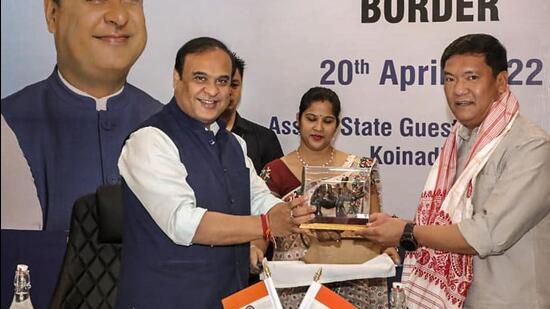
The decision was taken at the second official meeting on the issue between Assam chief minister Himanta Biswa Sarma and his Arunachal Pradesh counterpart Pema Khandu in Guwahati. Senior ministers and bureaucrats of both states were also present.
Also Read | Trying to solve border issues made by Cong’s unplanned creation of NE states: Assam CM
“We decided to form district-level committees in both states to resolve the issue in a time-bound manner. The district committees will undertake joint surveys in the disputed areas to find tangible solutions to the long-pending issue based on historical perspective, ethnicity, contiguity, peoples’ will and administrative convenience of both states. We have also finalised the terms of reference of the committees,” Sarma tweeted after the meeting.
Khandu said that the meeting was very fruitful and there was positive enthusiasm from both sides. Wednesday’s meeting was the second one after both chief ministers met in January this year and initiated preliminary talks for sorting out the decades old dispute.
{{/usCountry}}Khandu said that the meeting was very fruitful and there was positive enthusiasm from both sides. Wednesday’s meeting was the second one after both chief ministers met in January this year and initiated preliminary talks for sorting out the decades old dispute.
{{/usCountry}}“The positive enthusiasm for resolution on both sides is very encouraging. Grateful to Prime Minister Narendra Modi, union home minister Amit Shah for their guidance and Assam chief minister Himanta Biswa Sarma for his proactive and positive leadership from the Assam side,” Khandu tweeted.
Giving more details of the meeting, Assam border affairs minister Atul Bora said that the same formula used to resolve the border dispute with Meghalaya will be followed with Arunachal Pradesh.
“There are 123 villages along the border between Assam and Arunachal which are in dispute and claimed by the latter. We decided to form 12 committees in each state. These committees would conduct joint visit to all disputed areas and try and find resolution based on the terms of reference,” said Bora.
Assam shares an 804 km-long boundary with Arunachal Pradesh. Though there was no dispute initially, over the years allegations of residents of one state encroaching land on the other have led to disputes and violence. A suit has been pending in the Supreme Court since 1989 on the issue.
Last year, following the insistence of both Prime Minister Narendra Modi and union home minister Amit Shah, both states had resolved to settle their border dispute out of court through talks.
The border dispute between the two states has its genesis in 1873 when the British started the inner-line regulation creating an imaginary boundary between the plains and hills areas north of Assam. The inner-line regulation, which still exists, requires people from outside Arunachal Pradesh to take permits before entering the state.
This area ‘separated’ from Assam was initially called North East Frontier Tracts and later North East Frontier Agency (NEFA). It was under the administrative jurisdiction of Assam post-Independence.
In 1972, NEFA was renamed as Arunachal Pradesh and granted status of union territory and it became a full-fledged state in 1987. But before it got its present boundaries, a committee headed by former Assam chief minister Gopinath Bordoloi transferred around 3650 sq km of territory, which was earlier with NEFA, to Assam.
This transfer done without consultations with the people or administration of NEFA is the prime bone of contention between both states as Arunachal Pradesh doesn’t recognise it.
Last month, chief ministers of Assam and Meghalaya inked a deal in New Delhi in the presence of union home minister Amit Shah to resolve 6 of the 12 points of dispute along their border.
The agreement between Assam and Meghalaya, which favours a give and take formula, was formulated after both states created several committees comprising ministers, visited the disputed areas and interacted with residents. As per the deal, Assam will get 18.51 sq km of the total 36.8 sq km disputed area while Meghalaya will get 18.29 sq km.
Besides Meghalaya and Arunachal Pradesh, Assam has border disputes with Mizoram and Nagaland, states which were created from it.