
 E-Paper



Bijapur encounter: Bodies of 6 more Maoists found; toll rises to 18
According to police, 16 out of the 18 slain Maoists have been identified as senior cadres, collectively carrying a reward of ₹1.30 crore

 Prefer HTon Google


Six more bodies of Maoists were recovered on Thursday following an encounter with security personnel in Chhattisgarh’s Bijapur district, taking the toll to 18, officials said.
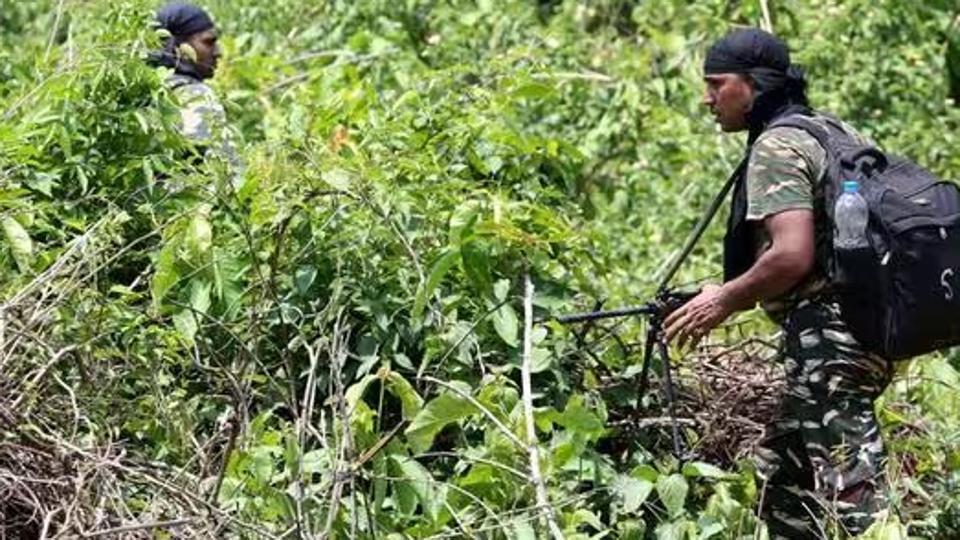
Three personnel of the District Reserve Guard (DRG) were also killed in the exchange of fire that erupted on Wednesday.
According to police, 16 out of the 18 slain Maoists have been identified as senior cadres, collectively carrying a reward of ₹1.30 crore.
Inspector general of police (IGP) Sundarraj P said the bodies of 12 Maoists were found till late Wednesday evening after prolonged intermittent firing between security forces and Maoists. When the firing stopped on Thursday morning, six more bodies were recovered during the search operation.
Also Read:Chhattisgarh: 12 Maoists, 3 DRG jawans killed in gunfight along Bijapur–Dantewada border
The encounter began around 9am on Wednesday in the forests of Kachilwar and Potenar villages and continued till 8am on Thursday. The joint operation involved personnel from DRG Dantewada, DRG Bijapur, Special Task Force (STF) and CoBRA, and was launched based on intelligence inputs about the presence of Maoists of the West Bastar Division and PLGA Company No. 2 in the region.
“Our security forces bravely retaliated to the Maoists’ firing, but unfortunately, three jawans of DRG Bijapur were martyred in action,” the IG said.
The deceased were identified as head constable Monu Vadadi, constable Dukaru Gonde and jawan Ramesh Sodhi, all residents of Bijapur district.
Three injured security personnel — ASI Janardan Korram, constable Somdev Yadav and constable Rammlu Hemla — were airlifted to Raipur for treatment and are stated to be out of danger.
Among the Maoists killed was Modiyami Vella, commander of PLGA Company No. 2, who was involved in at least 44 major Maoist incidents, including the 2013 Jhiram Valley attack, the 2020 Minpa ambush and the 2021 Tekalgudem attack. Police said he carried a reward of ₹8 lakh on his head. Fifteen other slain cadres carried a reward of ₹8 lakh each, while the identity of the remaining two is yet to be established.
A large cache of weapons was recovered from the encounter site, including one Light Machine Gun (LMG), four AK-47 rifles, four SLRs, one INSAS rifle, two .303 rifles, four single-shot rifles, two Barrel Grenade Launchers (BGLs) and one muzzle-loading rifle. Radio sets, scanners, multimeters, hand grenades, safety fuses, Maoist literature, uniforms, medical items and other materials were also seized.
IG further said coordination between police, security forces and stakeholders has intensified operations against the remaining Maoist hideouts.
“Our goal is clear, which is a peaceful and Naxal-free Bastar. Under current circumstances, the Maoist organisation is completely cornered and has no option but to abandon violence and return to the mainstream,” he said.
-kW0H-U20214218012MgB-250x250%40HT-Web.jpg)


