Gurugram’s civic woes — ranging from chronic waterlogging and traffic congestion to sewer overflows and damaged roads — are rooted in “fragmented governance” and “centralisation of powers,” according to experts and activists.
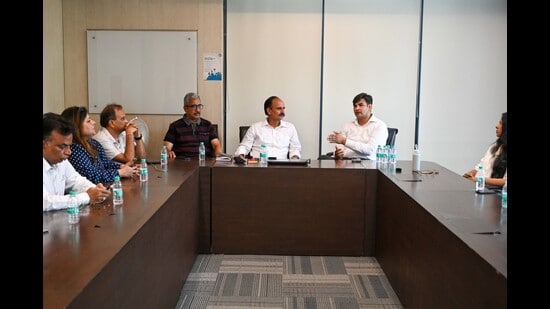
Resident discuss their views during the Gurugram Civic Lab meet on Sunday. (Parveen Kumar/HT)
{{^htLoading}} {{/htLoading}}
The concerns were raised during the “Gurgaon Civic Lab – All Hands Meet”, a civic policy discussion initiative organised by Mission 7374 Foundation, a think tank, in collaboration with Dwarka Expressway Gurugram Development Association (DXPGDA) and Digital Futurists, a community of tech experts,, on Sunday.
Speaking at the event, Mission 7374 Foundation president Gaurav Malik said Gurugram’s problems could not be solved only through flyovers, drains or construction projects. “The real issue is governance architecture. Unless Mayors and Councillors are given financial and administrative powers, every infrastructure reform will remain incomplete,” Malik said.
He said that although the 74th Constitutional Amendment Act of 1992 gave constitutional recognition to Urban Local Bodies, most municipal institutions continue to function with limited authority while major policy and financial powers remain concentrated at the state government level.
{{^htLoading}} {{/htLoading}}
{{^usCountry}}
Civic activist Sunny Singh Daultabad explained how the city’s rapid growth through industrialisation had significantly outpaced governance capacity over the past four decades.
{{/usCountry}}
{{#usCountry}}
Civic activist Sunny Singh Daultabad explained how the city’s rapid growth through industrialisation had significantly outpaced governance capacity over the past four decades.
{{/usCountry}}
“Gurugram did not fail overnight. We are seeing the cumulative effect of 40 years of disconnected planning, weak coordination and lack of integrated urban governance,” he said.
Referring to major expansion proposals such as the planned 5,000-acre land acquisition in Sohna, speakers argued that roads, drainage systems and utility networks are often approved without proper inter-agency coordination.
They proposed strengthening the Metropolitan Planning Committee (MPC), a constitutional body mandated for all metropolitan areas with a population of one million or more, for framing integrated city-level planning and execution.
The discussion also focused on infrastructure design failures, including incidents such as those at the Chintels housing society and recurring sewer overflows.
{{^htLoading}} {{/htLoading}}
The speakers proposed the establishment of an urban development institute to train officials of Haryana’s civic bodies in modern urban planning, infrastructure management, and financial management.
They also proposed creating a shared services centre for integrated departmental planning and bringing all agencies under one umbrella.
The need for better property tax realisation and accrual-based accounting mechanisms was also realised.
Real estate entrepreneur Prakhar Sahay urged citizens to remain engaged in long-term institutional follow-up. “Large infrastructure projects move when citizens sustain pressure, remain organised and continue institutional follow-up for years,” Sahay said.
Leena Dhankhar is Senior Editor and Bureau Chief, Gurugram, at Hindustan Times, where she has spent over 17 years chronicling the transformation of one of India's fastest-growing urban regions. From starting her career as a crime reporter to leading the Gurugram bureau, her journalism has been defined by investigative reporting, in-depth storytelling and an unwavering focus on public interest.
Over nearly two decades, she has reported extensively across crime, politics, civic governance, elections, real estate, environment, courts, sports, education and entertainment, covering Gurugram, Faridabad, Nuh and Palwal. Her reporting has exposed several major scams and systemic failures, including insurance frauds, waste management irregularities, illegal arms manufacturing units in Nuh, illegal mining in the Aravallis, organised crime networks and governance lapses affecting millions of residents.
Known for her investigative work and exclusive stories, Leena has reported on high-impact national issues, including the Nicaragua charter flight carrying Indian migrants that was turned back amid allegations of human trafficking, exposing the growing network of illegal immigration rackets. Her work has also focused on gang wars, prison administration, juvenile crime, women and child protection systems, the functioning of the Juvenile Justice Board and Child Welfare Committee, and environmental challenges such as pollution, waterlogging and deteriorating civic infrastructure.
Beyond hard news, Leena has extensively documented Haryana's rich heritage, forests and wildlife, bringing attention to the state's historical landmarks, biodiversity, conservation efforts and ecological challenges through immersive reportage and feature writing.
Her journalism has consistently gone beyond breaking news. She has documented Gurugram's rapid urbanisation through long-form narratives and enterprise reporting on issues ranging from pothole-ridden roads, flooding and waste management to the changing social fabric of India's Millennium City. She also writes widely read feature columns, including The Outsider, Changemaker, and Concern for Gurugram, profiling people, places and ideas shaping the city's identity.
Leena is the author of Gurugram School Murder, published by Juggernaut Books, a deeply reported account of one of India's most high-profile school murder investigations. She is currently working on her second book, an investigative work exploring some of India's most significant scams and fraud investigations.
Beyond print journalism, she has expanded her storytelling through public speaking and digital media. She is a TEDx speaker and has produced podcasts exploring Gurugram's transformation, civic challenges and untold stories. Her work reflects a commitment to narrative journalism that combines rigorous reporting with compelling storytelling.
A law graduate with an MBA in Human Resources, Leena brings a multidisciplinary perspective to her reporting, particularly on governance, public policy and legal affairs. She has travelled extensively across India to pursue investigative assignments, often reporting from remote locations and conflict-prone areas in search of stories that matter.
Home/Cities/Others/Civic activists call for integrated governance model in Gurugram
{{^htLoading}}
Advertisement
{{/htLoading}}
SHARE THIS ARTICLE ON
{{#usCountry}}{{/usCountry}}
Notifications
Get breaking alerts directly from the newsroom
Notifications are on!You'll be notified when news breaks