
 E-Paper



Civic Sanskriti: Neighbourhoods change, one small, concrete decision at a time
A couple of Sundays ago, I cycled up from Aundh to Bavdhan to experience the “No vehicle Sunday” organised by the Bavdhan Citizens’ Forum


A couple of Sundays ago, I cycled up from Aundh to Bavdhan to experience the “No vehicle Sunday” organised by the Bavdhan Citizens’ Forum.
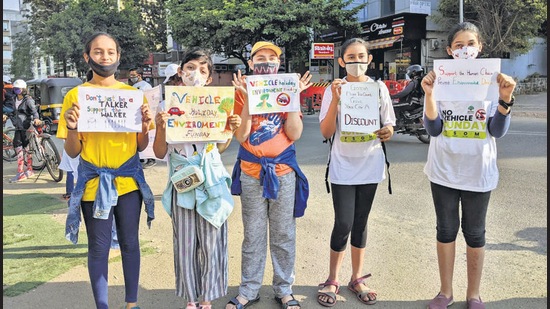
Children, young people and old, some with cycles, had formed a human chain with placards on reducing pollution and improving road safety (of course, everyone was requested to maintain Covid-19-appropriate distance).
Cycling enthusiasts from Aundh and Model Colony and students of Suryadatta College had joined in.
Talking about how the initiative started, Dushyant Bhatia from Bavdhan Citizens’ Forum said, “During lockdown, people enjoyed a pollution-free environment with fewer vehicles. We want to continue that experience with ‘No vehicle Sunday’, on the first Sunday of every month.”
Tejashree Patil, a member of theforum, says that participant numbers have increased from 30 in November 2020 to almost 170 this month. Activities include cycle rides in Bavdhan, cycle rentals, e-cycle demos, and repairing old cycles languishing dustily in society parking lots.
Corporators from Bavdhan are supportive.
This month, the Bavdhan Citizens’ Forum presented a request to corporator Dilip Vede Patil to improve footpaths and create cycle tracks, rental cycle hubs and cycle parking.
Mr Vede Patil has in turn promised to pursue the cause with the relevant municipal departments, and proposed a local e-rickshaw shuttle service.
“No-vehicle days, walking plazas, Happy Streets promote the idea of ‘streets for people’, rather than roads meant only for vehicles,” says Ashik Jain, architect, urban designer, and ‘Bicycle Mayor’ in Pimpri-Chinchwad.
This is a fundamental concept for cities: streets are public places; how they are designed, managed and used, influences our well-being. People use streets for many activities: personal mobility, transporting goods, for livelihood and as work spaces, to hang around, meet friends, and as conduits for service lines. Historically, and in current times, streets are venues for democratic communication and protest.
Street uses change with the time of day, seasons and festivals. Streets and chowks define, as well as reflect, the history and neighbourhood character – khaugalli, parathe wali galli, Fashion Street are self-explanatory. Some streets are quiet, leafy avenues, others bustle with activity. Some streets are pleasant and friendly, others feel uncared for, boring, devoid of human activity, or worse, unsafe.
Well-designed streets can make an area more comfortable, functional, safe and attractive.
Pune and Pimpri-Chinchwad have programmes for street design and sustainable transportation. Citizen movements can tie in to these, and new synergies can emerge in multiple neighbourhoods to benefit from, and help make wonderful streetscapes for everyone.
The Pimpri-Chinchwad Municipal Corporation (PCMC) is currently seeking public suggestions on its Draft Non-Motorised Policy to promote walking and cycling. PCMC is also preparing a Harit Setu masterplan to improve street infrastructure. With PCMC, Ashik Jain hopes to conduct no-vehicle days in Pimpri-Chinchwad.
The Pune Municipal Corporation’s (PMC) policies and plans applicable across the city to improve facilities for walking, cycling and public transport include the Development Plan, Comprehensive Mobility Policy, Pune Cycle Plan, Pedestrian Policy, and Parking Policy.
The municipal budgets of both PMC and PCMC and on-ground projects now must reflect the intent of these excellent policies and plans. PMC’s draft budget even has allocations for cycling infrastructure. However, the allocation should be for much more than 10km budgeted this year, so that a city-wide network is ready within two to three years. While the municipal corporations prepare city-wide plans and projects, the bottom-up citizens’ movement for streets for people and sustainable mobility should grow, become stronger, inclusive and deliberative.
Residents associations working with NGOs, experts and municipal authorities can make our connections to streets, places and people more holistic – road side greening efforts and neighbourhood nature walks, recycling treasure hunts to know what happens beyond the two bins at home, and walkability audits to check if street spaces can be used by children, women, seniors and people with disabilities.
Along with street vendors, auto-rickshaw associations and SWaCH, residents groups can check if adequate spaces are provided for these essential services and the people who run them. Surveys can check if parking is disciplined or if vehicles occupy road space meant for pedestrians, cyclists, street vendors, autorickshaws and buses.
Residents’ associations can check for bus routes connectivity and frequency, and possibilities of local area share rickshaw shuttle services. School and college students can even take up such surveys for their environment science projects. The initiative by the people of Bavdhan is commendable. May it inspire a city-wide movement of individual, collective and collaborative efforts from many neighbourhoods, accompanied by open, inclusive civic deliberations!


