LUCKNOW City residents are geared up to welcome the Bada Mangal month by offering prayers to Lord Hanuman and organising bhandaras (free offerings) on the four coming Tuesdays. This year, a few bhandaras may even offer millet-based prasad in the wake of the International Year of Millets.
Mangal Maan, a society that looks after the hygiene and cleanliness of the spot following the distribution of prasad, has urged bhandara organisers to introduce millets-based items -- like Bajre ki khichdi or kuttu aata ki poori -- in prasad. “We want at least one millet-based item to be introduced to promote millet food grains in Bada Mangal. If not in the first Bada Mangal, we are confident that in the remaining three Tuesdays, it will be made part of the prasad,” said RK Tewari, professor at BSNV PG College and convenor of Mangal Maan.
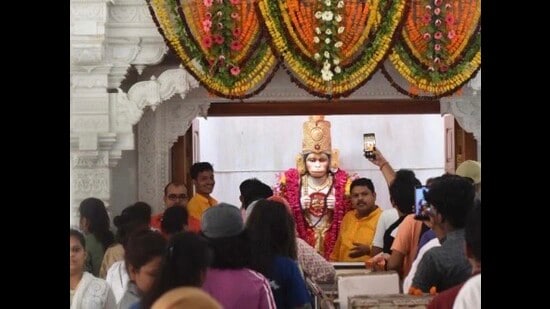
Separately, the Hanuman temples of the city, particularly Hanuman Setu, the new Hanuman temple at Aliganj, and another one at Hazratganj near multi-level parking are ready to host a large number of devotees.
“Bada Mangal is a 250-year-old tradition in Lucknow. The new Hanuman temple at Aliganj has been in existence since June 6, 1782, as per temple records,” said Rajesh Kumar Pandey, retired IPS and secretary of Aliganj Shri Mahavir Ji Mandir trust surfing details from the temple records. He added, “The sanctum sanctorum of the temple has been completely renovated and one can do darshan right from the gate. The old gate was demolished last month and a new gate will come up soon. Now devotees can enter the temple from the under-construction renovated gate.”
{{/usCountry}}“Bada Mangal is a 250-year-old tradition in Lucknow. The new Hanuman temple at Aliganj has been in existence since June 6, 1782, as per temple records,” said Rajesh Kumar Pandey, retired IPS and secretary of Aliganj Shri Mahavir Ji Mandir trust surfing details from the temple records. He added, “The sanctum sanctorum of the temple has been completely renovated and one can do darshan right from the gate. The old gate was demolished last month and a new gate will come up soon. Now devotees can enter the temple from the under-construction renovated gate.”
{{/usCountry}}Significantly, the city residents believe that this tradition should now spread to other cities as well. “It is now time to take Bada Mangal beyond the state capital. Lucknowites should take it forward to other cities just like the Maratha society succeeded in spreading Ganpati Puja across India,” added Tiwari.
Meanwhile, Diwakar Tripathi, secretary of Hanuman Setu temple trust, said, “We are expecting about 40,000-to-50,000 devotees on Tuesday. The temple gate will remain open till midnight. We have prepared laddu to be distributed among our devotees. The temple has been beautifully decorated so that devotees may have a hassle-free darshan.” Other prominent Hanuman temples are also decked up for festivities.
Choices galore for devotees at bhadaras
This year, the bada mangal platter will have a huge variety for the devotees. Ranging from traditional poori sabzi to laddoo, the prasad that would be distributed across the length and breadth of the city includes -- mewa kheer, pineapple halwa, flavoured milk, ice cream, juices, samosa, jalebi, chhole rice, raita, and a lot more.
“Not just for the devotees, but for every Lucknowite, Bada Mangal is a festive occasion. Nobody remains hungry on this day in the city,” said Subodh Tandon, who puts up a stall with friends at Koneshwar Mahadev temple in Chowk on all four Tuesdays of the Bada Mangal. He pointed out that the rationale behind setting up these stalls is to ensure that no one remains hungry in the city during the festival.
Legend behind Bada Mangal
Begum Janab-e-Alia, the second wife of Nawab of Oudh Shuja-ud-Daulah (1753-1775 A.D.), dreamt of a divine presence commanding her to build a temple honouring Hanuman. The dream pointed Nawab’s wife to a specific site where an idol of Hanuman was buried. Accordingly, the begum ordered the excavation of the site and when the idol was found, made arrangements for transporting it back to Lucknow on an elephant.
However, the elephant stopped in its tracks after some distance and refused to budge. The begum inferred this as another divine sign and ordered the erection of a temple at this spot-present day Aliganj. Since then, every year, people congregate at Hanuman temples in Lucknow in large numbers on the four Tuesdays of Jyestha (which falls between May and June in the Hindu calendar). People believe that Lord Hanuman answers all prayers during this period.