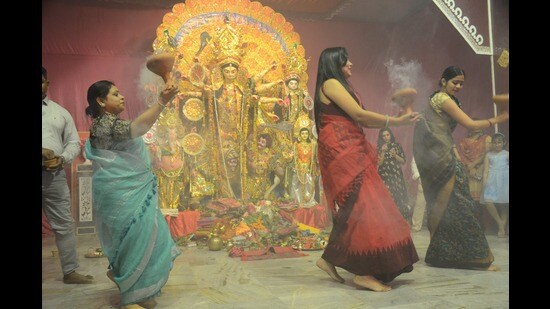
LUCKNOW Durga Puja in Lucknow has undergone a magnificent transformation, with a profusion of theme-based puja pandals now adorning the city, and millions of rupees poured into creating unparalleled spectacles. Amid this evolving landscape, the Lucknow Bengali Club stands as a shining example, faithfully preserving its Bengali traditions since its inception in 1914 by Atul Krishna Sinha. This year, the club marks an impressive 109 years of celebrating Durga Puja, welcoming both new and long-standing members.
Established in 1914, Purchased at Re 1
Established in 1914 with a humble purchase of land for a mere Re 1, the Lucknow Bengali Club has a rich history etched in time. Manindra Nath Pal (92), the club’s senior-most member, shares an intriguing tidbit: “Interestingly, the land was purchased at Re 1, and back then, the membership fee was a mere 25 paise or 50 paise.”
Arun Kumar Banerjee, the president of the club, delves into the club’s origin: “Our story begins with a young and enthusiastic Sinha, who secured employment in the Indian Railways engineering department and arrived in Lucknow in 1901. Driven by his profound love for Bengali theatre and art, Sinha and his friends founded the second Bengali institution in Lucknow in 1914, aptly named ‘The Bengali Club’ (the first being the ‘Bengali Youngmen’s Association’).
According to the club’s website, they initially held their celebrations in the homes of various members until they could purchase a permanent location on Hewett Road, now known as Shivaji Marg. Banerjee proudly states, “Since a majority of Bengali families resided in this area, the first public Durga Puja commenced in 1914. This celebration was grand, and it has only grown grander over the years.”
{{/usCountry}}According to the club’s website, they initially held their celebrations in the homes of various members until they could purchase a permanent location on Hewett Road, now known as Shivaji Marg. Banerjee proudly states, “Since a majority of Bengali families resided in this area, the first public Durga Puja commenced in 1914. This celebration was grand, and it has only grown grander over the years.”
{{/usCountry}}Living Testimony: A Puja with Deep-Rooted Generations
The individuals associated with the club contribute to making the puja more traditional, with many of them having deep-rooted connections to the club, spanning generations, whether as members or workers.
In addition to the nearly century-old ‘beti’ (supporting frame) of the idol, the generations-old dhakis play a pivotal role in making the Puja distinctive. “For the last 40 years, three generations of dhakis from Bengal’s Dakshin Dinajpur have been participating. Initially led by Dhuti Ram Natto, they were succeeded by his son and grandson, Madan Ram Natto and Rupam Natto,” mentioned Banerjee, who himself began volunteering at the age of 10.
Similarly, the idol has been crafted on the club premises for a century by the third generation of a family of idol makers with a century-old legacy in Lucknow. Likewise, the individuals responsible for the tent and lighting arrangements have been part of the club for four decades.
The descendants of the founding members continue to play a significant role in the club’s activities. Trisha Sinha, the great-granddaughter of Atul Krishna Sinha, one of the founding members, serves as the Assistant General Secretary of the Club. Her mother, AK Sinha’s granddaughter-in-law, is the lady vice-president of the Club.
Oldest Living Club Member Shares Memories of Puja, Netaji, and Tagore
The club’s oldest living member, 92-year-old Manindra Nath Pal, may be mostly confined to his chair, but his memory is astoundingly sharp when it comes to the club’s history. Pal reminisces, “The roof of this club was built by using a member’s car as mortgage, and six of the chairs from the first batch remain intact.” He designed advertorial posters for the club Puja in his prime.
Manindra Nath Pal also recounts significant moments in the club’s history. During the Emergency in 1975, the Puja celebrations were quieter than usual. Pal recalls, “Naturally, we could not compromise on the Puja, but we shut off all the lights, and there were no dhaks or music. We only prayed and ate together that year.”
Pal vividly remembers the historic visits of Netaji Subhash Chandra Bose in 1938 and Rabindranath Tagore in the 1920s. “The framed picture of Netaji now graces the Bengali Club hall,” he says. He fondly recalls, “Our club members held aloft swords, and Netaji walked under them when he entered the premises. We kids were not allowed inside, so we stood outside to catch a glimpse.” Tagore’s visit, he says, is part of the club’s cherished folklore: “We have only heard stories of when Tagore came to Lucknow in the 1920s. He was carried in a palanquin from Charbagh to AP Sen’s home, one of the club’s founders, where he stayed for a couple of days.”
A Glimpse into History
1914 Club established and First Puja begun
1920-25 Nobel laureate Rabindra Nath Tagore visited the club, however, no documentation to support it.
1938 Netaji Subhash Chandra Bose visited the club
1963 First Chandipath Mahisasur Mardini was started
2014 The club celebrated its 100 years