A traditional craft once on the brink of extinction in Uttar Pradesh has not only been revived but is now finding buyers across continents. The Sajar craft—rooted in the rare Sajar stone found only in the River Ken in Banda—has been brought back to life under the state’s One District One Product (ODOP) scheme, becoming a source of sustainable livelihood for hundreds of families.
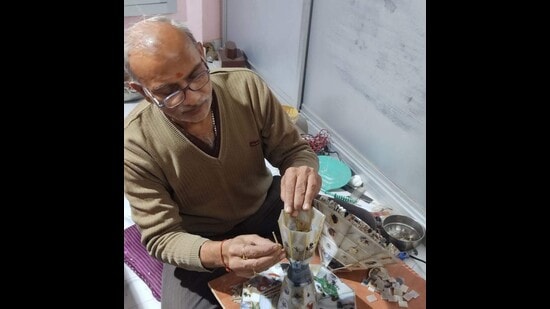
What was a fading rural art form now shines on international platforms, with products reaching markets in Africa, Europe and the Gulf. At the heart of this revival is Banda-based master craftsman Dwarka Soni, whose efforts have taken the craft from village bazaars to global exhibitions.
A stone shaped by nature—and time
The rare Sajar stone forms naturally along the Ken River’s streambed. Known for its striking patterns—traditionally believed to emerge when the shadows of trees, plants or birds fall on the stone under sunlight—the stone actually contains fossilised fungi, giving it its distinctive appearance.
Sixty-year-old Soni, from the Prayagraj Handicrafts Region, has played a pivotal role in reviving this heritage art.
“I learned the craft from traditional artisans like Kranti Bhargava and Satish Chandra Bhatt, and later introduced modern techniques to improve quality and production,” he said during a visit to Prayagraj from Banda.
Soni has showcased his craftsmanship in Tanzania (Africa), Saudi Arabia (Gulf), the Netherlands (Europe), Sri Lanka, and Hong Kong, giving the craft international visibility.
{{/usCountry}}Soni has showcased his craftsmanship in Tanzania (Africa), Saudi Arabia (Gulf), the Netherlands (Europe), Sri Lanka, and Hong Kong, giving the craft international visibility.
{{/usCountry}}“I have so far trained more than 440 artisans, with the dream that the exercise will ensure that the art survives for future generations and the craft does not remain confined to my family only,” he said. Thirteen members of his family—including his sons Vikas (38), Saurabh (34) and Ravishankar (35)—are now engaged in the trade.
From riverbed to global markets
The craft involves multiple labour-intensive processes, from extracting the stone to shaping and polishing it into jewellery such as rings, pendants and decorative items.
According to Banda’s deputy commissioner of industries, Gurudev Rawat, the Uttar Pradesh government selected Sajar craft under its flagship ODOP scheme, granting it a Geographical Indication (GI) tag. Under ODOP, artisans receive up to 25% subsidy on loans of up to ₹50 lakh. Today, more than 600 artisans in Banda are associated with the craft.
Soni recalls that in 2017, only 30–35 artisans worked with dendritic agate (Sajar stone). A government loan of ₹25 lakh under ODOP enabled him to set up a manufacturing unit in 2019.
His business expanded rapidly: Turnover rose from ₹25 lakh in 2019 to over ₹2.5 crore in 2024–25 and production increased from 5,000 to 35,000 pieces per month.
“This industry is returning to life,” he says.
Assistant Director (Handicrafts) Tanya Banerjee said that more than 51,000 artisans including those working with Sajar stone are registered under the Prayagraj handicraft division, which covers 11 districts including Banda.
In Banda, artisan cards have been issued to Sajar craft workers, training camps are being organised, and participation in national and international trade fairs is being promoted to widen market access, she shared.
Once a part-time rural occupation, Sajar craft has now grown into a thriving economic enterprise. With government support, rising global demand and continued training, Banda’s heritage stone craft is not only surviving—it is flourishing on the world stage, she added.