
 E-Paper



Bullock cart races gain new colour in Maharashtra ahead of local body polls
Traditional events like bullock cart races are increasingly turning into high-stakes political platforms across Maharashtra


Pune: Bullock cart races have been an integral part of Maharashtra’s rural culture for decades, celebrating farming traditions, animal strength and village camaraderie. But with local body elections approaching, these traditional events are increasingly turning into high-stakes political platforms.
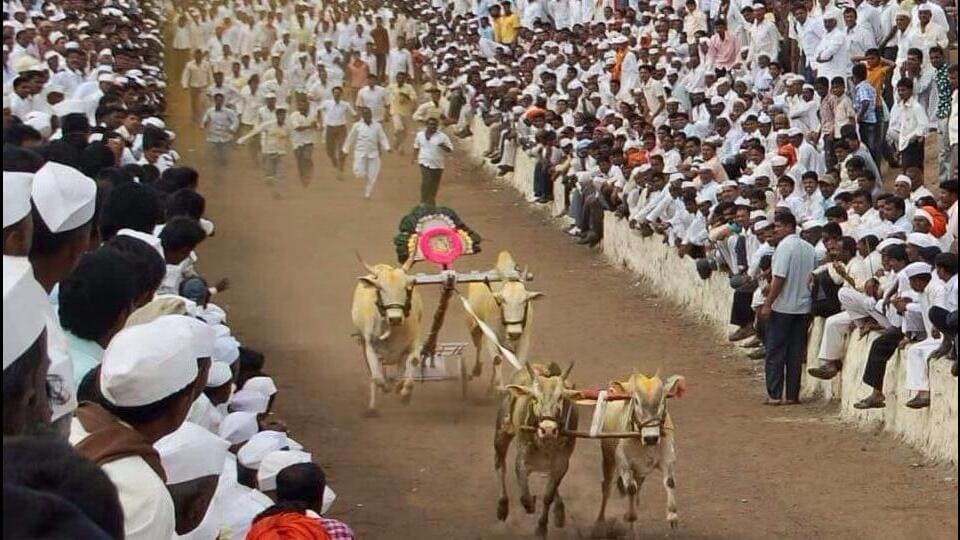
The shift was evident at a recent race in Sangli.
On November 9, the Shrinath Kesari Bullock Cart Race—organised by Shiv Sena leader and two-time Maharashtra Kesari winner Chandrahar Patil—was held at Borgaon in Kavathe Mahankal during the Yallama Devi Yatra. The scale of the prizes stunned many. Patil distributed two Fortuner cars, two Thar SUVs, tractors, motorcycles and over 150 vehicles in total. More than 1,200 entries were registered and over five lakh people attended the event. The show of resources underscored how politicians are using such gatherings to reach out to voters and demonstrate their financial clout. Patil even promised that he would offer Mercedes cars as prizes next year.
Patil said this was the fourth edition of the race in two-and-a-half years. “This is not a political event, but an event organised to boost the rural economy through the sale and purchase of bullocks,” he said.
According to Patil, the announcement of the race pushed the bullock trading market’s turnover beyond ₹100 crore, and he expects it to reach ₹400– ₹500 crore soon. He said the Sena plans to launch a Bullock Cart Pro League, modelled on the Indian Premier League (IPL). Patil declared that the next year’s winner will receive a high-end BMW.
Explaining the logic behind offering luxury vehicles, Patil said, “We have previously given Thar vehicles and tractors as prizes. The reason is that these prizes help determine the market price of bullocks. When bullocks are sold at higher prices, the income of farmers increases.”
Crowd-puller
Bullock cart races enjoy enormous popularity across Sangli, Satara, Kolhapur, Pune and Solapur, where farmers take great pride in training their bullocks. For years these races remained simple village celebrations. But political leaders across parties have realised the potential of these events, which attract thousands of villagers. Races now serve as an opportunity to address the public, strengthen local networks and build electoral influence.
The Sangli race is not an isolated case. In recent months, several political leaders—including BJP MLA Mahesh Landge, NCP MLA Sunil Shelke, and NCP leader Atul Benke—have organised or sponsored races in their constituencies. With local body elections drawing closer, high-value prizes such as bikes, tractors, JCB machines, Bullet motorcycles and even cash awards have become common, helping leaders project strength and generosity.
After the Sangli race, bullock cart owners are preparing for major upcoming events, including races in Pusegaon in Satara (December 16), Amdar Kesari 2025, Shambhumahadev Kesari in Vadgaon Maval (December 13–14), Maval Kesari, Aundh in Satara, Nagthane, Vadki-Haveli, and many others organised during village fairs.
In rural areas, the scale of such events is often seen as a reflection of a leader’s influence. High-value prizes leave a strong impression, and many villagers interpret them as proof of a leader’s financial capacity and ability to support the community.
But not everyone is comfortable with the growing political imprint on these races. “Earlier, it was about whose bullocks were the best. Now it feels more like a political rally,” said a farmer from Miraj.
The concerns
As political involvement deepens, activists worry that compliance with safety and welfare rules may weaken. Injuries to bullocks, overtraining and overspeeding continue to be concerns. Officials admit that enforcing norms becomes difficult when influential political leaders are at the centre of these events.
Bullock cart races were banned in 2014 over concerns linked to animal cruelty and remained suspended for years. They were allowed again in December 2021 under revised guidelines, and since then the Akhil Bharatiya Bullock Cart Sanghatana, Maharashtra State, says the sport has seen a sharp revival across rural parts of the state.
The participants
According to the Sanghatana, Maharashtra now has nearly 50,000 active bullock cart owners participating in races. The organisation, formed in 2009 and formally registered in 2014, has long campaigned for the revival and preservation of the tradition.
Nitin Shewale, president of the Sanghatana, who owns four pairs of bullocks and has been racing since 1999, said the return of the sport has brought relief to thousands of families. “Bullock cart racing is a sport. If it is getting political patronage, I don’t think anything is wrong with that. Many other sports and art forms receive political support. Finally, farmers are benefiting from it. We have no objection as long as our rules and regulations are not violated,” he said.
Sandip Bodge, executive president of the Sanghatana, said the sport has not only returned but has become a major attraction in the countryside. A fourth-generation bullock cart owner, Bodge maintains five bullocks and three cows. He said owners spend between ₹300 and ₹400 per day on each racer bullock, adding that the annual cost of maintaining a single animal can reach ₹1.5 lakh. “During the ban, we were forced to bear these costs without any income or opportunity,” he said. With the sport reinstated, high-value races have once again become a source of income, excitement and motivation for farmers and breeders.
Shewale said that in the current pattern, a single pair of bullocks can enter four to five races each month. The racing season begins from the Ganesh festival and continues till summer, before pausing and resuming after the Kharif season. The cycle sustains a year-round engagement with the sport in many parts of the state.
The types
Bodge said Maharashtra hosts seven distinct types of races, each tied to soil, geography and local custom. The pure bullock cart race, common in Pune and surrounding areas, involves two pairs of bullocks. In western Maharashtra, a format called “chakadi” uses a single pair. The Kolhapur and Sangli belt is known for “arat-parat”, in which the cart covers 500 metres, turns at a designated point and returns. Marathwada and Vidarbha host a format called “shankarpat”, where races are timed per second. The Gadhinglaj–Kolhapur region conducts “chikhalgutta”, a muddy-track race held during paddy sowing, while in the Konkan, a coastal version of “arat-parat” is staged along the shoreline and is locally called the “kinara” race. Each format has evolved through local traditions and remains deeply rooted in the culture of its region.
In its petition before the Supreme Court seeking to lift the ban, the Sanghatana estimated that the bullock cart racing ecosystem is worth nearly ₹3,500 crore. With such a wide network of owners, trainers, farmers, transporters and event organisers, the sport continues to draw political interest. Leaders across parties have begun to treat races as platforms to reach out to rural communities ahead of local body polls.
As Maharashtra heads into an election-heavy phase, more races are expected across western districts. The crowds are only growing, but the nature of the event is changing. What was once a celebration of rural pride and tradition is increasingly becoming a stage for political signalling and competitive spending. Whether the sport stays true to its roots or shifts further into a political arena will depend on how it navigates the pressures of money, influence and electoral ambitions in the months ahead.


