While the Pune Municipal Corporation (PMC) has been able to complete only 16 km out of the 68.80 km of Bus Rapid Transit System (BRTS) that was proposed in 2006, the existing BRTS - left only on Pune Satara road now in complete shape - too faces the risk of extinction due to a rapidly expanding metro.
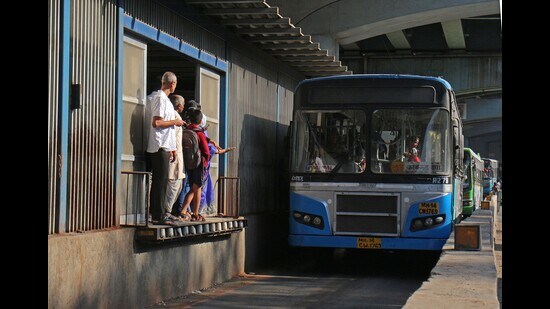
After the latest BRTS route being dismantled due to the metro is the 3.5 km stretch from Parnakuti (Yerawada) to Vimannagar Chowk, Metro rail network also poses challenge to 5-km long existing Swargate-Katraj route.
Nikhil Mijar, traffic planner, PMC, said, “After the metro project in Pune, there has been a rethink on the BRTS system. The BRTS and metro are competing with each other. They should not run parallel. The PMC has carried out all types of experiments regarding the BRTS but they have not been successful. Moreover, Pune was the first Indian city to implement BRTS and other cities learned from Pune and implemented their own BRTS systems. However, the BRTS systems in these cities are running successfully. We have to now think as to where we want the BRTS and where we want the metro…”
The metro has been a challenge for the BRTS system ever since it was introduced. According to traffic experts, both these mass transport systems serve similar purposes and are perceived as competitors. As a result, it is crucial to re-evaluate the implementation of BRTS in Pune, especially on the proposed metro routes. A senior official of the Maha Metro on condition of anonymity said, “Ideally, buses should provide a feeder service to the metro; they cannot run on the same track as the metro. In Pune however, both services are running on the same routes like Nagar Road, PCMC to Bopodi in the PCMC limit, and the proposed Swargate to Katraj underground metro.”
{{/usCountry}}The metro has been a challenge for the BRTS system ever since it was introduced. According to traffic experts, both these mass transport systems serve similar purposes and are perceived as competitors. As a result, it is crucial to re-evaluate the implementation of BRTS in Pune, especially on the proposed metro routes. A senior official of the Maha Metro on condition of anonymity said, “Ideally, buses should provide a feeder service to the metro; they cannot run on the same track as the metro. In Pune however, both services are running on the same routes like Nagar Road, PCMC to Bopodi in the PCMC limit, and the proposed Swargate to Katraj underground metro.”
{{/usCountry}}Anant Waghmare, BRTS manager, Pune Mahanagar Parivahan Mahamandal (PMPML), said, “At present, there are only two BRTS stretches which are operational namely, Swargate to Katraj and Sadalbaba (Yerawada) to Vishrantwadi Chowk. Out of the 16 km of BRTS, only 11 km (Swargate to Katraj, 6.5 km; and Sadal Baba (Yerawada) to Vishrantwadi Chowk, 4 to 5 km) of BRTS is operational.”
“The BRTS has a lot of benefits. It is an economical mode of transport with punctuality, less trip cancellation, less bus maintenance, high mileage, more time savings, and less accidents. Our buses run 30 km per hour on BRTS routes as compared to 12 km per hour on regular roads. The city needs BRTS for better transportation and to avoid traffic congestion,” Waghmare said.
According to PMPML, the Nagar BRTS route generates nearly Rs15 lakh in revenue with over one lakh commuters travelling on the route daily.
Jugal Rathi, a civic activist working in the transport sector, said, “BRTS has been proven good across the world. However in Pune city, it has failed due to lack of implementation and will power. Pune was the first city in the country to have BRTS. The PMC made plans for the BRTS network and expected to get funds under JNNURM (Jawaharlal Nehru National Urban Renewal Mission). Since the past 17 years however, the PMC has been able to complete only 16 km of BRTS after spending crores of rupees.”
Pune is the first city to have implemented the BRTS pilot (Katraj-Swargate-Hadapsar) in 2006. However, 20 years later, the PMC has been able to implement only 16 km of the proposed 68.80 km BRTS network.