Pune:
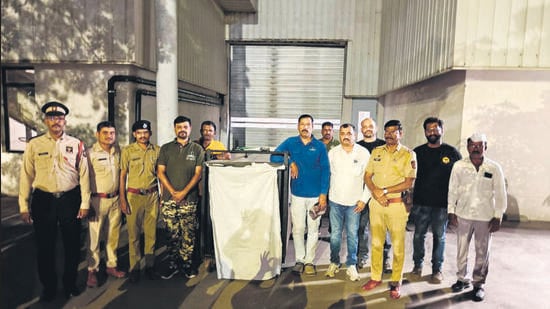
The recent incident – wherein a leopard strayed into the premises of the Mercedes-Benz manufacturing plant at Chakan Maharashtra Industrial Development Corporation (MIDC), and was able to be trapped inside a cage placed within the plant premises only after nearly two days of intensive monitoring and rescue efforts – has once again highlighted the worrying link between poor waste management and increasing leopard movement in and around human settlements and industrial zones.
On May 9, a leopard strayed into the premises of the Mercedes-Benz manufacturing plant at Chakan MIDC and was captured moving around in CCTV footage, triggering panic among employees. Eventually, it got trapped inside a massive shop floor, forcing the company to suspend production for two days as a precautionary measure. On May 11 after nearly two days of coordinated efforts by the Junnar forest department, RESQ Charitable Trust and Wildlife SOS teams, the leopard was successfully trapped inside a cage placed within the plant premises. Forest officials identified the animal as a fully grown male leopard aged around three-and-a-half to four years.
The operation was conducted under the guidance of Ashish Thakare, chief conservator of forests, Pune forest circle; Prashant Khade, deputy conservator of forests, Junnar forest department; and officials from the Chakan forest range, RESQ Charitable Trust, Wildlife SOS, police personnel, and Mercedes-Benz administration representatives.
According to forest officials, unmanaged garbage dumping and the rising stray dog population are the main reasons drawing leopards into industrial and urban areas around Chakan MIDC.
{{/usCountry}}According to forest officials, unmanaged garbage dumping and the rising stray dog population are the main reasons drawing leopards into industrial and urban areas around Chakan MIDC.
{{/usCountry}}“Chakan MIDC is surrounded by forest and agricultural land, so there is already leopard presence in the region. Though leopards generally avoid human habitats, they may wander into residential or industrial areas in search of food,” said Amrut Shinde, assistant conservator of forests, Junnar forest division.
Shinde added that poor waste management has emerged as a major contributing factor behind leopard movement near urban habitats. “The stray dog population increases where garbage dumping is high, and leopards enter such areas to prey on these dogs. Hotel waste, including discarded meat and fish, also attracts wild animals,” he said.
Forest officials said that awareness drives have been repeatedly carried out in the area, urging both industries and locals to maintain cleanliness and prevent dumping of waste in the open.
Garbage disposal has remained a long-standing issue at Chakan MIDC, with frequent disputes reported between the MIDC authorities and nearby villages. Villagers allegedly dump waste inside industrial zones due to the absence of a dedicated waste management system in the surrounding areas.
Acknowledging the issue, Navnath Avtade, sub-regional officer of the Maharashtra Pollution Control Board (MPCB), said that the Chakan MIDC and nearby villages have long been facing problems related to garbage dumping and poor waste management. “Recently, a meeting was held with representatives from the villages, MIDC authorities, and the Chakan Industrial Association to discuss measures to address the problem of non-hazardous waste in the area. All stakeholders responded positively and agreed to work towards resolving the problem,” he said.
Located near Pune, Chakan MIDC is one of Maharashtra’s major industrial hubs and houses several automobile and manufacturing companies, making it a critical centre for industrial and logistics activities in the region.