
 E-Paper



Making soil testing cheaper, faster and farmer-friendly
Pune Venture Center incubates, Saumya Rawat and Dhiraj Choudhary built a device that takes the lab to the field to help farmers test soil, cheaply, quickly and efficiently

 Prefer HTon Google


Start-up | Agrotech solutions
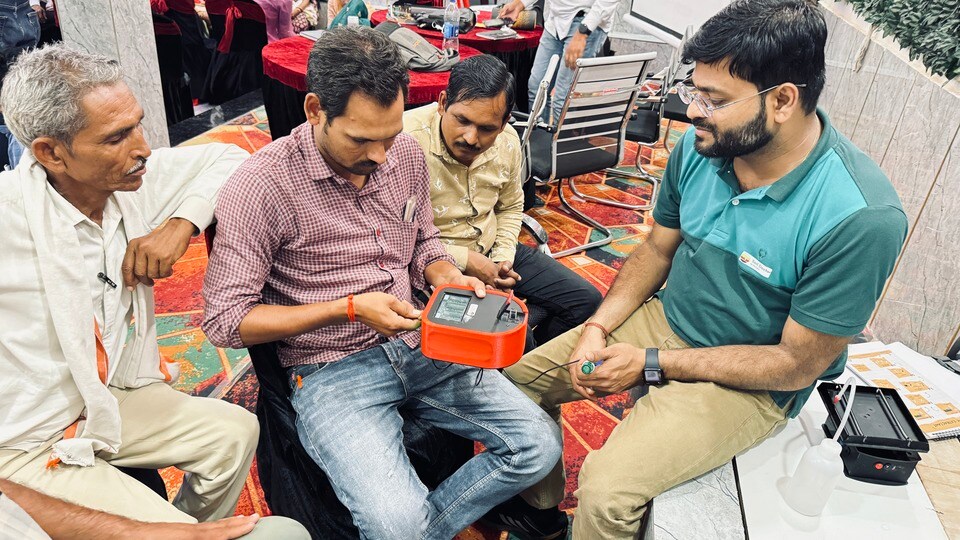
Pune Venture Center incubates, Saumya Rawat and Dhiraj Choudhary built a device that takes the lab to the field to help farmers test soil, cheaply, quickly and efficiently
Pune: It was a field visit that changed everything for Saumya Rawat. As a Master’s student in Agricultural Science, she was required to spend time in villages to understand how the theories discussed in the classroom played out in real farms.
She recalls, “During my field visits, I was stunned by the reality. Despite agriculture being the backbone of our economy, farmers had very little awareness of soil health or access to proper soil testing. Every time I met them, they said the same thing—‘Madam, we apply fertilisers based on experience and estimation.’ And this wasn’t because they didn’t care about their soil. The soil testing system itself was broken.”
According to Saumya, soil testing at the village level was too expensive and inaccessible.
“Farmers have to go to private labs, where one test costs anywhere between ₹3,000 and ₹5,000. These labs are far from their fields, take 30–60 days to deliver a report, and when the reports finally come, they’re so complex that farmers can’t understand them. So they use fertilisers blindly.”
This blind application of fertilisers was causing the very crisis farmers were struggling with. “Random application leads to nutrients leaching into groundwater. The soil becomes acidic or saline, the pH gets disturbed, yields decline, and fertiliser worth thousands goes to waste. Worst of all, the soil’s health keeps deteriorating.”
No surprise, then, that India’s nutrient-use efficiency is among the lowest in the world. “Our nitrogen use efficiency is around 30%, which means 70% of urea is wasted. Phosphorus efficiency is only 15–20%. The data shocked me,” she says.
With a growing population and unpredictable climate patterns deepening the challenge of food security, Saumya realised something the classroom couldn’t teach her: India’s food problem couldn’t be solved unless the soil’s health was fixed first.
The idea
Saumya knew the problem, but not the solution. One day, while venting to her friend and tech professional Dhiraj Choudhary, she told him, “We study soil health for years… but farmers don’t even get a basic soil test when they need it.”
Listening patiently, Dhiraj paused and asked a question that would change everything:
“If people can check their blood sugar at home, why can’t farmers check their soil the same way?”
Saumya almost instinctively replied, “Because labs are complicated! Chemistry, sensors, extraction… nothing is simple!” But Dhiraj pushed further: “Then let’s make it simple. Let’s bring the lab to the farmer instead of sending the farmer to the lab.”
And that was how the seed of ‘Ekosight Soil Doctor’ was sown.
Building the product
Once Dhiraj’s question set the direction, everything accelerated. The duo spent nights reading research papers, visited labs, met chemists, professors and agronomists, and filled whiteboards with possibilities—all with one goal: bringing the lab to the farmer.
“There were many technologies available,” says Saumya. “We experimented with several and finally zeroed in on colourimetry as the best fit. Then came the challenge of developing formulations that could test soil. Many chemicals were in liquid form and dangerous to carry on fields, so we converted them into a stable powder form.”
A crucial part of soil health is Soil Organic Carbon (SOC), which improves fertility, water retention, and nutrient availability. Increasing SOC also helps in carbon sequestration, reducing soil degradation and carbon release into the atmosphere.
While designing the device, they asked four fundamental questions:
Can soil testing be as quick as a glucose test?
Can it be affordable for every farmer?
Can it be simple enough to use in the field?
Can its accuracy match a standard laboratory?
After several iterations, by 2023, the prototype was ready. It gave results in 50 minutes, could be carried in a backpack, and required only basic training.
“Our device didn’t improve the lab,” says Saumya. “It eliminated the need for a lab.”
The Soil Doctor filled all the major gaps in one integrated model:
50-minute digital report instead of 30 days
₹500 per test instead of ₹3,000– ₹5,000
Portable and field-friendly, usable by any trained Soil Didi
92–96% lab-level accuracy using hybrid chemistry + sensors
Helps farmers save 20–30% on fertilisers, increase yields by 10–20%, and improve long-term soil health
But innovation is only half the journey — the real test lies in adoption.
Selling the Soil Doctor
After pilot tests in 2023, the Soil Doctor was ready for market launch in 2024.
“We decided early that we would reach farmers through NGOs, FPOs and agri-companies. NGOs already work with village-level resource persons. We selected those who wanted to support their families and do positive work,” says Saumya.
The first batch included two young women—soon known as Soil Didis. Today, there are 10. Instead of going farm-to-farm, they conduct awareness meetings and group demonstrations.
“In our first kharif season, we did 500 soil tests,” Saumya states.
How the Soil Doctor Works
Soil Doctor functions like a mini-lab inside a small device—making soil testing as simple as measuring blood sugar.
Step 1: Collect a soil sample
Step 2: Mix it in a bottle with Ekosight’s extraction solution
Step 3: Add a few drops into the device
Inside the device, sensors and chemical reactions measure nutrient levels—similar to how glucose or pregnancy test strips work, but more advanced.
Step 4: The device analyses nutrients—N, P, K, pH, Organic Carbon, EC, and micro-nutrients
Step 5: Data is sent to the cloud
Step 6: A simple, colour-coded advisory report is generated in 50 minutes
Farmers receive fertiliser recommendations, dos and don’ts, crop-specific advice, and application schedules—all in simple language.
Today, Ekosight also uses social media aggressively. “A few reels have crossed four lakh views,” Saumya says. “All organic leads.”
So far, over 5,000 farmers across seven states have used the device.
Last year, the company clocked ₹57 lakh in revenue; this year, they aim to reach ₹1 crore.
Money Matters
Soil Doctor was built with a mix of personal investment, grants, and early-stage funding.
“We invested ₹18 lakh of our own money, and received government grants worth ₹1.1 crore,” Saumya says.
Competition
Saumya is clear about competition. Says she, “In the soil testing landscape, we compete with players like Harvesto, PUSA STFR Meter, KrishiTantra, NeoPerk, and Bhuparikshak, along with traditional private labs and a few international sensor-based companies. Each competitor has its own USP—some offer lab-in-a-box machines, some provide semi-automated solutions, some use electrical or spectral sensing. But these systems still face some limitations: many rely on stable electricity, which is unreliable in villages; several are bulky and non-portable; maintenance is high because the device needs frequent calibration or on-site servicing; and most importantly, they stop at testing and don’t provide end-to-end advisory.
“Ekosight Soil Doctor is fundamentally different. Our device is fully portable, battery-operated, and works perfectly in remote villages without electricity. We provide lab-standard accuracy with field convenience—delivering results in 50 minutes, not days. While many competitors require trained technicians or complex lab conditions, Soil Doctor can be operated by any Soil Didi or village entrepreneur. Maintenance is minimal because our calibration, troubleshooting, and updates happen remotely, keeping the device always correct without physical servicing.
“Most importantly, we don’t stop at soil testing—we stay with the farmer throughout the season with actionable fertiliser advisory, satellite insights, nutrient planning, and continuous support. Competitors provide results; we provide decisions, savings, and yield improvement. This combination of portability, accuracy, low maintenance, offline usability, and end-to-end advisory creates a moat that even larger domestic and international brands struggle to match, making Soil Doctor the most practical and scalable solution for real Indian farming conditions.”
Future Plans
Ekosight Soil Doctor aims “to become the world’s most trusted soil and crop intelligence platform — improving farm profitability, enabling clean procurement, and restoring soil health at scale. Our vision goes far beyond soil testing. We are building a complete Soil & Crop Intelligence ecosystem that will transform how India grows food and how companies procure it.”
In the next 12–36 months, they plan to deploy 1,000+ Soil Doctor devices to create India’s largest ground-level soil dataset. They are also working on building a full Soil + Crop Intelligence Platform for procurement teams to source contamination-free, traceable produce directly from farmers. Integrate AI-based advisory for nutrients, pests, water, and soil regeneration.
“We want to build a network of 5000+ Soil Didis who will be the village-level agri advisors. We aim to enable digital traceability from soil to harvest, helping farmers meet export standards, expand to Africa and Southeast Asia, regions that are facing similar soil health challenges. Also in the works are plans to develop advanced modules for carbon measurement, sustainable farming scorecards, and climate resilience.”


