Vidyanand Bapat is not a politician, activist or public figure. A 37-year-old BPO professional from Ratnagiri who works largely from home, he lives in Narayan Peth and, until recently, was known mainly within his own neighbourhood. Today, his name has become associated with a campaign that has struck a chord with many Pune residents — the demand for stricter action against noise pollution; and a ban on it.
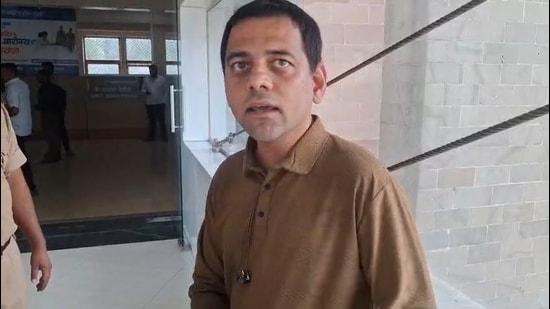
Bapat has lived in Pune for around eight years. His parents and family continue to live in Ratnagiri, where he grew up and completed his education. His work keeps him largely indoors. That, perhaps more than anything else, has made him acutely aware of the soundscape around his house.
Bapat is a Commerce graduate from Mumbai University. He also actively participates in various initiative by progressive organisations in Pune. He is also an active member of Andhashraddha Nirmulan Samiti.
In the old peth areas, where homes, shops, temples and public roads exist in close proximity, festivals can dramatically alter everyday life. For Bapat, the issue became particularly personal as he found himself trying to work from home amid loud music, dhol-tasha performances, processions and other public celebrations.
His views on noise are by now known to some Pune residents. But Bapat insists that the campaign did not begin with an ambition to become an activist. It emerged gradually from his experience of living in the city and questioning what he felt people had simply learnt to accept.
{{/usCountry}}His views on noise are by now known to some Pune residents. But Bapat insists that the campaign did not begin with an ambition to become an activist. It emerged gradually from his experience of living in the city and questioning what he felt people had simply learnt to accept.
{{/usCountry}}He remembers the Covid-19 lockdown as an important turning point. With public gatherings and celebrations restricted, the city became unusually quiet. For Bapat, those two years demonstrated that residents had perhaps normalised a level of noise and disruption that was not unavoidable.
The experience prompted him to start writing to authorities. Over the past three months, he has submitted around a dozen representations personally and sent another 15 to 16 complaints by email. His correspondence has reached elected representatives, civic officials, legislators, MPs, senior government officers and even the chief minister’s and prime minister’s offices.
His concerns are not limited to loudspeakers. He questions the occupation of public roads by mandaps, processions that make narrow streets difficult to navigate and the expectation that residents should simply leave their neighbourhoods during major festivals if they do not want to deal with the disruption.
But there is another side to Bapat’s campaign. He is conscious that opposition to noise can easily be portrayed as opposition to religion or festivals. He, therefore, repeatedly stresses that his objection is to excessive noise and obstruction, irrespective of who is responsible.
He applies the same argument to temples, mosques and other places of worship, as well as political rallies, public meetings and processions. He is particularly critical of political campaigns that selectively target loudspeakers at one religion while ignoring similar noise elsewhere.
His approach to public issues is also shaped by his belief that citizens should question authority. Bapat believes that when residents stop challenging elected representatives and officials, accountability suffers. His own repeated representations are, in some ways, an extension of that belief.
That persistence eventually took him to a Pune Municipal Corporation meeting on festival arrangements, where the discussion later turned chaotic. The episode brought his position greater attention and, he says, prompted several journalists and citizens to contact him. Some offered support over the phone while others sent messages. He says he has not personally received a direct message opposing his stand.
Bapat does not see himself as leading a movement in the conventional sense. He welcomes support, particularly from young people, but believes the issue cuts across age groups. Noise affects children, working professionals and senior citizens alike.
He also does not believe his ideological leanings should define the debate. While he does not entirely distance himself from his association with communist thought, he argues that the present issue is much more straightforward: a civic problem should be addressed as a civic problem.
For now, Bapat remains focused on what he believes should be the first step — preventing excessive noise rather than asking citizens to prove after the event that permissible limits have been breached.
If administrative action remains inadequate during the coming festival season, he says he is prepared to approach the courts.
For someone who began as an ordinary resident raising complaints about what he experienced around his home, the journey has taken Bapat into a much larger public debate. And while he may not have set out to become a campaigner, he now appears determined to ensure that his voice — unlike the noise he objects to — is not easily ignored.